






Technical debt is often invoked to explain a delay, an incident, or a request for a redesign. The term then becomes a vague container in which old code, architecture, documentation, security, data, and developers' irritants are mixed. As long as it remains formulated this way, it is difficult to fund and almost impossible to manage.
A usefully described debt links a technical fact to an observable consequence: a change takes three times longer, an update cannot be applied, an incident risks erasing data, or each deployment requires a manual operation. This translation allows comparing the debt to other product investments.
Technical debt is not necessarily a fault
A compromise can be rational. A team may accept a simple solution to validate a market, postpone automation, or maintain stable technology in order to meet a deadline. Debt appears when this compromise increases future costs. It becomes dangerous when no one knows its existence, its owner, or its reevaluation date.
It is therefore necessary to distinguish:
- the deliberate debt, chosen and documented;- the accidental debt, arising from a lack of knowledge or an unexpected effect;- the obsolescence debt, created by the evolution of dependencies and infrastructures;- the functional debt, when unnecessary rules or screens continue to be maintained;- the operational debt, related to deployments, backups, alerts, and manual procedures.
Not all are handled with the same budget or by the same team.
Why an estimate in correction days is not enough
Evaluating only the effort produces a list of projects, not a priority. An expensive item may have no immediate impact, while a two-hour fix can remove a critical risk. Conversely, the number of anomalies detected by a tool reflects neither the criticality of the processes nor the frequency of changes.
A useful measure combines at least four dimensions:
- probability that a problem will occur;2. impact on the profession, data, security, or reputation;3. frequency of exposure, that is to say, how many changes or users affect the area;4. cost of delay, which increases if the debt continues to spread.
The correction effort then takes place to choose the order and group the work.
A usable debt unit
Each element of the register must follow a common structure:
- observation: what is objectively observed;- proof: measure, incident, version, test, or example;- consequence: what it prevents or weakens;- scope: relevant modules, data, and users;- action: correction, isolation, replacement, or acceptance;- effort: order of magnitude and dependencies;- revision date: the moment when the compromise must be reconsidered.
For example, 'the code is poorly designed' is not actionable. 'Any change to the bonus calculation requires duplicating the rule in four modules, which caused two discrepancies in results over six months' allows one to make a decision.
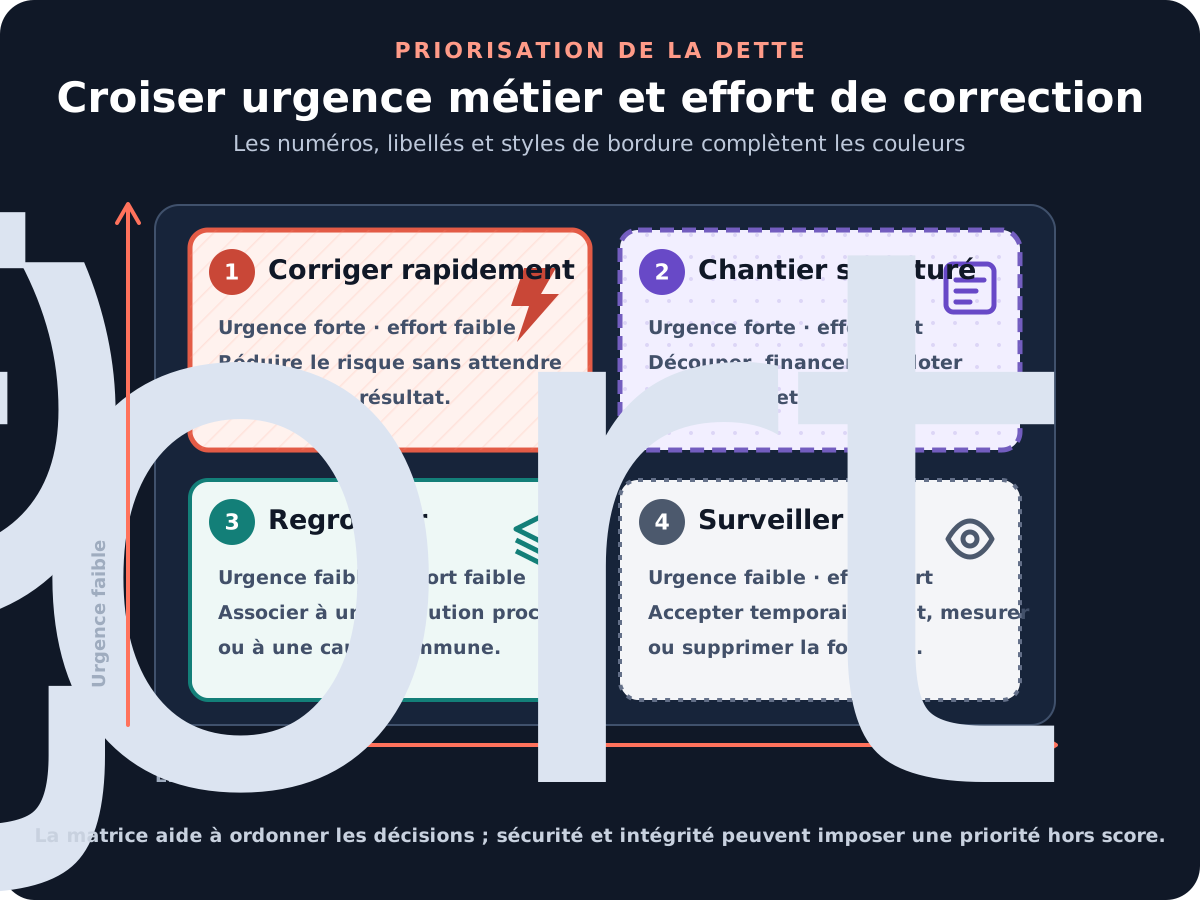
The diagram is a quadrant with two axes. Business urgency increases from bottom to top, and correction effort increases from left to right. Zone 1, at the top left, recommends quickly correcting urgent and low-cost items. Zone 2, at the top right, requires initiating a structured initiative for urgent and costly items. Zone 3, at the bottom left, suggests grouping low-urgency and low-cost items with a nearby evolution. Zone 4, at the bottom right, leads to temporarily accepting, monitoring, or removing low-urgency and costly items. Each zone has a number and an explicit action so that color is never the only information. The following table provides an equivalent textual representation.
| Zone | Business emergency | Correction effort | Proposed action |
|---|---|---|---|
| 1 — Quick correction | forte | weak | correct quickly |
| 2 — Structured construction site | forte | fort | plan and finance a construction site |
| 3 — Grouping | weak | weak | to deal with a close evolution |
| 4 — Monitoring | weak | fort | temporarily accept, monitor or delete the function |
Classify the debt by domain
Architecture
Excessive coupling, absent business boundaries, circular dependencies, single points of failure, or fragmented services without benefit. The answer is not always a new architecture: it can start with a facade, an API contract, or a division of responsibility.
Code and dependencies
Complexity, duplication, inconsistent conventions, unsupported components, or libraries that are difficult to update. Automated analyses spot trends; the priority depends on exposure and frequency of change.
Data
Inconsistent schemas, lack of constraints, non-reproducible migrations, duplicates, manual processing or uncontrolled retention. Data debt is often more expensive to fix late than code debt.
Tests
Unprotected critical paths, unstable tests, suites that are too slow or dependent on external environments. The goal is not a maximum percentage, but confidence proportional to the risk.
Security
Secrets, rights, logs, vulnerable dependencies, or absence of a remediation procedure. A security debt may require immediate attention, regardless of its apparent performance.
Exploitation
Manual deployments, untested backups, missing alerts, divergent configurations, or dependence on a single person. This debt often becomes apparent during an incident, when time is most costly.
Documentation and knowledge
Unexplained decisions, outdated procedures, absence of a business glossary or owner. Documentation should target what would be difficult to reconstruct, not describe every line.
Use a matrix, without believing in a magic formula
An urgency/effort matrix helps to visualize:
- high urgency, low effort: correct quickly;- strong urgency, strong effort: launch a structured project;- low urgency, low effort: group with a similar development;- low urgency, high effort: temporarily accept, monitor, or remove the function.
The score does not replace judgment. A security or integrity risk may require action even if its probability seems low. The weightings must be visible and revisable.
Book a recurring capacity
Dealing with debt only 'when there is time left' amounts to never dealing with it. A more effective strategy combines three mechanisms:
- a recurring capacity percentage dedicated to improvements;- quality criteria integrated into each new feature;- targeted projects when the cause exceeds a module.
The percentage is not universal. It depends on the risk, the production rate, and the condition of the platform. What matters is visibility: the debt is managed alongside developments, not hidden in their estimates.
Reducing the debt without launching a major cleanup
The first technique is the neighborhood rule: when an area is modified, improve what is necessary to make the change safe, without infinitely expanding the perimeter. The second is the addition of characterization tests before any transformation. The third consists of creating stable boundaries to prevent propagation.
Some debts must be eliminated through the product: removing an unused feature, reducing a variant, or harmonizing a process can save more than a refactoring. Others require an upgrade or a planned component replacement.
Measure the reduction, not the activity
Counting closed tickets encourages artificial splitting. More useful indicators track the outcome:
- average time for a development in the affected areas;- deployment failure rate;- incidents and recovery time;- number of unsupported dependencies;- share of protected critical paths;- number of manual operations;- time needed for a new person to intervene.
A debt can be considered controlled when it is known, circumscribed, monitored, and compatible with the strategy, even if it is not completely eliminated.
Present the debt to decision-makers
The language must focus on choice. 'Investing ten days allows reducing the delivery time of pricing rules and avoids four divergent implementations' is more useful than 'refactor the module.' The log must show the option of doing nothing and its likely cost.
A quarterly table can present the major risks, completed actions, new items, consumed capacity, and the evolution of indicators. This transparency prevents debt from being discovered during an urgent request.
Making debt a strategic tool
A platform without any debt does not exist. Quality comes from the ability to choose compromises, make them visible, and pay them back before they block value. Debt then becomes a portfolio of risks and investments, not a reproach directed at the past.
Partitech can audit an existing application, build a prioritized register, and integrate debt reduction into a maintenance or modernization roadmap. The goal is to secure the product while maintaining a pace of development useful to the business.
To extend this approach, start with acomplete technical audit of the application, define a trajectory for modernize a legacy application, frame the application maintenance and its service levels and discover the Partitech services.
Official references
References checked on August 17, 2026: