





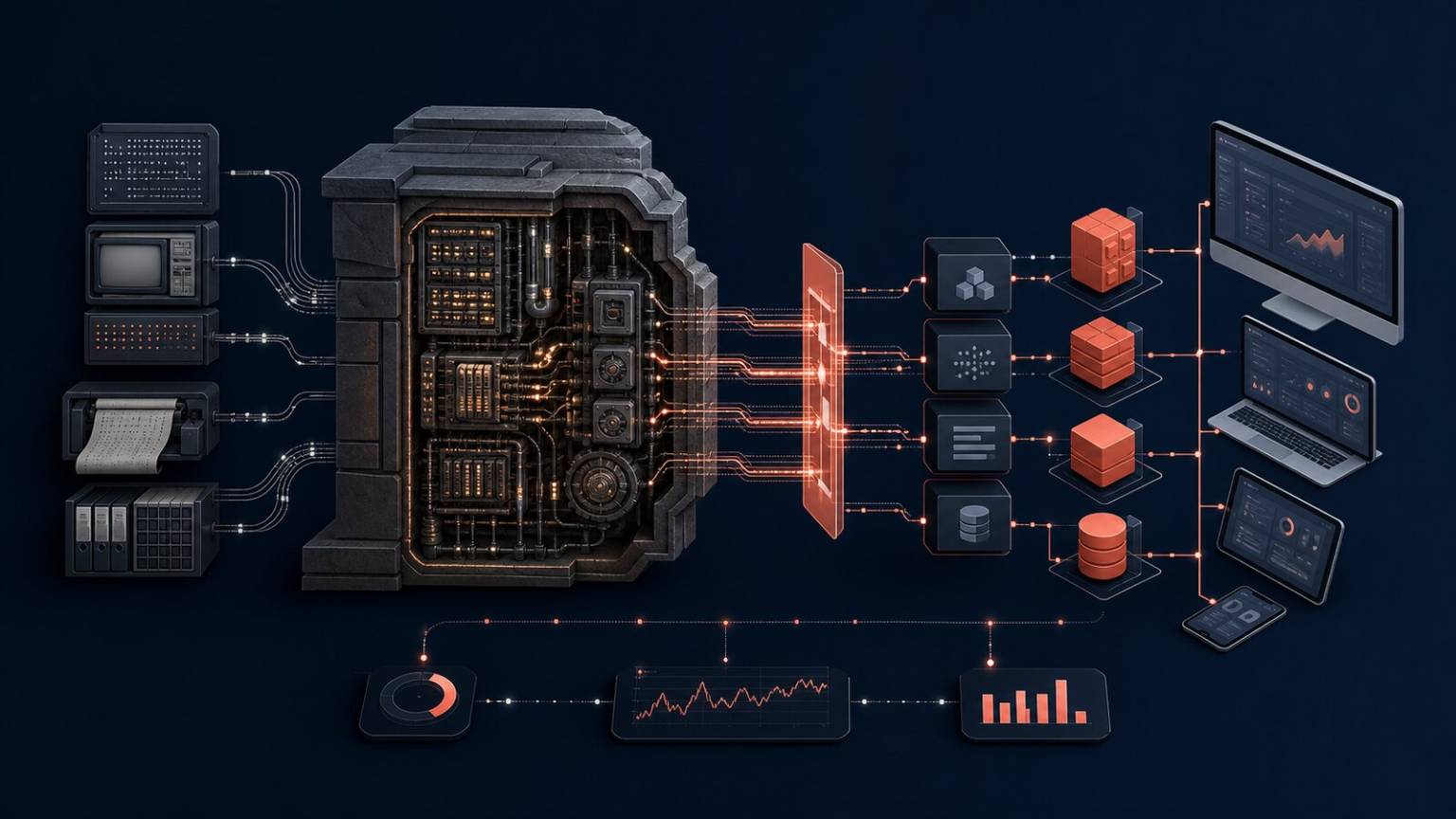
The term "legacy" is often used as a synonym for old or bad. This definition is misleading. An application truly becomes legacy when it remains important for the business but it becomes difficult to understand, modify, secure, or have a new team operate it.
It can rely on a recent technology and already be very coupled. Conversely, an old software can remain perfectly maintainable thanks to a clear architecture, reliable tests, and controlled operation.
The question is therefore not 'should everything be rewritten?', but 'what amount of change is necessary to restore the capacity for evolution, at what risk, and in what order?'.
Why total rewriting is so appealing
A new codebase promises to eliminate past compromises, use modern tools, and simplify the experience. On paper, it avoids having to understand every detail of the existing system. In reality, the most important business rules are rarely all documented. They are found in the code, the data, the manual procedures, and the users' habits.
A rewrite must therefore rebuild both the visible software and the sum of its exceptions. Meanwhile, the existing application continues to evolve, which creates two moving targets. The final switch concentrates the risks: data migration, scaling, training, interconnections, and rollback.
This does not mean that a rewrite is always a mistake. It becomes relevant when the product changes profoundly, when the data model is no longer suitable, when components cannot be isolated, or when the cost of a gradual transition would exceed that of a replacement. But this conclusion must be demonstrated, not assumed.
Start by mapping the value, not just the code
Before choosing a strategy, identify business capabilities: billing, searching, publishing, managing rights, importing, calculating, notifying, producing a report. For each, assess its criticality, rate of change, user satisfaction, and the technical quality of the component that supports it.
This mapping reveals four categories:
- stable and differentiating: to preserve and protect;
- stable but standardizable: candidate for a market service;
- unstable and differentiating: modernization priority;
- unstable and of little use: candidate for removal.
Modernization thus becomes a product program, not a technical cleanup campaign.
Seven possible strategies
1. Preserve and secure
When the application changes little and fulfills its role properly, the best decision may be to maintain it. Critical risks are corrected, backups are automated, supervision is reinforced, and operations are documented. This option costs little in transformation but requires accepting certain limits.
2. Replatform the infrastructure
The application remains largely unchanged, but its environment has been modernized: supported system, containers, managed database, deployment pipeline, observability. This strategy reduces operational risk without addressing the structural problems of the code.
3. Encapsulate behind stable interfaces
An API or an adaptation layer separates the old system from the new channels. Encapsulation allows for the development of a new interface, a mobile application, or a partner portal without directly exposing the historical model. It creates a useful boundary for the future, provided that all the inconsistencies of the existing system are not reproduced in the API.
4. Gradually refactor
The functional behavior is preserved while the internal structure is improved. This approach is effective when tests protect critical paths and teams can work in small increments. It restores maintainability without imposing a user migration.
5. Replace a targeted brick
Authentication, search, payment, email sending, or document management can be extracted or replaced by a more suitable component. The gain is quick if the interface with the rest of the system is controlled. However, the recurring cost, reversibility, and dependencies of the new service must be considered.
6. Build a 'strangler' type transition
The new features are developed outside of the historical core. A router, a facade, or events gradually direct the requests to the new modules. The old scope is reduced until it can be stopped. This strategy limits the risk of switchover, but requires a transition architecture that is explicitly managed.
7. Replace or completely rewrite
This option is suitable when the target product differs significantly, when the platform is no longer usable, or when the boundaries necessary for a transition do not exist. It should include a data strategy, a coexistence period, parity criteria, and a realistic rollback.
| Strategy | Quick Value | Transition Risk | Debt Handling | Testing Requirement |
|---|---|---|---|---|
| Retain and Secure | High | Low | Low | Moderate |
| Replatform | Medium | Low to Medium | Low | Moderate |
| Encapsulate | Medium | Medium | Indirect | Moderate |
| Refactor | Progressive | Low Incrementally | High | High |
| Replace a Component | High | Medium | Targeted | High at Interfaces |
| Strangler | Progressive | Medium | High | High |
| Rewrite | Late | High | Theoretically Complete | Very High |
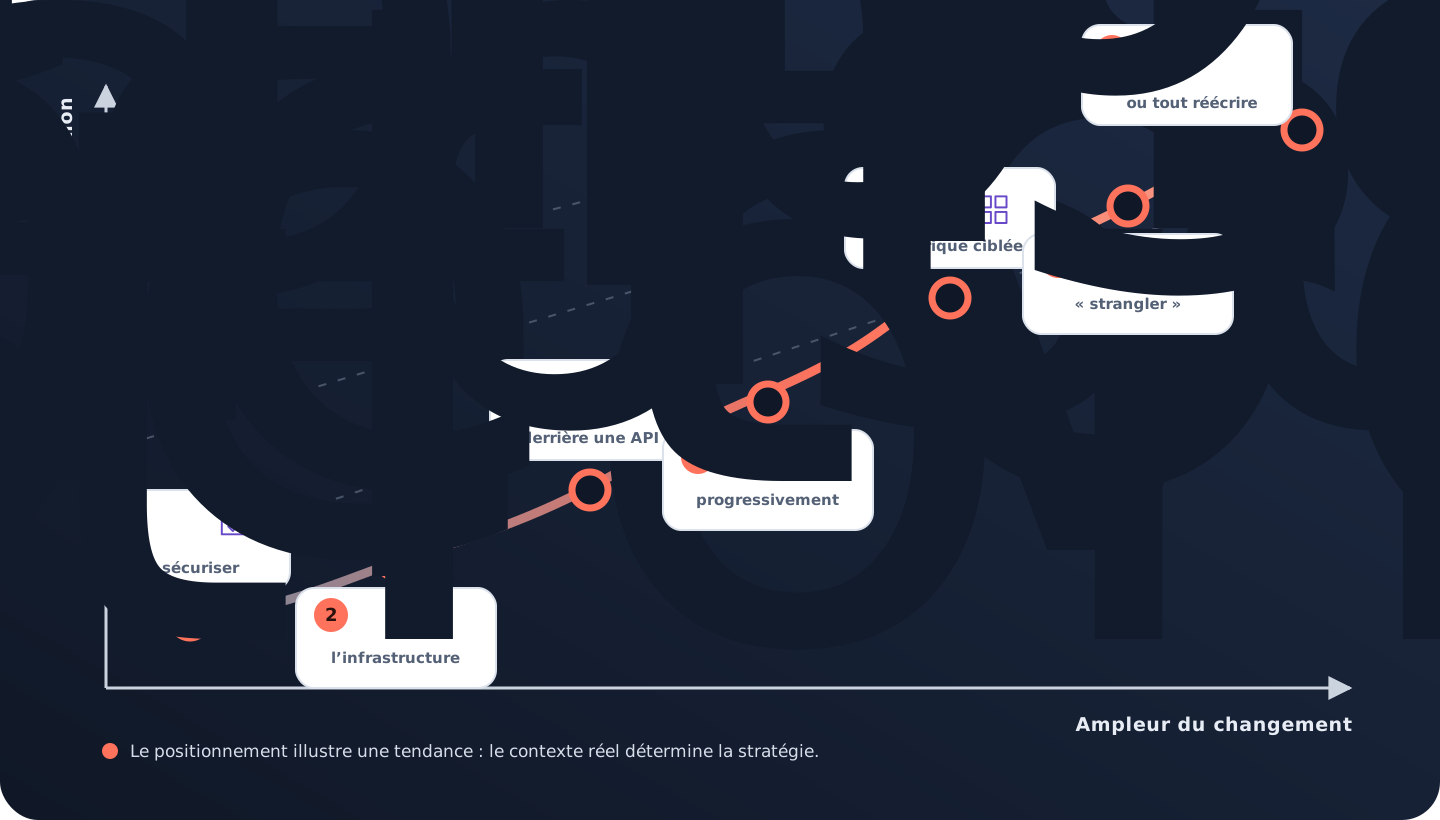
The diagram is read from left to right: the magnitude of the change and the transition risk gradually increase. Preserve and secure limits change; replatform modernizes the infrastructure; encapsulate creates a boundary; refactor improves the code incrementally; replace a brick targets a capability; the strangler model gradually reduces the historical scope; replace or rewrite concentrates transformation and risk. The previous table provides an equivalent textual representation.
Calculate the full cost of the transition
Comparing only the development cost distorts the decision. Modernization also involves understanding the existing system, dual maintenance, migrations, testing, training, supervision, and the coexistence period.
The cost of a strategy can be represented as follows:
total cost = transformation + maintenance of the existing + data transition + adaptation of integrations + change management + residual risk.
The risk must be translated into scenarios: delay, data loss, interruption, regulatory backsliding, or decrease in productivity. It is not necessary to claim artificial precision; documented ranges are sufficient to compare options.
A roadmap in four horizons
Horizon 1 — Make the system safe
Correct access, backups, critical dependencies, alerts, and procedures. This phase creates a stable foundation and can be initiated before the final architecture decision.
Horizon 2 — Making change measurable
Add characterization tests, metrics, and flow mapping. Define performance objectives and business success criteria. Without these elements, teams cannot prove that modernization actually improves the situation.
Horizon 3 — Create the boundaries
Isolate a module, introduce an API, an event queue, or an adaptation layer. The boundaries must correspond to business capabilities, not just to tables or technical directories.
Horizon 4 — Replace with value
Prioritize modules that combine high value, high risk, and isolation capability. Each replacement should reduce the old scope, not add a permanent layer of complexity.
Managing coexistence
For several months, two architectures can coexist. It is necessary to define which source is authoritative, how data is synchronized, how an incident is diagnosed, and who decides on the rollback. Temporary mechanisms must have an owner and a removal date.
A modernization dashboard tracks risk reduction more than the volume of new code: number of protected paths, unsupported dependencies removed, manual operations eliminated, delivery time, incidents, and the share of traffic handled by the new modules.
Preserve business knowledge
Experienced users, support, and historical data are essential sources. Edge cases must be captured in the form of examples, rules, and tests. A regular demonstration of old and new processes prevents discovering too late that a critical exception has been missed.
Modernization is also an opportunity to eliminate functions that have become unnecessary. Reproducing every screen and every field without questioning their value is equivalent to carrying functional debt into a new architecture.
Choose a proportional trajectory
The right strategy is rarely unique for the entire application. The same program can secure the core, replace the search, refactor the business logic, and rebuild the interface. The essential thing is to embrace this transitional architecture and simplify it at every step.
Partitech supports critical platforms over time, from auditing to takeover, version upgrades, and the development of new modules. Our goal is to protect the accumulated value while restoring a predictable capacity for evolution.
To frame this trajectory, start with a complete technical audit of the application, then delve into the issues of technical debt and compare a big bang or progressive overhaul. Also consult our Symfony update and Drupal update services, as well as our WordPress expertise.
Official references
References checked on August 17, 2026: