





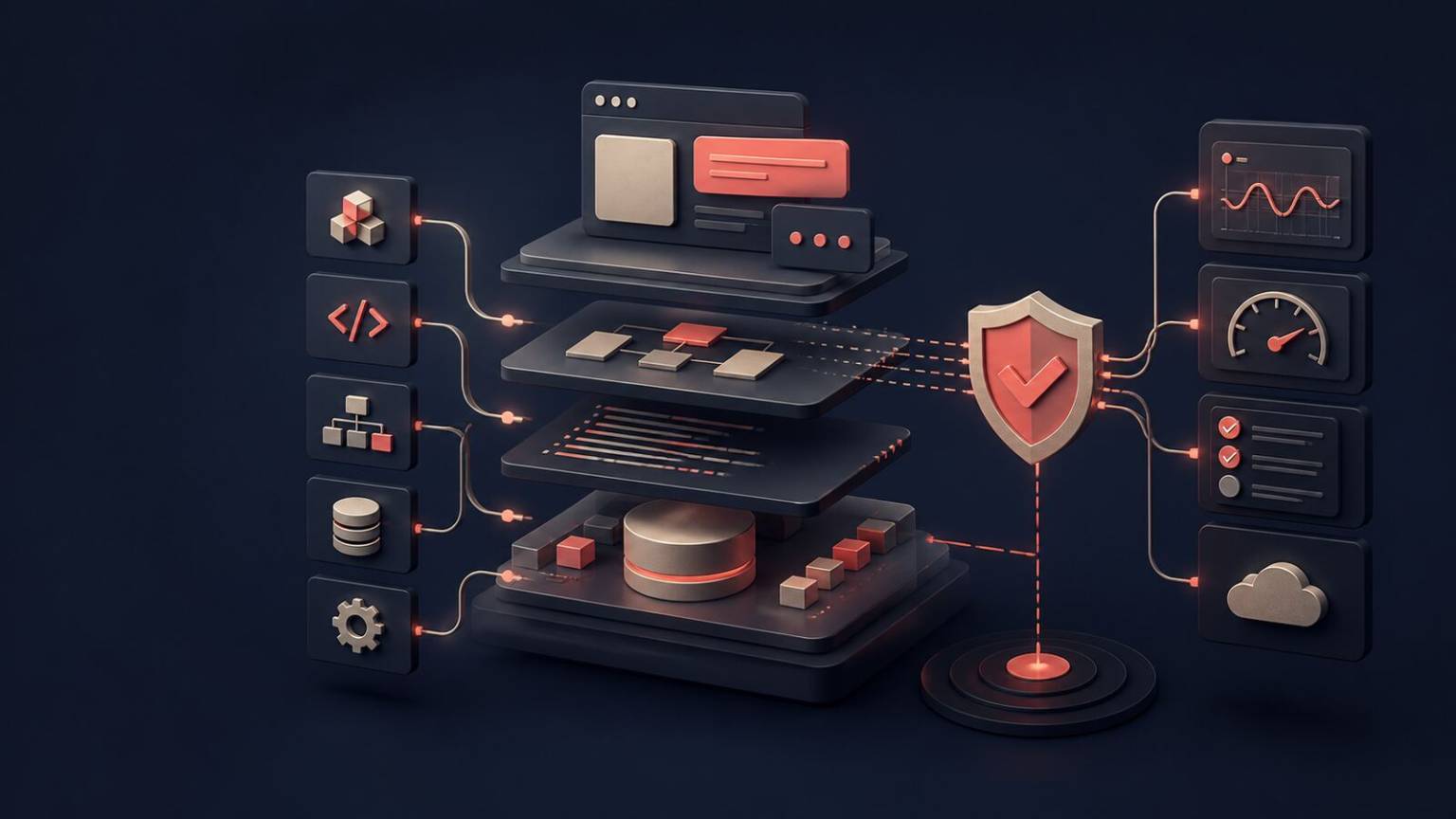
An application can appear to work correctly while concentrating invisible risks: abandoned dependencies, backups never restored, business rules buried in the code, lack of testing, permissions that are too broad or deployment known to only one person. Conversely, old code is not necessarily bad code. He can be stable, understood, properly supervised and perfectly suited to the job.
The objective of a technical audit is therefore not to distribute good or bad points. It consists of establishing verifiable facts, measuring their impact and giving decision-makers a realistic trajectory. Before a maintenance resumption, a redesign, an acquisition or a major investment, this photograph avoids deciding on the sole impression left by the interface or by a few recent incidents.
What a technical audit should help to decide
A useful audit answers concrete questions. Can the application continue to be operated without major risk? What incidents are plausible and what would their consequences be? Can the team deliver developments without causing regression? Is a gradual upgrade possible or do some bricks need to be replaced? What budget should be allocated to security, then to evolution?
He must also distinguish three often mixed notions:
- obsolescence, which describes the age or level of support of a technology;
- technical debt, which represents the future cost induced by past decisions;
- operational risk, which combines the probability of an incident and its business impact.
An old but isolated dependency, tested and without public exposure may be less urgent than a recent feature deployed without logging or access control. The audit serves precisely to establish this order of priority.
In what situations should the audit be launched?
The audit is particularly relevant before a change of service provider, a major version migration, an opening to new users, an interconnection with a critical system, a fundraising or the acquisition of a software asset. It is also useful when delivery times lengthen, incidents are repeated or each development requires the intervention of a specific person.
However, we should not wait for a crisis. A preventive audit, carried out while the application is stable, offers more freedom: teams can progressively correct, choose the right schedule and test recovery plans without commercial pressure.
The nine dimensions of a comprehensive audit
1. Architecture and application division
The auditor reconstructs the components, their responsibilities and their dependencies. It checks whether the boundaries between presentation, business, data and integrations are sufficiently clear to allow controlled development. It does not seek to impose a theoretical model: a well-structured monolithic architecture can be more reliable than a set of microservices that is too fragmented.
Observed points include synchronous and asynchronous flows, scheduled tasks, message queues, external services, single points of failure, and recovery mechanisms. The result must be a diagram understandable by both the developers and the platform manager.
2. Quality and maintainability of code
The review focuses on readability, division of responsibilities, duplication, complexity, conventions, error handling and the presence of hidden business rules. Static analysis tools can point out trends, but they are no substitute for contextualized reading.
An indicator only has value if it leads to a decision. For example, high complexity in a module that is rarely changed is not given the same priority as simpler but central code that is changed weekly and lacks testing.
3. Dependencies and Support Cycle
It is necessary to inventory the languages, frameworks, libraries, container images, managed services and front-end components. For each, the audit checks the version, support level, known vulnerabilities, updateability and replacement cost.
The deliverable must separate routine updates, migrations requiring adaptation and components without a credible trajectory. A raw list of versions is not enough: the risk depends on the exposure, criticality and compensations already in place.
4. Security and access management
The analysis covers authentication, authorizations, secrets management, sessions, input validation, dependencies, logs, administrative interfaces and third-party exchanges. Development, testing, and production environments should be considered separately.
The objective is not to transform a general audit into a penetration test. On the other hand, any observable critical defect must be reported immediately, without waiting for the final report. More offensive checks require specific scope and authorization.
5. Data and Integrity
A business application is often worth more for its data and its rules than for its interface. The audit examines schema, migrations, integrity constraints, volumes, indexes, retention, traceability, imports, exports and deletion mechanisms.
Above all, it verifies that the backups exist, that they are protected and that a restoration has been tested. A backup where no one knows the recovery time is not yet a recovery plan.
6. Performance and capacity to scale
We must distinguish between perceived slowness, measured bottlenecks and growth hypotheses. Response times, expensive queries, caches, background processing, queues, page weights and external calls are analyzed using reproducible measurements.
A serious audit avoids premature optimizations. It identifies critical paths, sets measurable objectives and estimates the margin before saturation.
7. Testing and mastering regressions
The number of tests is not enough. The auditor checks what they actually protect: sensitive business rules, permissions, payments, imports, data migrations, APIs and user journeys. It also observes their stability, duration and execution in continuous integration.
The absence of tests does not necessarily mean stopping developments. On the other hand, it imposes a progressive security strategy, starting with high-impact functions and frequently modified areas.
8. Deployment, hosting and operation
This dimension covers the reproducibility of environments, deployments, configuration management, certificates, backups, monitoring, alerts, logs, constraints and rollback capacity.
The key point is human dependence. A procedure that works only because an administrator remembers an undocumented command is a risk, even if no incident has yet occurred.
9. Documentation and transferability
The documentation must make it possible to understand the business, start the project, deploy, diagnose and resume operation. It does not need to describe every line of code. It must cover decisions that are difficult to reconstruct and operations whose forgetting would have an impact.
The audit also verifies code ownership, access to repositories, cloud accounts, domain names, certificates, tracking tools and third-party service contracts.
Transform findings into criticality level
A recommendation becomes actionable when it includes at least five pieces of information: the observed fact, the evidence, the risk scenario, the priority and the estimated effort. A simple grid can combine probability, business impact, exposure and difficulty of detection.
It is useful to classify stocks into four horizons:
| Horizon | Objective | Examples |
|---|---|---|
| Immediate | Reduce a critical risk | rotation of exposed secrets, backup, correction of access control |
| 30 days | Stabilize operations | monitoring, deployment documentation, security patches |
| 90 days | Restore the capacity to evolve | priority testing, dependency upgrades, targeted slicing |
| 6 to 18 months | Modernize sustainably | replacement of a brick, progressive migration, redesign of a module |
This timeline avoids two errors: launching a global rewrite when rapid fixes are possible, or multiplying small fixes without addressing a structural cause.
Expected deliverables
The complete report must be readable at several levels. An executive summary presents the major risks, the decisions to be made and the orders of magnitude. A detailed register documents the evidence and recommendations. Technical appendices contain versions, diagrams, tool results and reproducible commands.
The premium deliverable generally includes:
- a mapping of the architecture and flows;
- an inventory of components and their support;
- a prioritized risk register;
- an assessment of the debt by area;
- maintenance, modernization or replacement scenarios;
- a roadmap with dependencies and estimates;
- a list of accesses and missing documents;
- urgent measures already communicated during the audit.
How to prepare for the audit without biasing it
Before starting, gather code, procedures, documentation, read access, data schemas, recent incidents, volumes, and business objectives. Hold short interviews with product, development, operations and, if possible, a key user.
It is important not to turn the audit into a trial of the previous team. Technical choices were often made under deadline, budget or skills constraints. Understanding these constraints helps to propose a realistic trajectory and promotes the transmission of information.
Signals of an audit that is too superficial
Be wary of a report consisting only of tool captures, an overall score without evidence, or a rewrite recommendation decided before analysis. A good audit explains its limits: non-accessible parts, absence of production data, non-executable tests or unverified contractual dependencies.
It must also differentiate between what is certain, probable or simply to be confirmed. This transparency allows the decision-maker to finance the reduction of unknowns before making an irreversible commitment.
From audit to decision
The audit is not an end. Its value appears when findings are transformed into understandable decisions and a team can execute the roadmap without rediscovering the entire reasoning. The best outcome is not always a redesign: it can be stabilization, a version upgrade, progressive cutting or the replacement of a single component.
Partitech operates on complex digital and application platforms, including when they have been developed by a third party. Our approach aims to secure what already exists, preserve business value and propose a trajectory proportionate to real risks.
To extend this approach, discover our approach to technical audit and advice, the points to frame for resuming the maintenance of an existing application, a trajectory for modernizing a legacy application without rewriting everything and our reference for business platform financial.
Références officielles
References verified on August 17, 2026: