





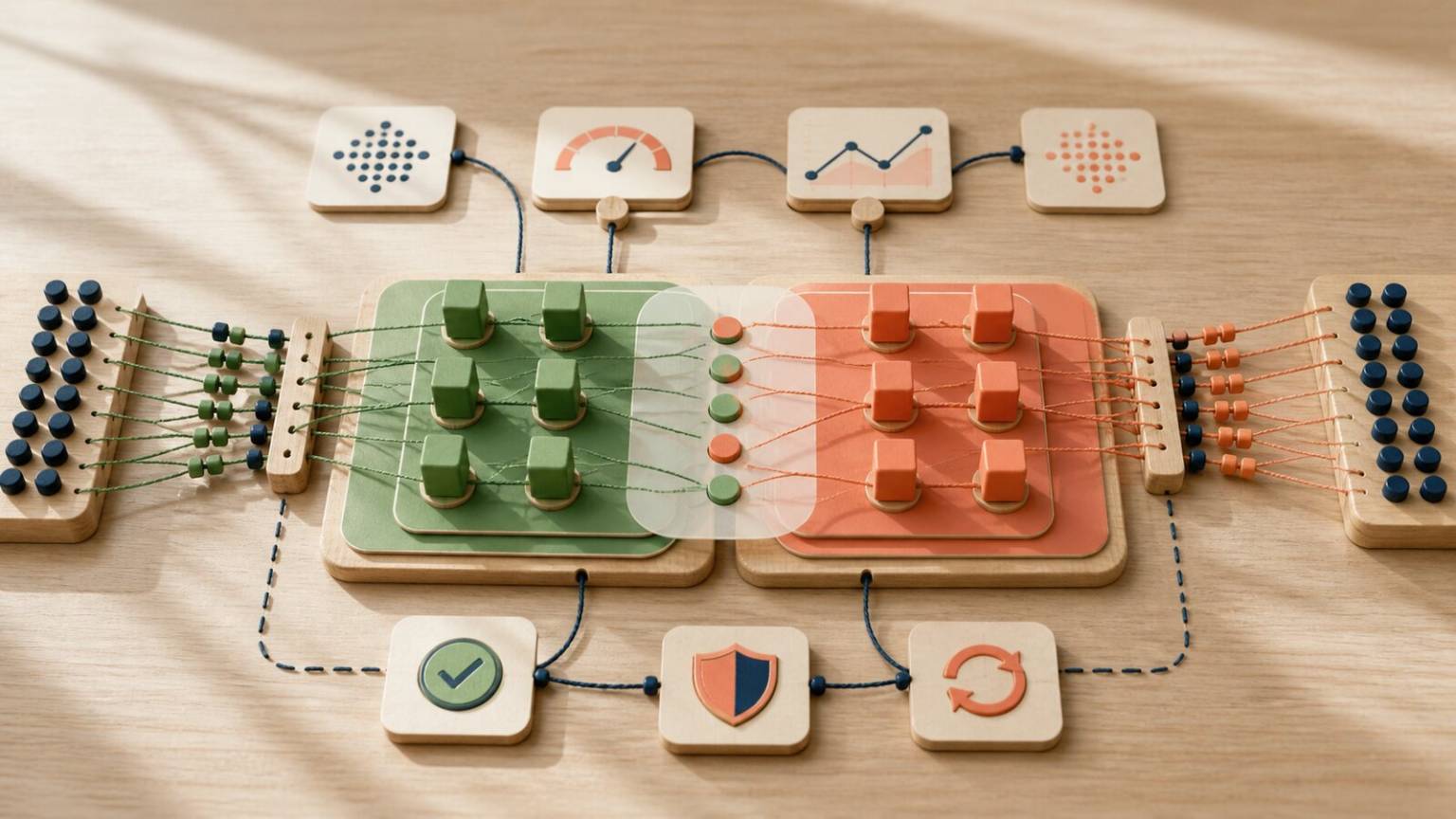
A seamless migration is not just about launching two versions behind a load balancer. The versions must include the same data, asynchronous tasks must not be duplicated, integrations must remain compatible, and rollback must preserve operations performed after the switch.
The real goal is not always "zero seconds." It is to make the interruption predictable, limited, and lossless, or to maintain the service when the business requires it. A short and tested window can be safer than a poorly controlled complex coexistence.
Define the expected continuity
The terms must be quantified:
- maximum acceptable unavailability;- features that can be set to read-only;- volume of data that can be replayed;- RTO and RPO;- schedules and critical populations;- external systems to coordinate;- observation period before final approval.
A secondary path can be temporarily disabled while the consultation remains available. This controlled degradation sometimes greatly simplifies the migration.
Mapping compatibilities
For each combination, check:
- old code with old schema;- new code with old scheme;- old code with new schema;- new code with new scheme.
A gradual migration often requires several combinations to operate for a period of time. Messages, caches, files, and APIs are also contracts to version.
The expand, migrate, contract method
Expand
Add the new fields, tables, endpoints, or formats without removing the old ones. The changes are compatible and generally optional. The new code can read the old state.
Migrate
Deploy the compatible code, start writing the new format, then gradually transform the existing data. Checks compare volumes, sums, fingerprints, or samples.
Contract
When all consumers are using the new model and the observation is conclusive, remove the old field, the old endpoint, or the compatibility code. This phase may occur several releases later.

Sequence expand, migration, validation, switch, observation, and removal of the old schema.
Design database migrations
Blocking operations on large tables must be measured on a representative copy. Some modifications can be performed online, while others require a batch strategy or a new structure.
A robust backfill has:
- bounded lots;- a cursor or recovery state;- an idempotence;- a load limitation;- metrics;- a business validation;- a stop procedure.
It must not saturate the database or prevent normal writes.
Double reading and double writing
Double writing can maintain two models, but it introduces a risk of divergence. It must be centralized, idempotent, and monitored. A distributed transaction is not always necessary; a queue and a repair mechanism can be more realistic.
Double entry allows you to compare the results or revert to the old system. It must define which source is authoritative and how to handle a discrepancy.
Temporary strategies have a withdrawal date. Otherwise, they become the permanent architecture.
Blue-green, canary and rolling
Blue-green
Two complete environments coexist. Traffic switches to the new one after validation. The return is quick as long as the data remains compatible. Infrastructure cost and synchronization must be anticipated.
Canary
A small portion of the traffic uses the new version. The metrics allow scaling up or stopping. Routing must preserve sessions, and population differences must be understood.
Rolling
The instances are gradually replaced. The old and the new version coexist, which requires strict compatibility of data, caches, and messages.
Planned stop
For certain transformations, a maintenance window remains the safest solution. It must be communicated, repeated, and accompanied by a restoration plan.
Scheduled tasks and message queues
Two versions can perform the same task or interpret a message differently. Consumers must manage schema versions, be idempotent, and track processing state.
During a switchover, it may be necessary to suspend a producer, empty a queue, change routing, or maintain a compatibility consumer. These operations are listed in the runbook.
Sessions, cache and files
Sessions must be shared or compatible. A change in session format can disconnect users or cause errors. Caches must include the format version or be invalidated in a controlled manner.
File storage migrations require copying, integrity verification, synchronization of new files, and link strategy. Transparent redirection can allow a gradual transition.
External integrations
Partners do not always change at the same pace. A facade can maintain the old contract while adapting the new system. Webhooks must accept replays and distinguish versions.
Before the switchover, confirm certificates, address lists, quotas, environments, schedules, and incident contacts. Human dependencies are part of the plan.
Rollback is not always possible
Reverting to the previous code is simple only if the produced data remains understandable. If the new system creates structures or operations unknown to the old one, the rollback may lose or hide information.
Three strategies exist:
- full return with controlled restoration and replay;- return of traffic to reading, manual processing of entries;- quick roll-forward with fix.
The strategy is chosen before the migration and repeated.
Repeat with representative data
A rehearsal must measure the duration of each step, the volume, the load, the controls, and the feedback. Sensitive data is anonymized or synthetic, but the distribution and anomalies must remain realistic.
The runbook is executed by the people who will intervene in production. The commands, responsibilities, thresholds, and communications are explicit.
Define the go/no-go criteria
Before the switch, check:
- tests and acceptance completed;- backup and restore validated;- sufficient capacity;- metrics and active alerts;- synchronized data;- available partners;- feasible return plan;- identified decision-maker.
An unsatisfied criterion results in a deferral or a formal acceptance of the risk.
Observe after the switch
Technical metrics must be linked to the business: errors, latency, queues, connection rates, transactions, amounts, volumes, and support. Consistency checks compare the old and new system whenever possible.
The migration is only complete after a period of observation, the resolution of discrepancies, and the removal of temporary mechanisms.
Document and clean
Flags, double entries, old tables, temporary access and environments must be removed. The architecture diagram, procedures, and inventory are updated.
The feedback records the actual durations, surprises, and improvements for the next migration.
Compatibility as a strategy
Safe migrations are prepared by small, compatible, and observable changes. This discipline allows modernization without concentrating all the risk in one night.
Partitech can audit dependencies, design the steps, automate controls, and support the transition of applications, CMS, databases, and infrastructures. The goal is a reversible and understandable transition, adapted to business criticality.
Let's talk about your project
Prepare a testable and reversible migration with Partitech.Contact Partitech.