






Two closely timed announcements have reignited the topic of the origin of AI-generated content: Anthropic presented a statistical watermark for future Claude models on August 14, 2026, while Google launched Credentio, a C2PA verification library. These technologies are complementary, but none alone proves that content is true, lawful, or entirely produced by a human.
1. Three problems often confused
Detection aims to estimate whether content was probably generated by a model. Provenance describes the declared history of a file: tool, transformations, signature, and identity of the issuer. Authenticity seeks to establish that the content indeed corresponds to a real source or event.
These notions are not interchangeable. A correctly signed C2PA file can contain false information published by an authenticated organization. A watermark can indicate that a model likely contributed to a text without identifying the author or the owner. Human content can finally lose all metadata during a copy.
A serious policy must therefore separately answer three questions: who produced or transformed the content, what technical evidence accompanies this statement, and who approved the publication?
2. How a text watermark works
Anthropic announces that a future generation of Claude models will use a version of the SynthID-Text approach. The system relies neither on invisible characters nor on the addition of an identifiable token. It slightly modifies the probability of certain word choices when multiple formulations have a comparable meaning.
On a sufficiently long text, a detector can search for this statistical distribution and estimate whether Claude likely participated in its generation. Anthropic specifies that the marking does not allow for identifying a particular user or organization.
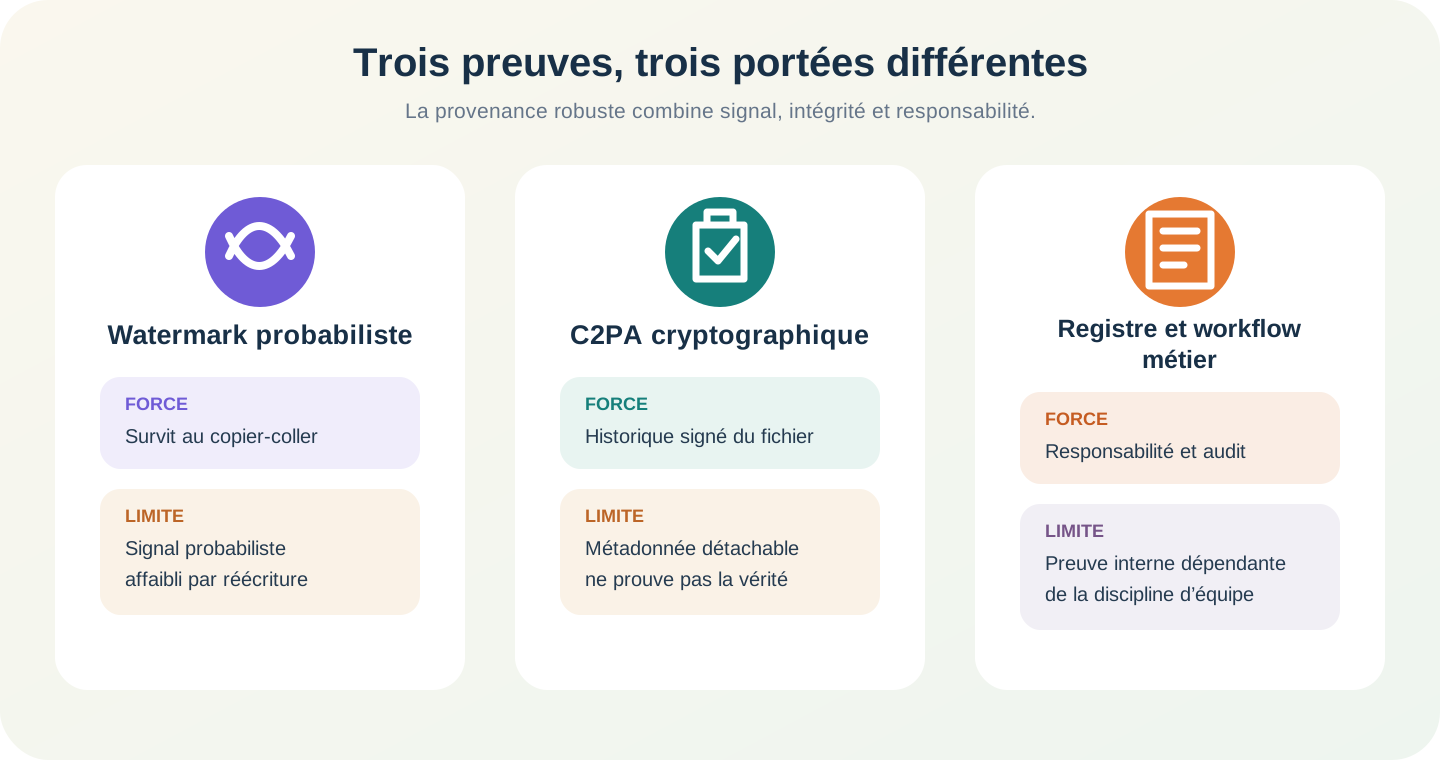
The advantage is not to visibly modify the content or its format. The mechanism can follow the text after a copy-paste, unlike a simple file metadata.
3. The recognized limits of statistical marking
The watermark is less reliable on short texts, code, very factual answers, or heavily constrained content. In these situations, the model has fewer stylistic choices without degrading quality.
A complete rewrite can also remove the signal. The announced detector must therefore provide a probability, not a legal verdict. A negative result does not prove that no AI was used, and a positive result proves neither ownership nor intent.
Since the update of September 1, 2026, Anthropic has been offering the detection API in a private preview to certain eligible organizations and companies subject to similar obligations. No public access has been announced. Companies should not build a high-impact automated decision based solely on this signal, even when they have access to the preview.
4. What C2PA brings to files
C2PA defines Content Credentials, that is, provenance manifests cryptographically linked to a file. They can record the identity of a signer, the tool used, and certain transformations. Validation allows verifying that the manifest and the file have not been altered since signing.
This approach is particularly suitable for images, videos, documents, and other assets published as files. It facilitates a chain of responsibility: creation, editing, export, and distribution.
C2PA does not, however, guarantee the truth of the scene or the quality of the issuer. Trust depends on the list of recognized authorities or organizations, the protection of keys, and the ability of the interface to explain the information to the public.
5. The role of Credentio
Google has released Credentio, an open-source C++ library designed to validate Content Credentials compliant with versions 2.2 and 2.4 of the C2PA specifications. The company states that the same foundation is already used in many products and on a very large volume of assets.
The library is designed to operate locally: a file does not need to be sent to an external service to be validated. This reduces latency, bandwidth consumption, and exposure of sensitive content.
Credentio allows the configuration of official or private trusted lists and produces detailed reports on manifests, assertions, signatures, and claims. The first version focuses on validation. The creation and integration of new Content Credentials are announced for later.
The repository specifies, however, that the project remains under active development, may introduce breaking changes without notice, does not provide the trust lists itself, and is not an officially supported Google product. A production integration must therefore lock a revision, manage its own trust lists, and plan for updates.
For a company, the main interest is to be able to integrate verification into a DAM, a CMS, a moderation chain, or a mobile application without depending on a proprietary endpoint.
6. The link with the AI Act
The transparency obligations of Article 50 of the AI Act have been applicable since August 2, 2026. They notably provide that certain content generated or manipulated by AI must be marked in a machine-readable and detectable format, subject to the exceptions and conditions provided. A transitional provision grants until December 2, 2026, for certain systems placed on the market before August 2 to comply.
The European Commission has published its guidelines and the final code of good practices on AI-generated content before it comes into effect. Technical standards such as C2PA or watermarks can contribute to implementation, but their presence alone is not sufficient to demonstrate full compliance.
It is necessary to connect the labeling to the use case, to the user information, to the system registry, and to editorial responsibility. Our AI Act action plan provides the general framework.
7. A realistic provenance architecture
The first layer is the production log. Each asset receives an identifier, an author or service, the model and version used, the sources, the transformations, and the human validator.
The second layer is the marking adapted to the medium. For a file, a Content Credential can be signed at the time of export. For a text, a watermark can serve as an additional signal when it is available.
The third layer is publication. The CMS maintains the link between the asset, its manifest, its license, and the validation workflow. An accessible interface allows the reader to check the provenance without having to interpret a raw cryptographic report.
The fourth layer is resilience. The system must handle the loss of metadata, format conversion, screenshot capture, and key revocation. The published content must remain traceable in the internal registry even when the public signal has disappeared.
8. The implementation plan for a company
Start by inventorying the relevant content: articles, visuals, videos, commercial documents, and automated responses. Rank the risks according to the impact of an incorrect attribution or manipulation.
Then define a policy: who can generate, who validates, what labeling is applied, how long the evidence is retained, and how an error is corrected. Separate technical evidence from editorial statements.
Test C2PA on a limited stream, for example images generated or retouched by AI for blogs. Check the signature after compression, passing through the CDN, and downloading. For text, evaluate the private pre-release of the detector only if your organization is eligible, without making it a high-impact automated control, and keep the model and workflow in the internal metadata.
Finally, consider the user experience. An icon without explanation can give false reassurance. Clearly present what is verified: the source of the file, the use of a tool, human validation, or absence of modification since signing.
The announcements from Google and Anthropic show that provenance is becoming an infrastructure component. The right answer is not to choose between watermark and C2PA, but to integrate them into a governance chain where each signal has a known scope.
Partitech supports organizations in designing AI content workflows, C2PA integration, CMS/DAM traceability, and operational compliance with the AI Act.