






Symfony announced on August 17, 2026, the beta of Symfony Language Tools, its official LSP server. The tool promises cross-cutting understanding of PHP, Twig, and YAML, with navigation, completion, and diagnostics based on the actually compiled container. Since then, several versions have expanded its compatibility, and an official command allows its diagnostics to be run in CI. For a Symfony team, the potential gain is significant, but its mode of operation deserves careful reading before widespread deployment.
1. Why a Symfony-specific LSP?
An LSP server, for Language Server Protocol, provides a code editor with functions such as completion, go to definition, renaming, or diagnostics. General PHP tools know classes, methods, and types. They understand less well the conventions specific to a framework: service identifiers, route names, configuration options, events, messages, or Twig variables.
In Symfony, the same functionality often spans multiple formats. A route can be declared by a PHP attribute, a service configured in YAML, a template called from a controller, and a translation referenced by a string. The quality of support therefore depends on the ability to connect these elements, not just on analyzing each file in isolation.
Symfony Language Tools targets precisely this semantic layer. The project is offered as a native extension for VS Code, with a Neovim configuration available from the start, as well as a standalone LSP server for other compatible editors.
2. What the tool actually understands
The official announcement covers a wide range: routing, dependency injection, Twig, translations, environment variables, bundle configuration, Messenger, events, security, forms, validation, Serializer, AssetMapper, Stimulus, Live Components, and Doctrine.
In practice, this should allow for completing a route name, opening the corresponding service, identifying an invalid reference, or renaming a concept used in multiple files. The diagnostics are described as cautious: the tool aims to report what is demonstrably invalid rather than multiplying approximate warnings.
This philosophy is important. An LSP that is too noisy is quickly disabled. A reliable tool can, on the contrary, shift some of the errors from execution or code review to the typing itself.
3. A major difference: the core of the application is started
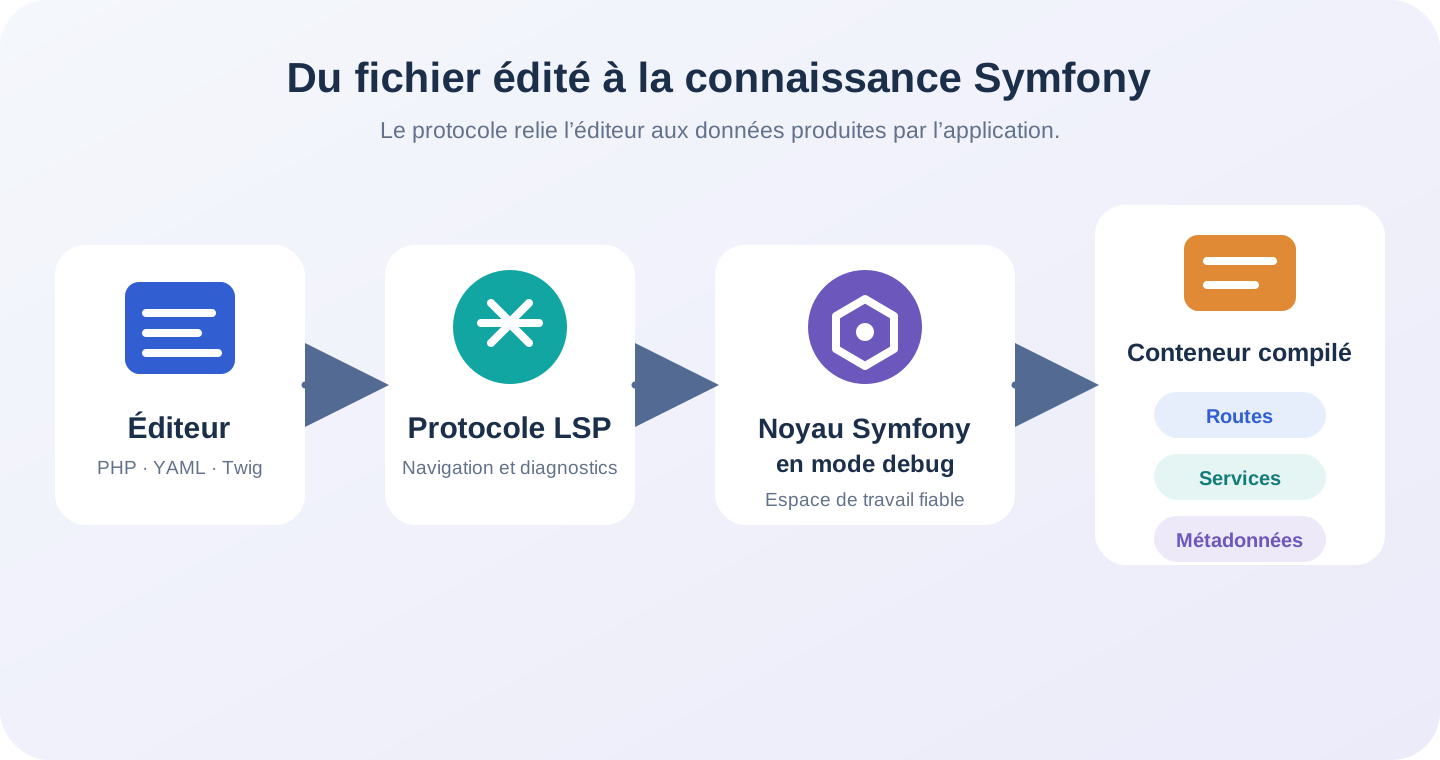
Symfony Language Tools does not rely solely on static analysis. In a declared trusted workspace, it starts the Symfony kernel in debug mode in order to read the compiled container, the router, and the metadata produced at runtime.
This choice improves accuracy, particularly when the configuration depends on bundles, environment variables, or container compilers. It also means that opening the project can execute local code. The notion of a 'trusted workspace' is therefore not cosmetic.
A team must apply the same rules as when executing a cloned project: check the origin of the repository, isolate dependencies, do not inject production secrets, and control scripts that may be run. On a sensitive workstation, a development container or a remote environment can provide an additional barrier.
4. The expected benefits for a team
The first benefit is the reduction of search time. Navigating directly from a route to its controller, from a service to its definition, or from a Twig variable to its source avoids some of the textual searches and the back-and-forth in the documentation.
The second benefit concerns onboarding. A developer who joins an old application understands the connections between layers more quickly. This does not replace architectural documentation, but it reduces the cost of purely mechanical questions.
The third concerns refactoring. Assisted renaming and cross-references can secure changes that would otherwise be performed with fragile global search. In an application with multiple bundles or a lot of historical configuration, the effect can be significant.
Finally, the tool can standardize the experience between editors. The LSP protocol allows centralizing Symfony knowledge rather than relying on multiple extensions with divergent behaviors.
5. The risks and limitations of beta
The project is still presented as a beta. A beta can produce false negatives, consume more resources, or not cover certain internal conventions. Six days after the announcement, Symfony was already reporting ten releases and a version 0.16 notably expanding support for real applications, Docker, XML definitions, and other editors, including an official extension for Zed.
Since August 31, 2026, the command symfony lsp:check officially brings Symfony diagnostics to the command line and to CI. This availability makes the idea of confining the tool to the editor obsolete. It remains prudent to start in informational mode, then use a baseline and an explicit policy before making some diagnostics blocking.
Kernel startup can also reveal existing weaknesses: configuration dependent on an external service, slow bootstrap, side effects on loading, or secrets required right from the development environment. These problems are not necessarily caused by the LSP, but they can make its use difficult.
Finally, the announcement specifies that a large part of the code was written or reviewed with AI models, under human supervision. This point does not invalidate the tool, but reinforces the importance of checking the quality of the code, the dependencies, updates, and the security process as with any new development tool.
6. How to evaluate it without disrupting the project
Start with two or three volunteers on a representative repository. Set up the server in a development environment without sensitive secrets, then record CPU and memory usage, indexing time, and any errors encountered.
Then prepare a set of scenarios: navigation to a route, searching for a service, completing a bundle option, renaming a message, diagnosing a Twig template, and working on an incomplete branch. Compare the results with the tools already used.
During this phase, keep the existing analyzers: PHPStan or Psalm, PHPUnit, linters, functional tests, and configuration checks. The LSP complements these checks; it does not replace code review or behavior tests. Also evaluate symfony lsp:check on a targeted perimeter, in source-only mode if the CI should not start the application, before activating a blocking failure.
If the trial is successful, provide a versioned configuration, an installation procedure, and an explicit rule on trusted workspaces. Avoid making the extension mandatory as long as users of other editors do not have an equivalent solution.
7. The indicators to measure
Success is not measured by the number of completions shown. Rather, track the time needed to find a route or a service, the number of configuration errors detected before CI, the onboarding duration, and the frequency of tool deactivations.
Also collect the cases of failure. A short list of misleading diagnoses allows you to decide if the overall benefit remains positive and to provide useful feedback to the open source project.
During a migration or a maintenance takeover, the tool can be assessed as a complement to an approach of reduction of technical debt. It facilitates exploration, but does not replace the inventory of dependencies and risks.
8. Our recommendation
Symfony Language Tools is a structuring announcement for the PHP ecosystem. The choice of an official, multi-editor, and runtime-aware LSP responds to a real need. As of September 2, 2026, it should still be treated as a promising beta: guided pilot, isolated environment, comparison with existing tools, and gradual adoption of symfony lsp:check in the IC.
Teams that are already industrializing their development environments will likely get the most out of this first version. Those whose project only starts with production secrets should first fix this point.
Partitech supports Symfony teams in auditing applications, modernizing their tooling, industrializing environments, and securing technical migrations.