





On August 25, 2026, Microsoft Azure published an analysis of the collapse of the ‘patch window’: a vulnerability made public in the morning may be scanned or targeted for exploitation during the day, while a company still needs several days to identify the affected systems, test the patch and organize its deployment. The response can no longer rely solely on update speed.
Key takeaway: when a patch cannot be applied immediately, the goal is to reduce exposure measurably. Segmentation, traffic restrictions, application filtering, identity controls and enhanced monitoring must buy time. These measures remain temporary: they replace neither the patch nor the removal of a vulnerable component.
1. Why the patch window is shrinking
The traditional cycle assumed that a security team had a reasonable period between the publication of a flaw and its large-scale exploitation. It could analyze the advisory, identify the affected versions, test the patch, schedule a maintenance window and deploy it progressively.
That assumption is holding less and less often. Advisories, code repositories, patches, proofs of concept and analyses circulate almost instantly. AI-assisted workflows speed up the review of changes, the search for dependencies and the identification of likely attack paths. An attacker needs only one entry point; the defender must understand an entire estate.
At the same time, production constraints have not disappeared. A billing application, customer extranet or industrial tool cannot always be stopped as soon as an advisory is published. Dependencies, data, integrations and testing obligations still require serious controls.
The problem is therefore not only slow patch management. It is the existence of a period in which the risk is known but definitive remediation is not yet safe.
2. The immediate patch is not always the safest response
Applying a patch without understanding its impact can cause an outage, data corruption or an integration failure. On a legacy application, an apparently local update can modify a shared library, a session format, a database driver or a web-server configuration.
This caution must not become an excuse. The company must distinguish three situations: a patch that can be applied immediately with low risk, a patch requiring a short test phase, and a patch that requires a deeper change. Vulnerability severity alone is not enough; it must be combined with actual exposure, available privileges, the data involved and the possibilities for lateral movement.
The right trade-off is to reduce the attackable surface immediately, then carry out the shortest testing phase compatible with application safety. An emergency change procedure should exist before an incident, with decision-makers, minimum evidence and the rollback mechanism already defined.
3. From visibility to exposure reduction
Scanners and vulnerability platforms answer the question “where is the affected component?”. They do not, by themselves, reduce a third party’s ability to reach it.
Exposure reduction answers other questions: which flows are actually necessary? Does the service need to be reachable from the Internet? Which accounts can use it? Which functions can be disabled temporarily? What scope must be isolated to prevent propagation?
The network then becomes an important control plane because it can act around a workload without immediately changing its code. A reverse proxy, WAF, API gateway, distributed firewall or Kubernetes policy can restrict a route, protocol, origin or request volume faster than a complete application release.
This does not mean that the network “fixes” the flaw. It means breaking the conditions required to exploit it or limiting the consequences of a successful exploit while remediation is being validated.
4. Compensating controls to activate
The first measure is often to reduce accessibility. A publicly exposed administration service can be placed behind a VPN, an allowlist or stronger authentication. A rarely used API can be disabled temporarily. An unnecessary port, route or HTTP method can be blocked.
The second measure concerns behavioral filtering. A WAF or gateway can limit certain request sizes, parameter combinations, rates or sequences known to be dangerous. For a protocol-related risk, a more precise rule can preserve legitimate use while bounding the exploitable characteristic. These rules must be tested to avoid a false sense of security and a silent service break.
The third measure is segmentation. A vulnerable application should not have broad access to databases, secrets, administration environments and other networks. Reducing service-account permissions, closing outbound flows and isolating dependencies reduces the blast radius.
Finally, monitoring must be strengthened: reverse-proxy logs, authentications, process creation, outbound calls, file changes, unusual errors and traffic variations. The goal is to detect an attempt quickly and have usable evidence if the incident has already begun.
5. Building an actionable inventory for an emergency
A software inventory is useful only if it connects technical components to business services. Knowing that a vulnerable version exists on twelve servers is not enough; you need to know the exposed URLs, owners, data handled, dependencies and deployment procedure.
For each critical application, retain at least: framework and runtime versions, container images, main packages, public ports and routes, service accounts, inbound and outbound flows, accessible secrets, business owner, technical owner, test environment and last tested restore.
An SBOM can speed up the search, but it must be supplemented by runtime reality. A package present in an image is not necessarily loaded; conversely, a component installed manually may not appear in the manifest. Telemetry, deployment configurations and network rules must therefore be compared.
This mapping makes it possible to prioritize an exposed, privileged application over an isolated internal component, even when both share the same vulnerability identifier.
6. The runbook for the first twenty-four hours
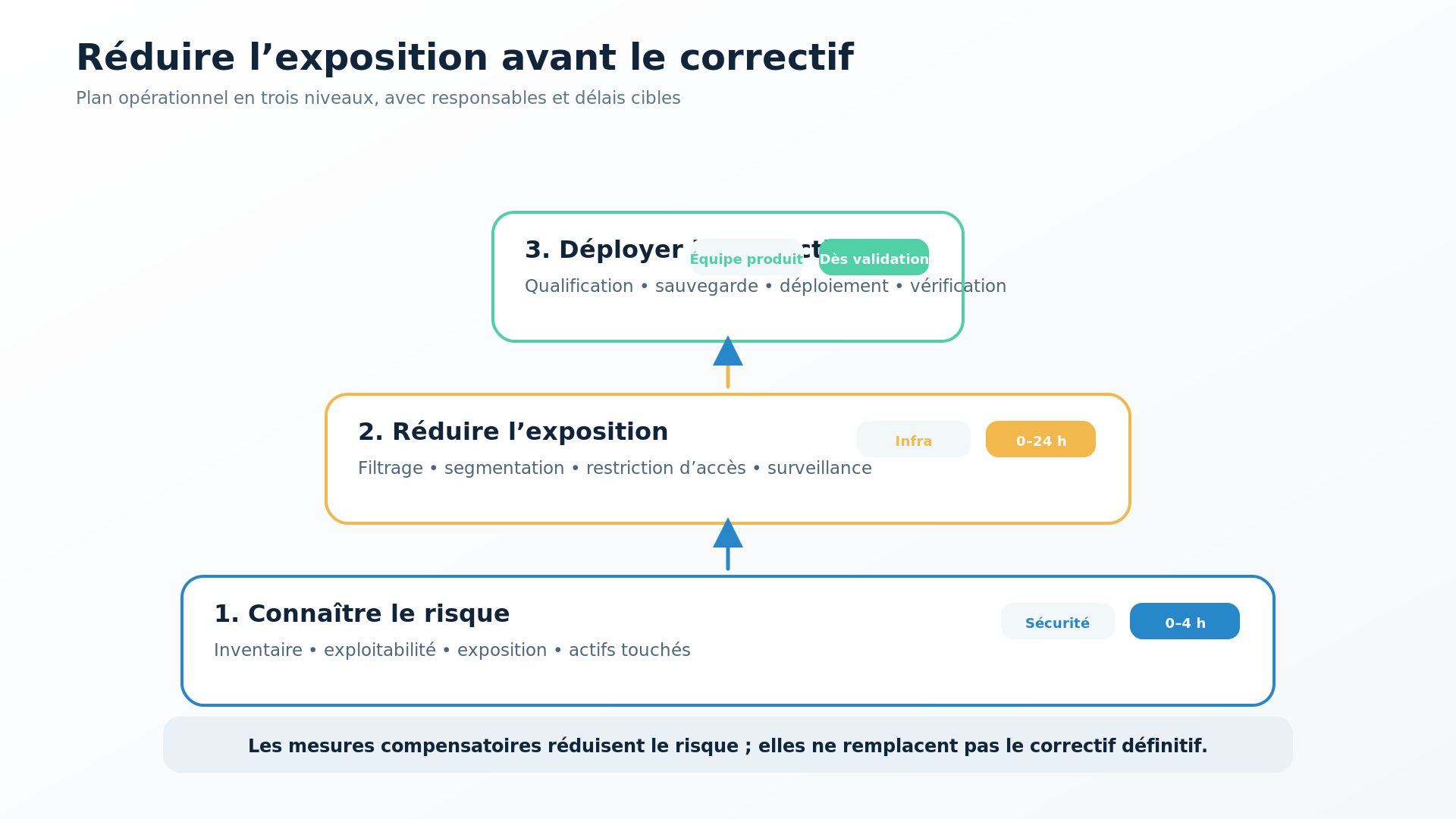
During the first hour, qualify the source, affected versions and exploitation conditions. Open a single incident, appoint a lead and prevent decisions from being scattered across multiple channels.
Within four hours, identify the assets that are actually exposed. Activate the simplest reversible measures: restrict access, close an endpoint, rotate a risky secret, reduce privileges and collect logs more extensively. Preserve evidence of the changes.
Within eight hours, reproduce the production version in a pre-production environment, apply the patch and run critical user journeys. Tests must cover authentication, permissions, data flows, asynchronous tasks, integrations and functions directly related to the corrected component.
Before twenty-four hours have passed, make an explicit decision: deploy the patch, maintain temporary compensating controls or stop the service. Each option must have a review date and an owner. A temporary measure without a deadline quickly becomes invisible debt.
7. Organizing the return to normal operation
After deployment, verify that the version actually running matches the expected version. Clear the necessary caches, restart the relevant workers and check for instances still using an old image. A partial update can preserve the risk even though the ticket is marked resolved.
Temporary controls must then be removed with the same rigor used to add them. An overly broad WAF rule, an improvised allowlist or a feature block can cause incidents weeks later. Keep what represents a lasting improvement — segmentation, least privilege and observability — and remove what was only emergency protection.
Finally, conduct a post-incident review: detection time, mapping delay, time to put protections in place, test coverage, patch time and coordination difficulties. Actions should feed the maintenance backlog, not merely a forgotten report.
This approach aligns with our method for taking over maintenance of a business application in ninety days: regain control of the environment before the emergency forces risky choices.
8. Indicators that truly measure risk
The raw number of open vulnerabilities is not enough. Measure the time between publication and identification of exposed assets, then the time needed to apply an initial exposure reduction. These two delays show the ability to react before the patch.
Also track the proportion of critical applications with a faithful pre-production environment, a tested rollback, a named owner and documented network rules. A company that fixes quickly once but depends on one person or improvisation remains fragile.
For each incident, record how long the service remained accessible in its vulnerable configuration, the scope of potentially reachable data and privileges, and the verified effectiveness of compensating controls.
The real objective is not to display a spectacular average time. It is to make the period between disclosure and correction understandable, controlled and as short as possible.
Conclusion
The shrinking patch window makes it necessary to complement patch management with an immediate ability to reduce exposure. The network, identity, segmentation and application gateways can limit attack paths during testing, provided the rules are targeted, observable and temporary.
A mature organization does not choose between “patching” and “protecting”. It first protects what cannot yet be fixed, then deploys definitive remediation within an explicitly tracked timeframe. Partitech supports application-estate audits, the construction of incident runbooks, the implementation of test environments and the industrialization of secure deployments.