






The Cl0p extortion group claimed in August 2026 to have stolen data from numerous organizations using PTC Windchill or FlexPLM. Reuters reports nearly fifty claimed victims, while noting that the scale could not be independently verified. PTC updated its advisory on August 20 and 26 with two new CVEs and indicators of compromise. The incident mainly illustrates a recurring problem: between the release of a patch and the actual reduction of risk, there remains the inventory, deployment, and search for compromise.
1. What is confirmed and what remains claimed
The U.S. authorities have issued several advisories regarding critical vulnerabilities in PTC Windchill and FlexPLM. It is necessary to distinguish the CISA ICS advisory of March 26, 2026, dedicated to CVE-2026-4681, of vulnerability CVE-2026-12569 added to the catalog of known vulnerabilities actively exploited on June 25, 2026. This second entry imposes on the relevant federal agencies a remediation deadline set for June 28, 2026.
Reuters reports that Cl0p then claimed to have stolen data from nearly fifty organizations, including large companies. The agency could not independently confirm the nature or extent of all the intrusions. Some companies said they had contained an attempt or found no evidence of a breach of customer data, while others were continuing their investigations.
It is therefore incorrect to present fifty compromises as an established fact. The signal nonetheless remains serious enough to trigger an immediate check in any organization running the affected versions.
2. A timeline that should alert operators
PTC released remediation measures on June 17, 2026, followed by patches for several versions starting on June 18. CISA added CVE-2026-12569 in the KEV catalog on June 25. An industry organization then raised an alert in July about an exploitation attributed to Cl0p, before the public claims reported by Reuters on August 13.
After the initial editorial check, PTC added on August 20 the CVE-2026-77645 and CVE-2026-77646 In his opinion, a new compromise indicator was then published on August 26. An organization that had only dealt with the first CVE must therefore review the opinion in its current version and broaden its search.
This sequence shows that the window between the initial alert and large-scale exploitation can be short. A critical vulnerability exposed to the Internet cannot wait for the usual monthly cycle when proof of exploitation exists.
The correction time frame must be related to exposure and impact, not just the CVSS score. A system containing design, supplier, or product data deserves an emergency procedure.
3. Why PLM applications are valuable targets
A PLM centralizes lists of materials, plans, documents, suppliers, versions, and validation processes. This data can have high industrial, commercial, and regulatory value.
The application is often integrated with the directory, document storage, ERP tools, and external partners. A compromise can therefore be used for exfiltration, pivoting, or credential harvesting.
Finally, these platforms have a long lifespan and many customizations. The fear of breaking a connector can slow down updates, creating an advantage for the attacker.
4. The trap of 'correction applied, incident over'
Installing a patched version blocks a known future exploitation. This does not prove that the system has not been compromised beforehand. If the attacker created an account, uploaded a file, obtained a token, or extracted data, the patch does not remove these effects.
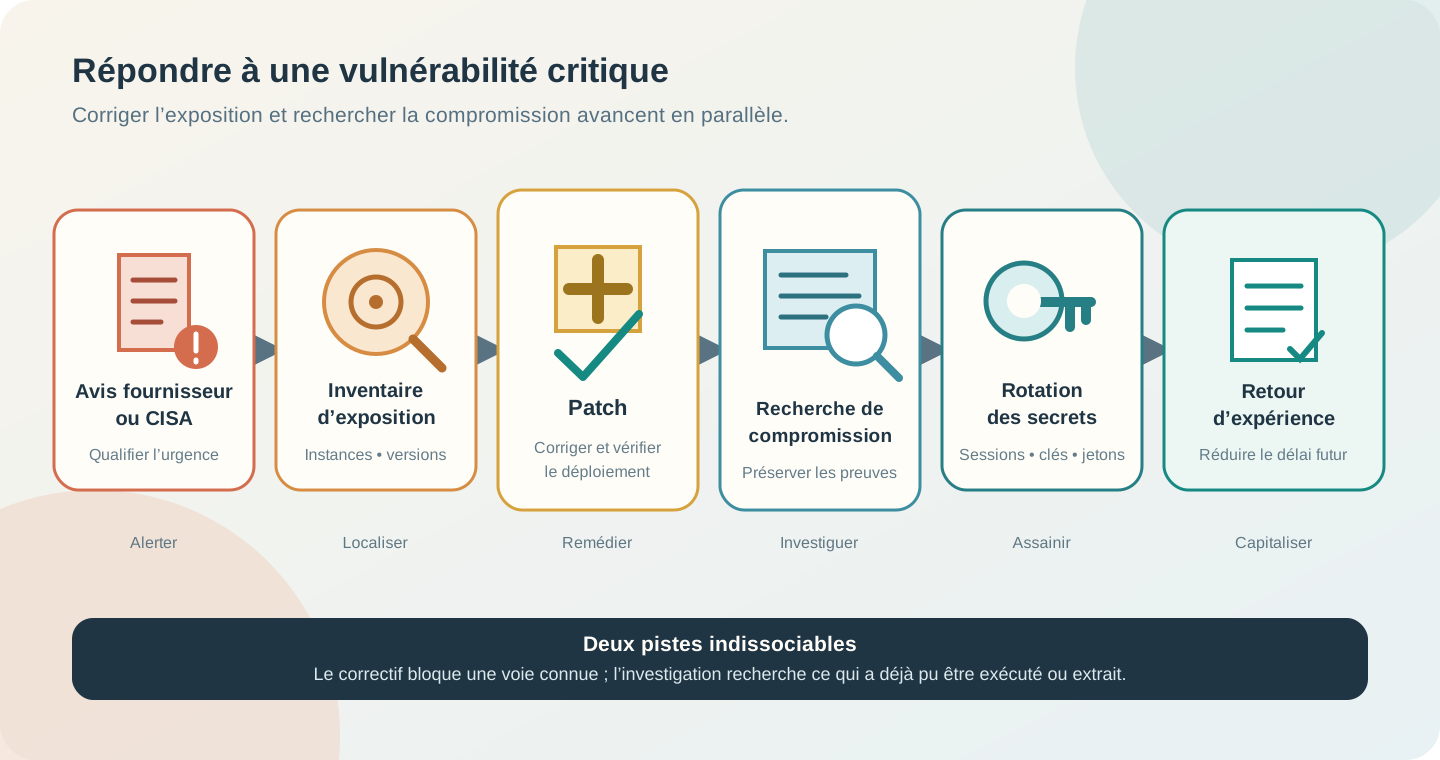
A complete response involves two parallel tracks: remediation of the vulnerability and investigation of compromise. The logs must cover the period prior to the notice, within the limits of their retention.
It is also necessary to check the secondary nodes, reverse proxies, file services, technical accounts, and integrations. A patched application can continue to use a stolen secret.
5. Actions to be taken in the first 24 hours
Identify all instances, including test, preproduction, old URLs, and subsidiary environments. Confirm their version, exposure, and operational owner.
Apply the measures from the vendor and CISA. When an immediate patch is impossible, reduce exposure: network filtering, VPN access, disabling vulnerable features, or temporary isolation. These measures do not replace updating.
Preserve logs before rotation: proxy, web server, application, authentication, database, EDR, and network flows. Create a timestamped copy and document the chain of custody.
Start an initial search: account creations, unusual logins, abnormal queries, command executions, large archives, and outgoing transfers. The PTC update of August 26 notably adds the IP address 23.95.238.5. The notice also includes webshell paths under /Windchill/login/*.jsp, already documented in its previous versions; use the publisher's complete and current list rather than a fixed excerpt. Revoke sessions and secrets that are obviously exposed.
6. The search for compromise over seven days
Expand the analysis period beyond the date of the patch. Compare access to a baseline and look for sequences rather than a single indicator: exploration, collection, compression, then exfiltration.
Examine privileged accounts, API tokens, service keys, and connections with the ERP or storage. A valid authentication is not reassuring if the credential has been stolen.
Check the integrity of the deployed files and extensions. On a customized platform, compare with a reference artifact or the code repository. Inspect scheduled tasks and persistence mechanisms.
If a compromise is plausible, involve an incident response team capable of analyzing without destroying evidence. Inform the DPO and legal officers according to the data and jurisdictions concerned.
7. The structural measures over thirty days
Build a live inventory of exposed applications, versions, owners, and dependencies. Each security notice must be able to be automatically matched to this inventory.
Define correction SLAs by risk level, with a time-limited exception procedure. An exception must include a compensatory measure, an owner, and an end date.
Improve telemetry: sufficient retention, centralization, alerts on outgoing volumes, and visibility on technical accounts. Test the restoration and rotation of secrets.
Finally, reduce permanent exposure. A portal used by a few partners does not necessarily need to be open to the entire Internet. Segment the application and limit the flows to internal systems.
8. Communication in case of extortion
A claim page is not complete evidence, but it should not be ignored. The organization must establish the facts, preserve evidence, and coordinate security, management, legal, communication, and insurance.
Avoid absolute statements until the analysis is complete. Distinguish what is confirmed, what is under investigation, and the measures already taken. This precision protects credibility and helps clients assess their own risk.
In the case of personal data, the notification obligations depend on the nature of the breach and the risk to individuals. The timeframes require having prepared the process before the incident.
9. Lessons for any business application exposed
Teaching goes beyond PTC. CRMs, extranets, HR tools, EDM, and custom applications follow the same mechanism: a critical dependency, a forgotten instance, and an automated operation.
Security maintenance is not just about "doing updates." It connects monitoring, inventory, pre-production, testing, emergency deployment, detection, and feedback. That is also the reason why a resumption of structured maintenance start by mapping what exists.
Organizations that already had an owner, an inventory, and logs were able to respond quickly. The others had to start by figuring out where the application was at the very moment they had to determine whether it had been compromised.
Partitech supports the securing and recovery of business applications: exposure inventory, emergency update, code and configuration audit, centralization of logs, remediation plan, and industrialization of maintenance.