




When an AI use case is validated, the company must choose a path. A SaaS solution promises a quick launch. A configurable platform offers more control. A custom development allows precise integration of data, rights, and processes. In practice, the best response is often hybrid: using existing models and components while building the business layer that differentiates the organization.
The decision should not be made based on a demonstration or a list of features. It should compare the value, the risks, the total cost, and the ability to scale.
Define what must be differentiating
A generic feature like summarizing a text or transcribing audio does not necessarily justify full development. On the other hand, an assistant that understands its own rules, reproduces complex rights, and operates in multiple applications can become a strategic capability.
It is necessary to distinguish:
- generic capability of the model;
- data and company context;
- business workflow;
- integrations;
- controls and policies;
- user experience;
- exploitation and evaluation.
The more value is concentrated in the final layers, the more the company must retain control over it.
Four options, not two
Ready-to-use SaaS
The product covers a standard need with a managed interface, integrations, and operation. The timeframe is short and the initial cost low. Customization, transparency, and portability may be limited.
Configurable platform
A platform provides models, RAG, agents, security, and observability, then allows configuring sources and workflows. It accelerates industrialization, but can create a deep dependency on its data model and its connectors.
Custom development
The organization designs orchestration, experience, integrations, evaluations, and policies, while often using external or open models. It controls the trajectory but takes on more engineering and operations.
Hybrid architecture
A market solution can provide generic capability, while an internal layer manages identity, data, rules, and reversibility. This is often the most realistic compromise.
The twelve decision criteria
1. Business differentiation
Is the process common in the market or does it constitute a unique advantage?
2. Data
Are the sources standard, sensitive, scattered, or subject to fine rights?
3. Integrations
Is a superficial connection enough, or is it necessary to orchestrate transactions, errors, and retries?
4. Deadline
What date produces real value, and not just a simple demo?
5. Quality
Does the product allow testing real cases, adjusting behaviors, and preserving evidence?
6. Sovereignty
Where does the data go, who chooses the model, and which dependencies are acceptable?
7. Safety
Can identity, permissions, auditing, and limits be applied according to internal policies?
8. Operation
Who supervises, handles incidents, updates, and responds to users?
9. Volume
Is the business model suited to peaks, long tasks, and growth?
10. Evolution
Can we change the model, prompt, source, or workflow without waiting for the editor?
11. Skills
Can the company or its partner take responsibility for the product, data, development, and security?
12. Reversibility
Can conversations, index, evaluations, configurations, and data be exported and reused?

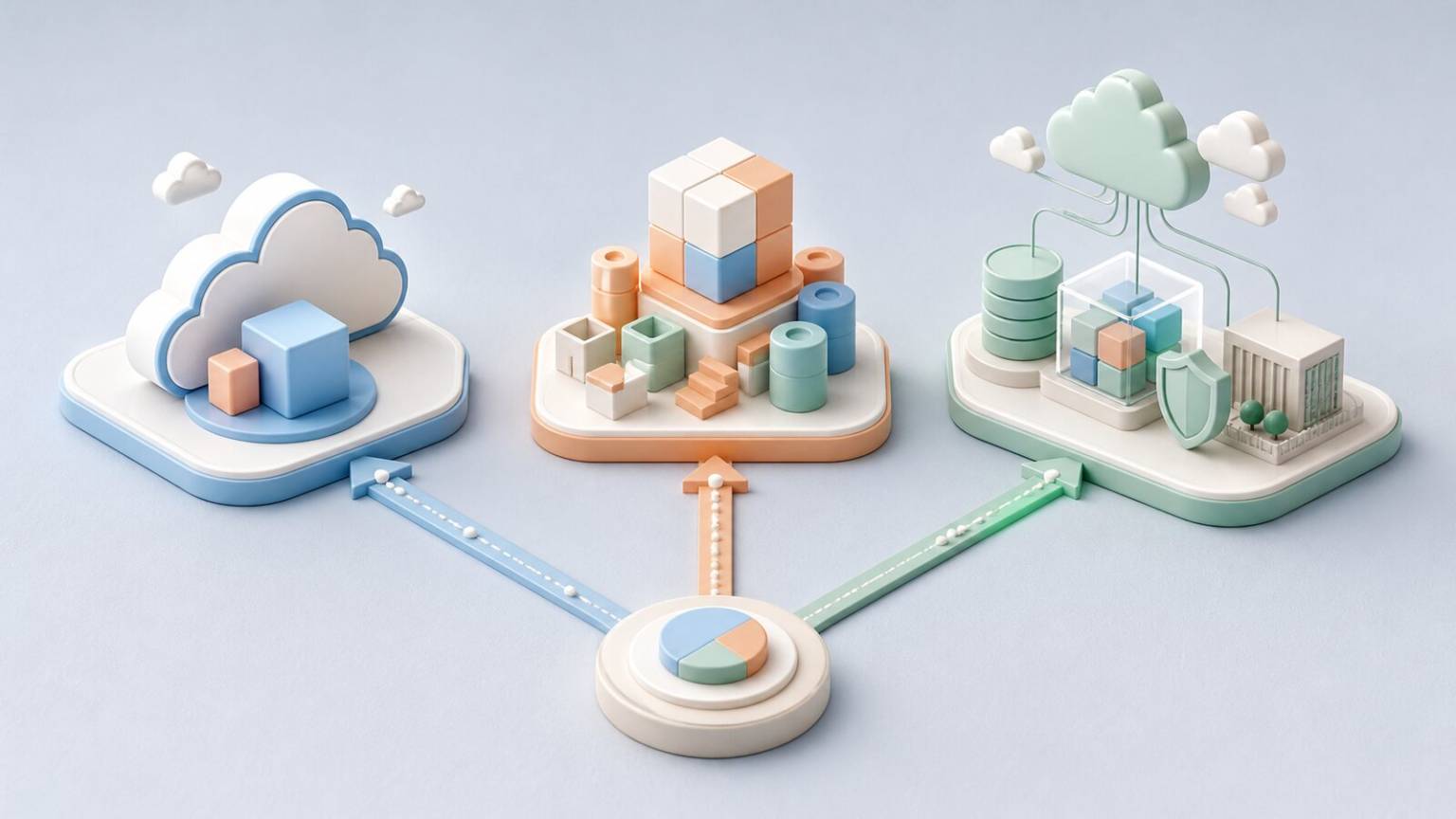
The generic layers of an AI assistant are distinguished from differentiating data, processes, and controls.
Evaluate a market solution
A demonstration must be replaced by a pilot on real data and users, within an authorized scope. The evaluation covers:
- quality on a case set;
- rights;
- quotations and traceability;
- latency;
- cost;
- administration;
- integration;
- export ;
- error behavior;
- support.
The contractual documentation confirms retention, training, subcontractors, region, availability, and change notification.
Identify the supplier lock-in
Lock-in is not just a proprietary API. It can come from a knowledge format, a workflow studio, a conversational memory, connectors, or evaluations that are impossible to export.
For each layer, ask:
- output format;
- stable identifiers;
- API contract;
- quotas ;
- migration procedure;
- exit cost;
- behavior after termination.
An internal adaptation layer can protect critical interfaces, without trying to hide all the differences between products.
Calculate the total cost
Costs of a purchased solution
License, consumption, connectors, environments, premium support, storage, overruns, and integration.
Custom-made costs
Framing, UX, development, security, testing, infrastructure, models, observability, maintenance, and possible on-call duty.
Common costs
Data preparation, change management, human validation, governance, evaluation, and user support. They exist regardless of the choice and are often underestimated.
The TCO must be calculated over several usage scenarios and three years, with a cost of change.
Bespoke does not mean rebuilding everything
A specific project generally uses existing building blocks: models, vector database, framework, storage, identity, or monitoring. The value of development lies in the assembly, the business, the policies, and the experience.
It is necessary to avoid recreating a mature standard function. The architecture defines the boundaries between purchased components and internal property.
SaaS does not mean lack of integration
Even a ready-made solution must receive the right data, respect rights, and fit into the process. Generic connectors rarely cover the exceptions, recovery, and traceability required for critical use.
The team must plan for support, accounts, configurations, security reviews, and version changes.
Design a hybrid architecture
A typical approach may combine:
- models accessible via API or self-hosted;
- internal gateway for routing and policies;
- controlled data pipeline;
- RAG and own permissions;
- interface integrated into the business software;
- observability and internal evaluations.
The company retains the data, the tests, and the decisions, while benefiting from the innovation of model providers.
Testing the ability to evolve
The pilot must include a voluntary change: replace the model, modify a source, add a rule, or export the data. This exercise reveals rigidity before commitment.
The performances are compared on the same set of cases, with the same metrics. The results are documented, not just observed during a meeting.
Organize the responsibility
A purchased product still has an internal owner. This person manages the usage, rights, budget, incidents, and vendor relationship. Custom development requires a team or a partner responsible for the lifecycle.
The decision must specify who assumes each layer, including after the launch.
Choose a reversible trajectory
An initial version can use a SaaS to validate adoption, then extract a business layer. Conversely, an internal foundation can integrate a specialized product. The roadmap must preserve useful data, evaluations, and contracts.
The right choice is the one that delivers value with a proportionate level of control and a possible outcome.
Partitech can conduct the benchmark, build the comparative pilot, design the hybrid architecture, and develop the business layers. The goal is to invest where the company differentiates itself and to buy what can remain standard without creating excessive dependency.
Let's talk about your project
Align your build, buy, or hybrid strategy with Partitech. Contact Partitech.