






The Symfony AI project announced on August 13, 2026, the creation of a dedicated Core Team. This development does not instantly transform each component into a mature building block, but it serves as an important governance signal for companies wishing to integrate models, agents, or RAG into an existing PHP application.
1. A governance step, not just a simple title change
Symfony AI was launched in July 2025 to offer abstractions and integrations suitable for Symfony applications. A year later, the project announces a core team composed of Christopher Hertel, Oskar Stark, Johannes Wachter, and Fabien Potencier.
The creation of a Core Team clarifies who arbitrates the directions, reviews sensitive contributions, and maintains long-term consistency. For a company, this clarity is almost as important as the list of features. A critical open source dependency must have an identifiable decision-making process, responsible parties, and the ability to manage compatibility breaks.
This change brings Symfony AI closer to the governance model that has been the strength of the Symfony ecosystem. However, structured governance should not be confused with a contractual guarantee of stability.
2. What the project figures reveal
The Symfony announcement reports more than 90 packages, over 160 contributors, around 3,800 commits, and 1,600 merged pull requests. These figures reported by the organization show significant activity and an already large scope; they do not constitute an independent audit of the project's maturity.
They also indicate a risk: more than 90 packages represent many API surfaces, dependencies, and version combinations. A team should not 'adopt Symfony AI' as a single indistinct block. It should select a minimal subset corresponding to its need: model provider, tools, storage, observability, or agentic protocol.
The volume of contributions is not a direct measure of maturity. Good indicators are the stability of the interfaces used, the frequency of releases, the quality of tests, the documentation of migrations, and the ability to replace a provider without rewriting the business logic.
3. What a Core Team really improves
A core team can accelerate cross-functional decisions and prevent each integration from developing its own conventions. It can also strengthen the review of changes that affect security, message formats, serialization, or compatibility between providers.
It also provides a reference point for package maintainers. In an ecosystem as fast-moving as AI, vendor APIs often change. Clear governance helps decide what should be absorbed into a common abstraction and what should remain specific.
Finally, the Core Team can make the roadmap more readable. For companies, this visibility makes planning easier: adopting a feature now, waiting for stabilization, or temporarily isolating a component behind an internal interface.
4. What it does not guarantee
The creation of a Core Team does not mean that all packages are ready for critical use. Some may remain experimental, change quickly, or not receive the same level of maintenance.
It does not protect against external developments either. A provider can change its models, pricing, limits, retention policy, or API format. A vector database can evolve its indexing. An agentic protocol can introduce new security constraints.
Finally, Symfony AI does not replace user project governance. Permissions, accessible data, logs, evaluations, and human validation mechanisms still need to be designed. Our article on AI agents connected to the information system details this responsibility.
5. Why PHP remains relevant for AI applications
The essence of an enterprise AI application does not consist of training a model. It is necessary to authenticate users, apply permissions, retrieve data, orchestrate calls, manage errors, trace decisions, and integrate business processes. PHP and Symfony are perfectly suited for this application layer.
Using the existing stack avoids creating a Python microservice just because the word 'AI' appears in the requirement. A separate service is still relevant for scientific processing or a library unavailable in PHP, but it should not become an architectural reflex.
Symfony already provides the service container, Messenger, cache, security, the Serializer, events, and testing tools. Symfony AI can integrate into this environment instead of imposing a second operating platform.
6. The architecture to prioritize
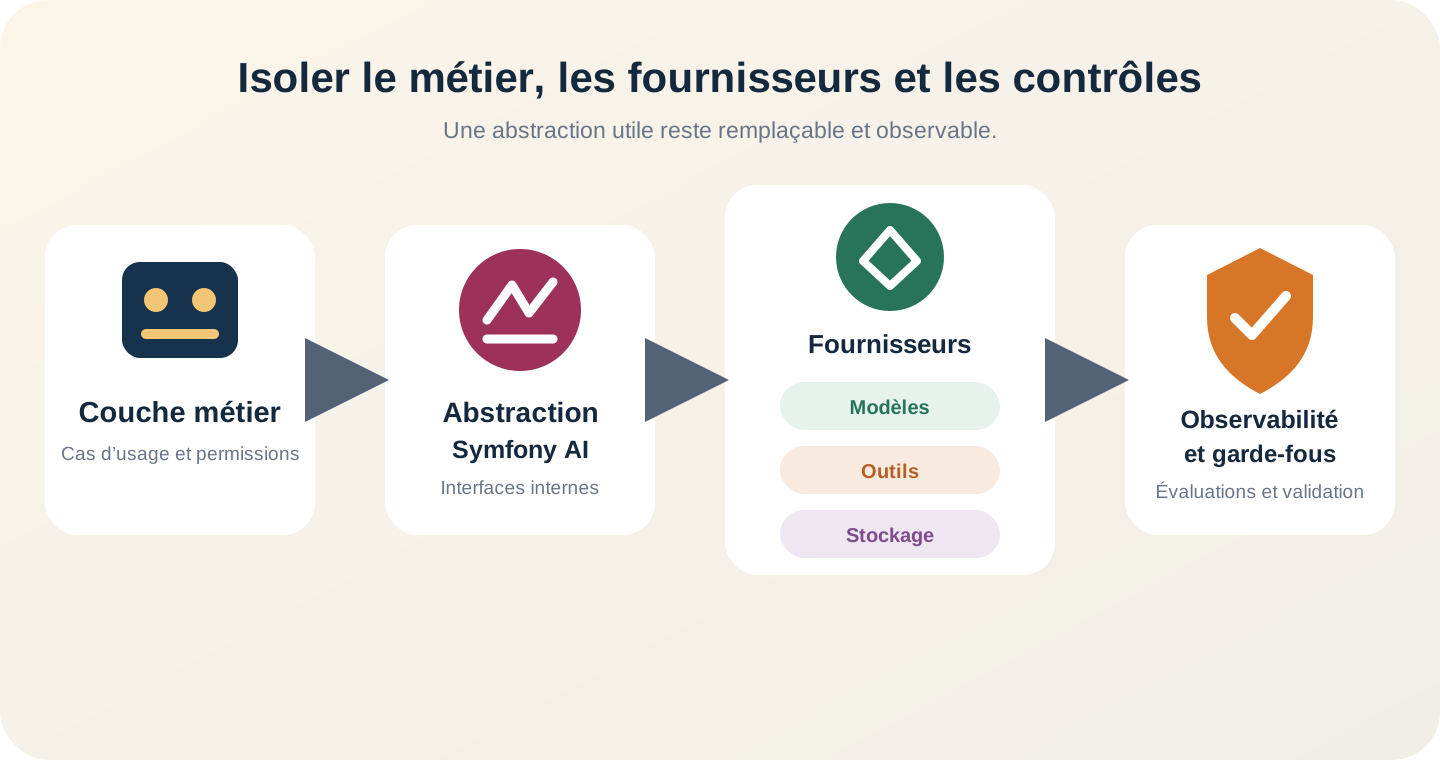
The business logic should never directly call multiple vendor SDKs. Create an internal interface corresponding to the need: classify a document, produce a sourced response, extract fields, or propose an action. The Symfony AI implementation remains behind this boundary.
Then keep four separate layers: context preparation, model call, result validation, and possible execution of an action. This separation simplifies testing and prevents a textual response from being automatically treated as authorization.
Observability must record the model, the prompt version, the tools used, the duration, the cost, the errors, and the final decision, without unnecessarily logging personal data. Evaluation datasets must be versioned in the same way as code.
Finally, prepare an exit strategy. It can be simple: a second supplier tested each month, an internal message format, and the absence of proprietary objects in the business domain.
7. A decision grid before adoption
Evaluate each package according to its version, its experimental or stable status, its maintenance frequency, its test coverage, and its dependence on third-party components. Also check the quality of the documentation dedicated to errors, delays, streaming, and quotas.
From a functional perspective, ask yourself whether abstraction brings real value. For a single very simple call, the official SDK may be sufficient. For multiple models, tools, RAG, or orchestration integrated into Messenger, Symfony AI becomes more interesting.
From a security standpoint, test size limits, malformed content, timing, responses that do not conform to the schema, and injection attempts. A practical abstraction does not exempt from in-depth verification.
8. A 90-day experimentation plan
The first month should be used to choose a limited and measurable use case, to define an evaluation set, and to set up logging. The second allows for comparing two providers, testing errors, and integrating human validation. The third should check operations: costs, alerts, recovery, security, and deactivation procedure.
At the end of this period, the team should be able to answer three questions: does the service create measurable value, is its behavior sufficiently controlled, and can it be evolved without excessive coupling?
The creation of the Core Team makes Symfony AI more credible as a strategic option. The right decision remains, however, a gradual adoption, focused on the necessary components and framed by the same requirements as any other critical dependency.
Partitech supports companies in designing AI architectures integrated with Symfony, from the evaluated prototype to deployment, with data governance, observability, and vendor management.