





You receive a text intended for your site. Its record indicates that an assistant prepared a first version, then that someone reworked it. Could we find this origin by analyzing only the final text? The announcement from OpenAI provides a new tool to explore this question. It does not exempt you from keeping the writing history. In the fictional scenario of this article, you prepare a help sheet in French and seek to document its production without confusing technical evidence, accuracy and responsibility.
What is announced on October 5
On October 5, 2026, OpenAI opens an optional watermark for certain models of its API, disabled by default. Watermarking eligible outputs from ChatGPT and Codex in the European Union will follow in the coming weeks. Initial access to the detector is aimed at researchers and approved expert organizations. An API allows your application to call a service.
This distinction suggests three different questions for your team: Can your app request marked text? Do you have authorized access to verification? Do you know how to keep the declared origin even without a detector? Answering the first does not solve the next two. As of October 6, it is better to enter the exact status of each step in your project sheet than to present a feature announced as an already integrated service.
The word “provenance” here designates the path of content production. It may include automatic preparation, information selection and human review. Your help sheet already has a provenance when you log these steps. The interest of a technical signal would be to complete this description ; documenting your work remains useful before and after its arrival.
Understand what a signal can do
The method textGrain statistically marks word choices. According to OpenAI, detection remains fallible, particularly after modification or translation and on short texts. It establishes neither truth, nor identity, nor ownership or responsibility. Its absence does not prove human writing.
To represent the statistical concept, imagine two sets of texts: one produced with marking, the other without. Some characteristics might be more common in the first set. The sets can, however, overlap. This image is a conceptual explanation proposed by Partitech, not a reproduction of the algorithm. The proximity of a text to one of these sets does not tell the whole story of its individual journey.
In our fictitious help sheet, someone corrected an incorrect step and added clarification from the product. The final text may be relevant or incorrect regardless of detection. To check its contents, you must check the instructions in the product. To find out about its validation process, you must consult the editorial sheet. These questions call for different proofs.
A false positive consists of detecting a signal when it was not present. A false negative is missing a present signal. The cost of both errors depends on your usage. An internal indication intended to request a rereading does not produce the same consequences as a public accusation. Our editorial recommendation is to limit the first integration to a tool to support review, with an explicit possibility not to conclude.
Prepare an evaluation before seeking a verdict
The following protocol is a Partitech proposal. It has not been executed and provides no performance results. Its objective would be to determine in which cases your team can interpret a result, with an authorized corpus and a known reference truth.
Start with texts whose production is documented. Provide sheets written by people without generative assistance, versions from a marked generation when this option is actually accessible and revised variants. The origin must be known through the creation process, never inferred from the detector you are evaluating. Otherwise your test would go in circles: the tool would be used to create its own expected response.
Keep text families separate: French and other useful languages, short and long passages, free content and constrained formulations. A troubleshooting sheet consisting mainly of button names bears little resemblance to a long explanatory article. If you mix everything up, a satisfactory average can hide an unusable category. Also set the length with a constant unit; do not equate a number of words with a number of processing units of the model.
The transformations are used here to reproduce the editorial cycle: correction of a sentence, shortening for an interface or authorized translation. Record their purpose and author. This approach evaluates your usual documents; it does not aim to organize the concealment of an origin.
| Proposed case | Known origin | Transformation declared | Detector access | Result and interpretation |
|---|---|---|---|---|
| Initial French sheet | To be documented at creation | None | To be confirmed | To be completed after testing |
| Revised French sheet | Same starting document | Business proofreading | To be confirmed | To be completed separately |
| Summary for an interface | Same starting document | Shortening | To be confirmed | To be completed separately |
| Authorized translation | Same starting document | Translation | To be confirmed | To be completed separately |
| Human control | Documented human process | Usual proofreading | To be confirmed | To be completed separately |
Do not indicate “no watermark” when the call was not possible. Write “not tested” and its reason. A network error, no authorization, and a negative output are three separate observations. Keep the raw output in a protected space, along with the tool version and date. The summary must specify the number of cases actually controlled and the number of cases excluded.
Define the decision before reading the results
Before testing, write the sentences allowed in your product. For example: “A signal associated with marking has been detected; the editorial history remains to be consulted.” Or: “No interpretable results are available for this document.” This prevents a score from being automatically translated into a broader conclusion.
Also define the criteria for abstention. A document without a reference origin, a language absent from the protocol, a passage too distant from the cases evaluated or an unknown version of the tool justify a review. Abstention means that your system retains visible uncertainty. It does not designate the fault of a person and should not produce a sanction by default.
For the help sheet, the publication decision can remain simple: a person checks each step, confirms the source of the content and validates the final version. The provenance check has its own status. An incident on this tool does not have to remove the proof of a proofreading already carried out; a positive detection cannot create a review that never happened.
Keep a minimal production log
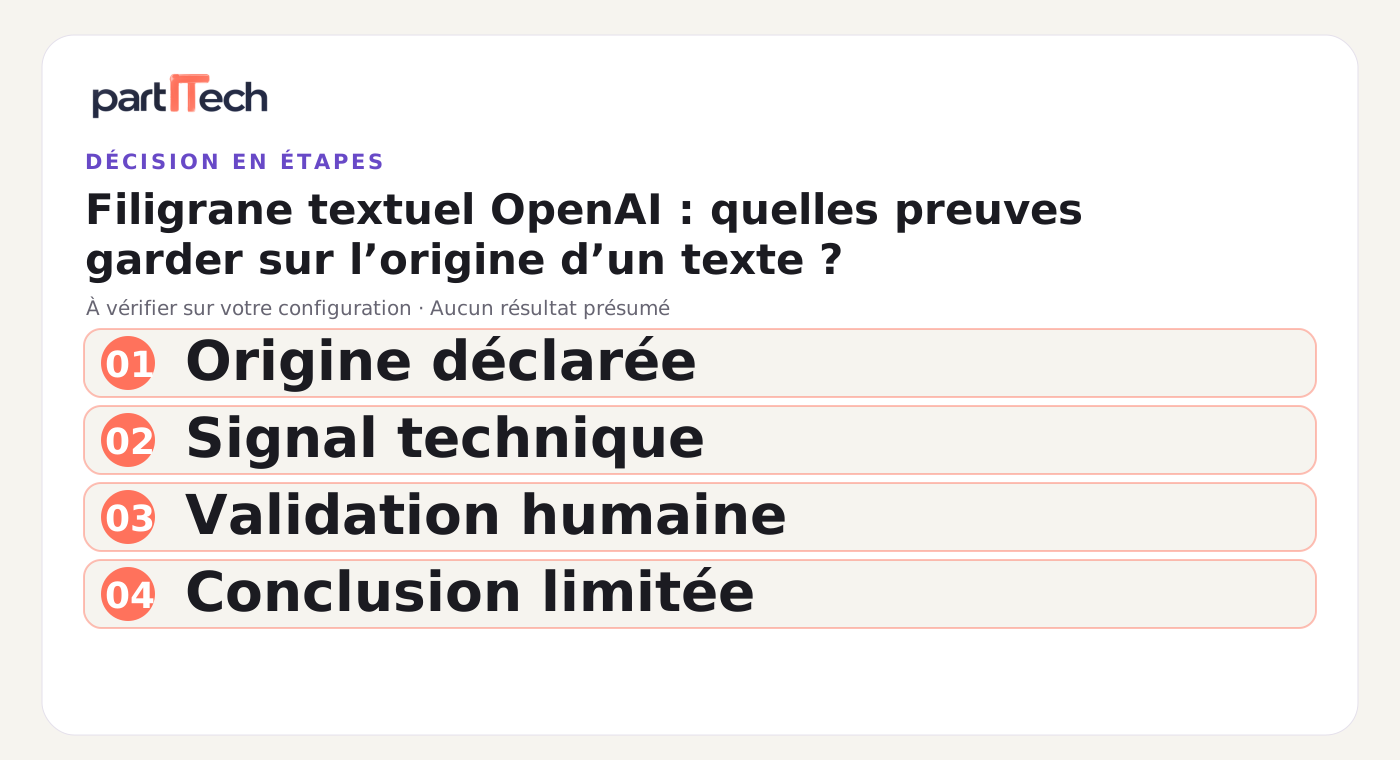
Here is a conceptual organization that your team could adapt to its editorial tool. Each version of the document retains a declared origin, a creation date, the model and its version when known, the requested state of the marking, the transformations and the person responsible for validation. The possible control has a date, a tool, a protected output and a limited conclusion.
Link the validation to the exact version of the text. If a sentence subsequently changes, you need to know whether the rereading remains valid. In our example, replacing the name of a button may require targeted verification; changing a handling instruction may require a new validation. A clear rule helps more than a “checked” stamp attached to the document forever.
This journal does not require keeping any conversations with an assistant. Our proposal consists of keeping only the elements necessary for editorial monitoring, with defined access rights and duration. Sensitive texts and detailed results can remain in a reserved space; the public page can receive short and understandable information about its preparation. Have this information decided by those responsible for the content, according to its use.
Linking technology to transparency obligations
The European Commission distinguishes marking and detection on the supplier side from disclosure on the deployer side depending on usage. It indicates that the code of good practice is voluntary, while the relevant transparency obligations have applied since August 2, 2026. The October announcement therefore does not constitute a new date of entry into force.
For your project, map the usage, audience, editorial responsibility and evidence retained before choosing a tool. This is a method of preparation, not personalized legal advice. An activated button provides technical information; it does not on its own complete your compliance file.
The reasonable decision today is to document your writing cycle and prepare a bounded test if you get authorized access. Start with a family of files, formulate the permissible conclusions and check the separation between provenance and quality. Until French performance in your context is established, keep the detector as a clue to examine.
Sources and date of verification
Primary sources reopened and read on October 6, 2026: OpenAI, October 5 announcement on textual provenance ; European Commission, transparency code, page updated on July 31. The examples, the log and the protocol are Partitech proposals, without detector testing or claimed accuracy rate.