






A group that operates multiple sites often ends up facing the same dilemma. Each local team wants to maintain its autonomy, while management wants to reduce costs, harmonize the brand, accelerate deployments, and control security. A successful multi-site platform does not take sides. It makes clear what is shared, what can vary, and who decides.
The number of sites is not the only indicator of complexity. Three sites with regulations, catalogs, and independent teams can be more difficult to govern than thirty nearby institutional sites. The architecture must therefore stem from the organizational model, not just a 'multisite' feature of the CMS.
The four forms of pooling
The shared code
All sites use the same platform, the same components, and the same update cycle. This approach makes security and maintenance easier. It enforces a discipline of compatibility: an improvement useful to one brand must not break the others.
Shared services
Authentication, search, media, consent, analytics, forms, or directories can be shared even if the sites remain separate. This strategy is often more flexible than a single instance.
Shared content
Group information, a product, or news can be distributed across several sites. You need to choose between duplication, synchronization, and inheritance with local override. Without a clear rule, the variations become impossible to update.
Shared governance
Design system, SEO conventions, accessibility, security, publishing procedures, and indicators can be shared without imposing the same content. This organizational pooling is often the most cost-effective.
Three architectural models
A single multisite instance
A single installation hosts multiple sites. It simplifies deployment, the sharing of components, and sometimes contributor accounts. It increases the scope of impact: a configuration error or an update can affect the entire network.
This model is suitable when the sites share a strong functional foundation and when central governance is real.
A common foundation with separate bodies
Each site has its own environment or base, but the code, components, and industrialization are common. Isolation improves resilience and allows for different paces. Operating costs increase if automation is not up to standard.
A composable platform
The experiences are separate, while transversal services provide content, identity, search, or product data. This model supports a wide variety of channels, but requires an API architecture, observability, and mature contract governance.
Build the central/local matrix
For each area, a owner and a margin of variation must be designated.
| Domain | Central | Local | Mixed model possible |
|---|---|---|---|
| Infrastructure | standards and safety | rarely | capacity or residence by country |
| Code | base and components | framed extensions | modules validated by brand |
| Design | tokens and accessibility | campaigns | controlled derived subjects |
| Content | group information | local news | central source with adaptation |
| SEO | technical conventions | keywords and local pages | central models, local validation |
| Analytics | marking plan | local objectives | common collection, dedicated views |
| Support | platform | editorial animation | shared services center |
The matrix must be associated with a decision-making process: who proposes, who validates, who deploys, and who responds in case of an incident.
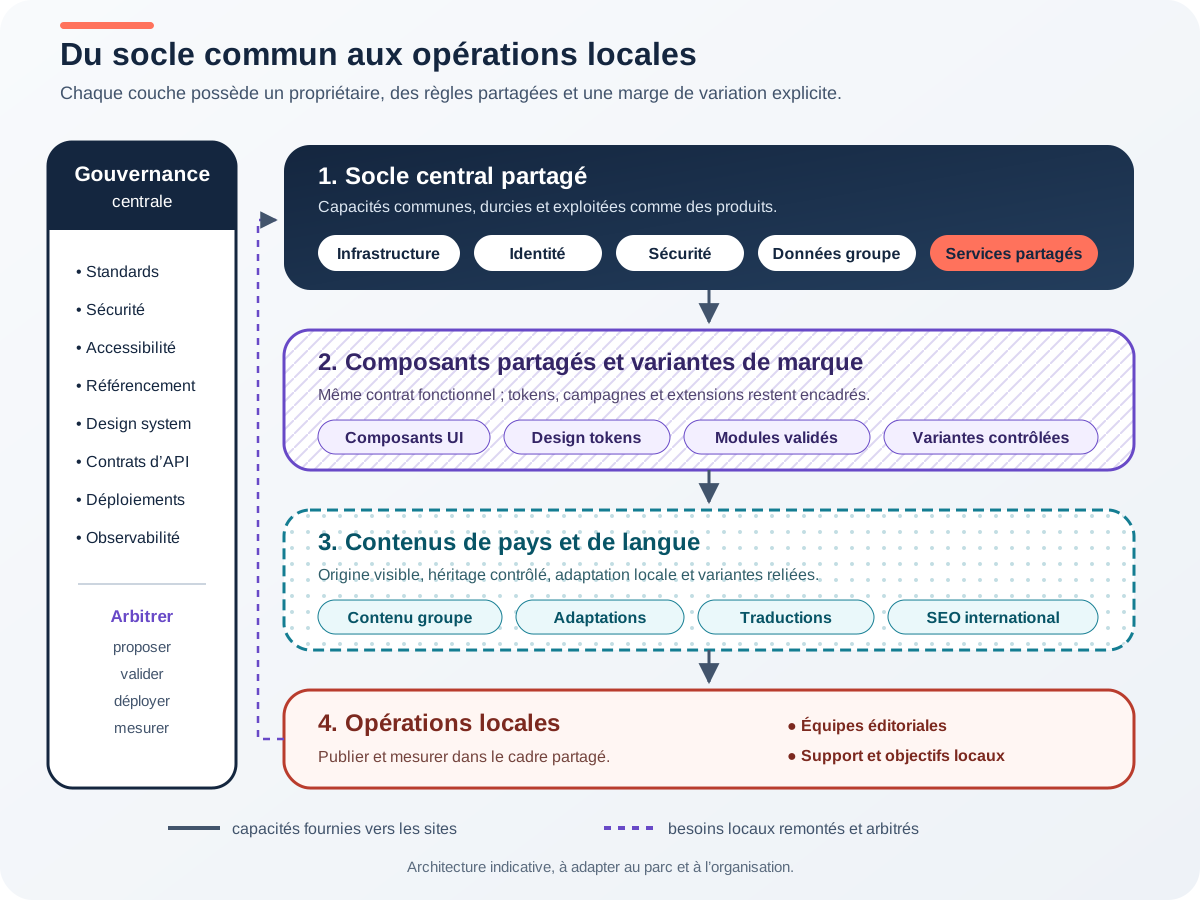
The diagram presents four connected layers. The central platform carries the infrastructure, common code, identity, search, as well as security, accessibility, and technical SEO rules. The brand layer applies the components, design tokens, and presentation rules without duplicating the foundation. The country and language layer combines group content with translations, regulatory adaptations, taxonomies, media, and local journeys. Finally, local operations cover contribution, support, campaigns, and objectives specific to each market. Governance flows bring local needs up to the center; validated components, data contracts, and standards flow down to all variants.
- From the center to the marks: The code, services, security requirements, and quality standards are common; each brand uses approved tokens and component variants.
- Tags towards countries and languages: Page templates and reference content are inherited, translated, or adapted according to an explicit rule.
- From countries to local operations: Teams publish authorized content, manage their campaigns, and apply local obligations within the prescribed boundaries.
- Local operations to the center: Incidents, component requests, indicators, and regulatory requirements feed the shared roadmap.
- Between all the layers: API contracts, identifiers, responsibilities, deployment rules, and observability measures make every exchange traceable.
Design a truly multilingual content model
A language should not be treated as an additional field placed on a page. Content may have different cycles, local regulations, and specific publication dates. Some elements are translated, others adapted, and others absent.
It is necessary to define:
- the translation unit;
- the link between variants;
- the source language;
- the translation and validation workflow;
- management of media and alternative texts;
- the behavior when a translation is missing;
- archiving and redirects.
Automatic translation can speed up a first version, but it does not replace the validation of business, legal, and cultural information.
Avoid uncontrolled duplication
Copying a page to ten sites is quick the first day and expensive afterward. When the shared content changes, no one knows which copies need to be corrected. Three models can be combined:
- central content not editable, identical everywhere;
- inherited content with local fields, for coordinates or obligations;
- fully local content, when the meaning actually differs.
Each template must clearly display its origin in the back office so that the contributor knows what they can modify.
The design system as a contract
A multisite network should not only share templates. It should share rules: typography, spacing, colors, components, states, accessibility, and responsive behavior. Brands can have tokens or variants without duplicating the component.
The governance of the design system must specify the procedure for adding an option, deprecating a component, and migrating existing pages. Without this discipline, each campaign creates a specific element and the common foundation becomes fragmented.
Deployment and compatibility
A shared platform must be able to answer four questions:
- which sites use a given version?
- Is an update compatible with all configurations?
- Can a patch be deployed on a subset?
- how to go back without losing the content?
Configurations must be versioned when the CMS allows it. Migrations must be automated and tested on representative copies. Risky features can be enabled by flag in order to organize a pilot.
SEO of a multilingual and multiregional ecosystem
The choice between domains, subdomains, and directories depends on the brand, the organization, and the operation. No structure compensates for weak content or poor governance.
The fundamentals are as follows:
- a stable URL per language and region;
- a coherent canonical, generally self-referential;
- annotations
hreflangreciprocals between equivalent variants; - complete and controlled sitemaps;
- redirects during structural changes;
- truly localized content;
- a navigation that does not force the user based on their IP address.
It is also necessary to avoid closely related pages competing with each other for no reason. A keyword and local page strategy must specify the intent specific to each market.
Analytics, consent, and compliance
A common collection facilitates comparison, but purposes, providers, and obligations may vary by country. The tagging plan must distinguish global and local dimensions, maintain stable event names, and document transformations.
The consent manager, policies, and retention periods must be integrated into the architecture, not added site by site after launch.
Exploiting without creating a central bottleneck
Total centralization can slow down teams. Service levels must be defined: platform incidents, component requests, local campaigns, site creation, new language, and regulatory changes.
A catalog of components, approved templates, clear documentation, and preview environments provide autonomy without sacrificing consistency. Local teams need to know what they can do on their own and how to request an extension of the foundation.
The indicators of a healthy platform
Beyond the number of sites, track:
- timeframe for creating a new site or a new language;
- share of components actually shared;
- deployment time of a global patch;
- number of specific variants;
- accessibility and performance compliance;
- obsolete common content;
- incidents having a cross-functional impact;
- satisfaction of local contributors.
These indicators reveal whether pooling generates savings or just dependence.
Sharing a foundation, preserving the ability to evolve
A sustainable multisite platform relies on an explicit architecture and experienced governance. It does not seek to standardize everything. It turns common elements into maintained products and gives local sites clear boundaries.
Partitech can intervene from the audit of an existing park to the design of the foundation, the design system, workflows, industrialization, and international referencing. The goal is to reduce the network cost while improving the speed and quality of each site.
Discover the Partitech reference dedicated to a multi-site architecture, our comparison WordPress, Drupal, Symfony or headless, the guide Core Web Vitals and performance budget and the analysis SEO, GEO and AI answer engines.
Official references
References consulted on August 17, 2026: