





LoRA or Full Fine-Tuning: Which Fine-Tuning Strategy Should You Choose for Your AI Models?
In a world increasingly dominated by artificial intelligence (AI), adapting language models to specific business needs has become a strategic issue for many companies. Transformer models, such as LLaMA, Mistral, Phi, Qwen, or GPT, are powerful tools capable of understanding and generating text, but they often require customization to meet particular requirements.
fine-tuning is one of the most effective methods for adapting these models to specific tasks or particular sectors, such as finance, healthcare, or even e-commerce. However, several approaches exist to perform this fine-tuning, each having its advantages and disadvantages. Among them, three stand out: LoRA (Low-Rank Adaptation), full fine-tuning, and fine-tuning with freezing of parameters (freeze weights).
In this article, we'll explore these three techniques in depth and help you understand which one is best suited to your fine-tuning needs. Whether you are a developer or responsible for digital transformation in a company, you will discover here the subtleties of these methods, illustrated by concrete code examples.
Fine-Tuning: Why and When to Use It?
Before diving into the comparison between LoRA, full fine-tuning, and weight-freeze fine-tuning, it's important to understand why fine-tuning is a key step in integrating language models into enterprise AI solutions. Large pre-trained models, such as GPT-4, LLaMA 3, or Mistral, are trained on billions of general data sets, but they are not always perfectly suited to specific domains. Here are some reasons why fine-tuning is crucial:
-
Adaptation to specific data: A company's internal data, whether textual data or specific interactions (e.g., conversations with customers), often differ from the data used for pre-training models. Fine-tuning allows you to train a model on this new data to improve its performance on specific tasks.
-
Error Reduction: In critical fields like medicine, finance or law, a model that is not finely tuned can make costly errors. Fine-tuning improves the accuracy of the model by taking into account the specific nuances of the domain.
-
Personalization of responses: For chatbot or virtual assistant type applications, it is important that the model generates responses consistent with the company's communication style. Fine-tuning allows you to adapt the tone, style and way in which responses are formulated.
LoRA: A Light and Effective Adaptation
LoRA (Low-Rank Adaptation) is a recent and innovative approach that was developed to address the challenges posed by fine-tuning very large models. LoRA is a fine-tuning method particularly suitable when you want to adapt a model to a specific task while minimizing the use of computing resources, particularly memory (VRAM) and computing power.
How does LoRA work?
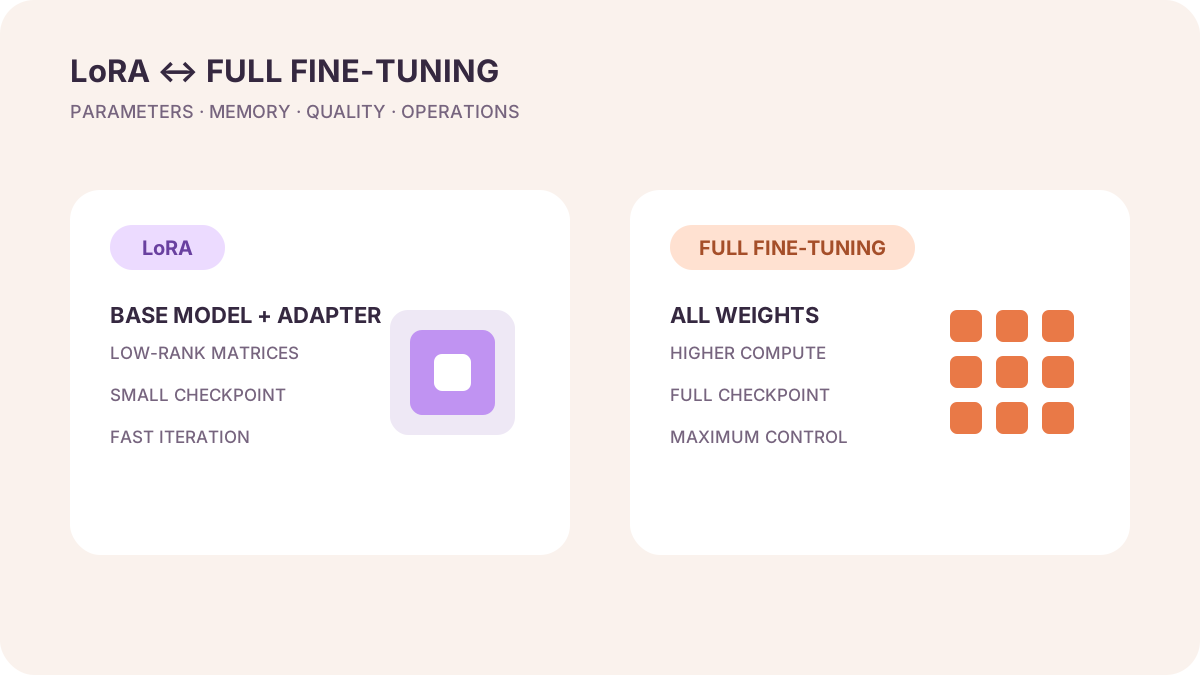
LoRA works by introducing low-rank matrices into certain layers of the Transformer model. Rather than directly modifying all model weights, LoRA inserts these matrices into specific modules (like Transformers projection layers) and trains only these new matrices. During this time, the original weights of the model remain frozen, preserving the general knowledge acquired during pre-training.
Here are the main features of LoRA:
-
Freezing main weights: The weights of the pre-trained model are frozen, allowing the knowledge acquired during the pre-training phase to be retained. This means that the model does not "unlearn" soft skills, a common problem in full fine-tuning when handled poorly.
-
Use of low rank matrices: LoRA matrices are light adjustments that allow the model to be specialized without having to modify a large part of the original weights. This method is particularly effective for integrating business knowledge while maintaining a reduced memory footprint.
-
Saving VRAM and Compute: As only small LoRA arrays are updated, VRAM usage is significantly reduced compared to full fine-tuning. This makes LoRA extremely performant for fine-tuning large models (like LLaMA) on machines with fewer GPU resources.
-
Prevention of overfitting: By limiting the number of parameters fitted, LoRA reduces the risk of overfitting, a phenomenon where the model becomes too specialized on the training data and loses its ability to generalize to new data.
Examples of LoRA Usage Scenarios
-
Chatbots and Virtual Assistants: Let's say you have a virtual assistant pre-trained on general data. You want to tailor it to more specialized conversations, like customer interactions in the insurance industry. LoRA makes it possible to specialize the assistant without losing its general language processing skills.
-
Internal Search Engines: If you are integrating an information retrieval augmented search (RAG) model for internal databases (for example, legal or technical documents), LoRA can help adjust the model to better understand and handle queries specific to your domain, while retaining its capabilities to handle general searches.
Example Code with LoRA
from peft import LoraConfig, get_peft_model
from transformers import AutoModelForCausalLM, AutoTokenizer, Trainer, TrainingArguments

# Charger le modèle pré-entraîné LLaMA et le tokenizer
model = AutoModelForCausalLM.from_pretrained("path/to/llama3")
tokenizer = AutoTokenizer.from_pretrained("path/to/llama3")

# Configurer LoRA avec des matrices de faible rang
lora_config = LoraConfig(
    r=8,               # Taille de la matrice de faible rang
    lora_alpha=32,      # Facteur de mise à l'échelle
    target_modules=["q_proj", "v_proj"],  # Modules cibles (couches de projection)
    lora_dropout=0.1,   # Dropout pour prévenir le surajustement
)

# Appliquer LoRA au modèle pré-entraîné
model = get_peft_model(model, lora_config)

# Préparer les données d'entraînement métiers
train_dataset = ...  # Charger ou préparer vos données métiers

# Définir les arguments d'entraînement
training_args = TrainingArguments(
    output_dir='./results',
    per_device_train_batch_size=8,
    num_train_epochs=3,
    logging_dir='./logs',
)

# Créer et lancer l'entraîneur (Trainer)
trainer = Trainer(
    model=model,
    args=training_args,
    train_dataset=train_dataset,
)

trainer.train()
Full Fine-Tuning: A Complete Adaptation, but More Expensive
full fine-tuning consists of training all weights of the model on the new data. This approach is often used when you need complete specialization of the model to a specific task. Unlike LoRA, where only a few parameters are adjusted, full fine-tuning updates the entire model, layer by layer.
Advantages of Full Fine Tuning
-
Maximum adaptation: Since all model weights are updated, full fine-tuning allows for complete specialization. This can be particularly useful in areas where the new data differs significantly from what the model was pre-trained on.
-
Better performance on very specialized tasks: For complex or highly specialized tasks, such as detecting specific anomalies or understanding complex technical texts, full fine-tuning allows the model to be adjusted at each level. This makes it a very powerful tool for applications requiring advanced expertise.
Disadvantages of Full Fine-Tuning
-
High resource consumption: The main disadvantage of full fine-tuning is its cost in GPU resources. As all parameters are updated, this method requires a large amount of VRAM, especially for large models like LLaMA or GPT-4. This may limit its use to companies with powerful GPU clusters.
-
Increased risk of overfitting: If the dataset is limited in size or very specific, full fine-tuning can cause overfitting. In this case, the model may lose its ability to generalize to more general tasks.
-
Longer training time: Full fine-tuning of large models can take several days or even weeks, depending on the size of the model and the volume of training data.
When to use Full Fine-Tuning?
Full fine-tuning is recommended when:
- You have access to significant GPU resources and enough VRAM to train a large model.
- You have a large volume of data specific to your domain and want the model to be completely readapted to this new data.
- You have highly specialized tasks where performance and precision are critical.
Example Code for Full Fine-Tuning
from transformers import AutoModelForCausalLM, AutoTokenizer, Trainer, TrainingArguments

# Charger le modèle pré-entraîné LLaMA
model = AutoModelForCausalLM.from_pretrained("path/to/llama3")
tokenizer = AutoTokenizer.from_pretrained("path/to/llama3")

# Préparer les données d'entraînement
train_dataset = ...  # Charger ou préparer vos données métiers

# Définir les arguments d'entraînement
training_args = TrainingArguments(
    output_dir='./results',
    per_device_train_batch_size=4,
    num_train_epochs=3,
    logging_dir='./logs',
)

# Créer l'entraîneur (Trainer)
trainer = Trainer(
    model=model,
    args=training_args,
    train_dataset=train_dataset,
)

# Lancer l'entraînement complet du modèle
trainer.train()
Fine-Tuning with Parameter Freeze: A Smart Compromise
fine-tuning with freezing of parameters, or freezing of weights, is an intermediate approach which consists of freezing certain layers of the model, while only allowing the training of certain others, generally the last layers close to the output. This method allows training to be limited to a small portion of the model, which reduces the memory footprint (VRAM) and computational resources required.
How does Fine-Tuning with Weight Freeze work?
-
Freeze the inner layers: Generally, the first layers of the model are frozen. These layers capture general information about the language (e.g., syntax), and they do not necessarily need to be updated for specific tasks. By freezing these layers, you save resources and preserve the knowledge gained during pre-training.
-
Train final layers: Only the final layers (or sometimes only the output head) are trained. This allows the model to be adapted to specific data while limiting computational costs.
-
Maintaining general capabilities: As only the top layers of the model are modified, general knowledge remains intact, while allowing the model to adapt to new data. This offers a good compromise between specialization and generalization.
Benefits of Weight Freeze
- Memory saving: By updating only the final layers, memory usage is significantly reduced.
- Training speed: Freezing weights reduces the number of parameters to train, which speeds up the fine-tuning process.
- Knowledge preservation: The first layers, which capture the general representations of the language, are preserved, allowing the model to keep its general skills.
Example Code for Fine-Tuning with Weight Freeze
from transformers import AutoModelForCausalLM, AutoTokenizer, Trainer, TrainingArguments

# Charger le modèle pré-entraîné LLaMA
model = AutoModelForCausalLM.from_pretrained("path/to/llama3")
tokenizer = AutoTokenizer.from_pretrained("path/to/llama3")

# Geler les premières couches (par exemple, les 8 premières)
for i, param in enumerate(model.base_model.parameters()):
    if i < 8:  # Geler les 8 premières couches
        param.requires_grad = False

# Préparer les données d'entraînement
train_dataset = ...  # Charger ou préparer vos données métiers

# Définir les arguments d'entraînement
training_args = TrainingArguments(
    output_dir='./results',
    per_device_train_batch_size=4,
    num_train_epochs=3,
    logging_dir='./logs',
)

# Créer l'entraîneur (Trainer)
trainer = Trainer(
    model=model,
    args=training_args,
    train_dataset=train_dataset,
)

# Lancer l'entraînement avec gel des poids
trainer.train()
LoRA vs. Full Fine-Tuning vs. Fine-Tuning with Weight Gel: Detailed Comparison
| Criterion | LoRA | Full Fine-Tuning | Freezing Settings |
|---|---|---|---|
| Learning ability | Excellent for nuanced adjustments while preserving overall capabilities. | Very flexible, but may impair general skills. | Good compromise between generalization and specialization. |
| VRAM/Compute Consumption | Very weak. LoRA allows fine-tuning with modest GPU resources. | Very high. Requires powerful GPUs or computing clusters. | Less demanding than full fine-tuning, but more than LoRA. |
| Quality of adaptation | Ideal for capturing specific nuances without degrading overall performance. | Full adaptation, but requires large amounts of data to avoid overfitting. | Limited but effective adaptation for light adjustments. |
| Risks of overfitting | Low, thanks to the preservation of the main weights of the model. | High, especially with limited or very specific data. | Low, because only part of the model is adjusted. |
| Ease of implementation | Simple, via libraries like Hugging Face. | Requires more resources and computing time. | Relatively simple and quick to implement. |
| Flexibility | Light adaptation, retains the general capabilities of the model. | Maximum flexibility, modifies the entire model for very specific tasks. | Less flexible, but good local specialization. |
Towards Even More Effective Fine-Tuning Techniques: QLoRA, DoRA, Galore, QGalore and the Unsloth Library
In the field of fine-tuning large language models, new techniques continue to emerge to make this process even more efficient and accessible. Among the most recent and promising ones, we find QLoRA, DoRA, Galore, QGalore, as well as the Unsloth library. These innovations aim to further optimize model performance while minimizing the use of hardware resources, including VRAM and computational costs.
-
QLoRA (Quantized Low-Rank Adaptation): QLoRA is an evolution of the LoRA method, which integrates the quantification of weights into the fine-tuning process. In practice, this means that QLoRA allows the size of model parameters to be reduced (usually with 4-bit quantization) without significantly compromising model performance. This method is ideal for companies with limited GPU resources, as it allows very large models like LLaMA to be fine-tuned with even lower memory consumption. QLoRA retains the advantages of LoRA in terms of fast and lightweight adaptation, while maximizing memory efficiency.
-
DoRA (Distributed Low-Rank Adaptation): DoRA extends the concept of LoRA by distributing the adaptation of low-rank matrices across distributed systems. This allows even larger models to be trained in parallel on multiple machines or GPUs, while benefiting from the reduced memory and compute costs offered by LoRA. This approach is particularly relevant for companies looking to leverage distributed computing architectures to maximize training speed on multi-GPU infrastructures.
-
Galore (Gradient-Aware Low-Rank Adaptation): Galore is an improved version of LoRA which introduces a finer approach to managing gradients during fine-tuning. Galore adjusts low-rank matrices adaptively, taking into account the magnitude of the gradients for each layer of the model. This allows more precise tuning of model parameters, leading to increased performance while retaining LoRA's own memory efficiency. Galore is particularly useful when the new training data is very heterogeneous, requiring finer adjustments in certain layers of the model.
-
QGalore (Quantized Gradient-Aware Low-Rank Adaptation): QGalore combines the strengths of QLoRA and Galore. By integrating quantization (like QLoRA) and adaptive gradient adjustment (like Galore), QGalore provides a fine-tuning solution that is extremely efficient in terms of memory consumption and performance. This method is ideal for scenarios where minimizing hardware resources is crucial, without sacrificing the accuracy of model fits. QGalore stands out for its ability to optimize large models on constrained computing environments.
-
Unsloth: The Unsloth library is an innovative tool designed to facilitate the use of these advanced techniques, such as LoRA, QLoRA, Galore and their variants, while optimizing the training of models on less powerful infrastructures. Unsloth specializes in integrating memory reduction techniques, such as dynamic quantization and intelligent parameter slicing. It is ideal for development teams who want to fine-tune large models without having to invest in expensive infrastructure. Unsloth also allows testing multiple fine-tuning configurations (LoRA, QLoRA, DoRA, etc.) in a flexible and modular way, facilitating experimentation and optimization.
At Partitech, we remain at the forefront of these new technologies to offer our customers ever more effective artificial intelligence solutions adapted to their needs. These new fine-tuning methods, such as QLoRA and Galore, allow you to take full advantage of large language models while maintaining a reduced memory footprint and computational costs. By combining our expertise and these cutting-edge techniques, we help our partners develop tailor-made, optimized and efficient AI solutions.
Conclusion: Which Strategy Should You Choose for Your AI Models?
The choice between LoRA, full fine-tuning and fine-tuning with weight freeze depends on your business objectives, your resources, and the level of specialization you want to bring to the model. Here are some general recommendations:
-
Choose LoRA if you need fast and efficient specialization while preserving the general skills of the model. LoRA is particularly suitable for companies that have limited GPU resources or that want to fine-tune large models like LLaMA without investing in heavy infrastructure.
-
Choose full fine-tuning if you have a large volume of specific data and infrastructure powerful enough to train a model in depth. This approach is particularly suitable for companies that require complete model specialization, with a focus on very specialized and precise tasks.
-
Choose fine-tuning with parameter freeze if you want a compromise between specialization and resource usage, while maintaining the general skills of the model. This method is ideal when you want light specialization without complete retraining of the model.
In summary, LoRA offers a more lightweight and flexible approach to fine-tuning language models while minimizing the resources required. Full fine-tuning is more suitable for specific needs and large volumes of data, while freezing weights is an interesting option if you need a limited, but effective adjustment.
About Partitech
At Partitech, we specialize in the integration of advanced AI solutions, whether it involves fine-tuning of language models or the implementation of RAG (retrieval-augmented generation) systems for business databases. Our teams support you in each step of the implementation of your personalized AI solution, with effective optimization methods such as LoRA, full fine-tuning, or fine-tuning with weight freezing. Contact us to learn more about how we can help you integrate tailored AI solutions and meet your specific needs.
Check the number of parameters actually trained
With PEFT, explicitly target the model's modules and immediately control the proportion of trainable parameters:
from peft import LoraConfig, TaskType, get_peft_model

config = LoraConfig(
    task_type=TaskType.CAUSAL_LM,
    target_modules=["q_proj", "v_proj"],
    r=8,
    lora_alpha=32,
    lora_dropout=0.1,
)
model = get_peft_model(base_model, config)
model.print_trainable_parameters()
The target modules depend on the architecture of the model. Validate the quality on a separate dataset and always compare the adaptation to the base model. Reference: official PEFT guide.