





Advanced search functions can browse numerous sources, synthesize documents, and produce a report with citations. In 2026, some tools also allow limiting the search to trusted sites or connecting internal databases via applications and MCP.
These capabilities save time, but they create a particular risk: a long, well-structured, and heavily cited report seems more reliable than it actually is. A citation may point to a page that does not precisely support the claim, rely on a secondary source, or ignore a contradiction.
The search and login features are evolving. Any significant analysis must be reviewed from the original sources.
A search is not a longer generation
A research officer must conduct a process:
- understand the decision;
- break down the question;
- plan the sources;
- to collect;
- extract the evidence;
- look for contradictions;
- to synthesize;
- to quote;
- to report the limits;
- have validated.
If one only asks 'do a complete study,' the system may maximize apparent coverage rather than the quality of evidence.
Define the decision to be informed
A good research begins with the use of the report. Comparing three suppliers, preparing an investment, understanding a regulation, or writing an article does not require the same level of evidence.
Specify:
- the decision-maker;
- the decision;
- the deadline;
- the perimeter;
- the hypotheses;
- the risks of error;
- the formats;
- acceptable sources;
- what must remain out of scope.
A question that is too broad is broken down into testable sub-questions.
Write the research contract
The contract defines what the system must deliver and how it must behave. For example:
- distinguish fact, estimate, and opinion;
- cite each figure and date;
- favor primary sources;
- indicate the date of consultation;
- do not invent a reference;
- open and read the source before quoting it;
- to note the disagreements;
- report the missing information;
- not to give definitive legal or medical advice;
- produce a source appendix.
The stopping criteria prevent an endless search: sufficient coverage, budget, deadline, or lack of new evidence.

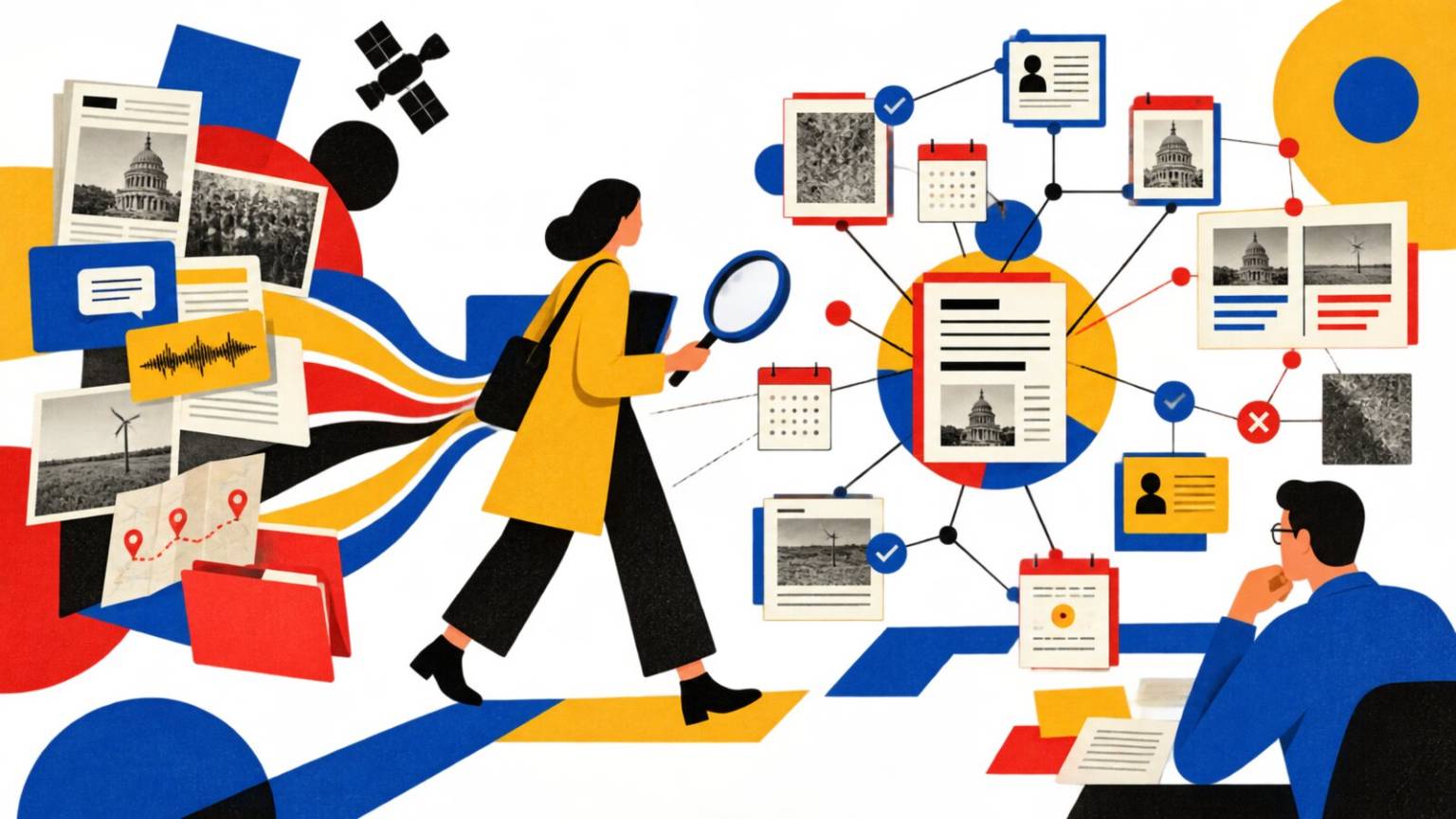
Proof graph linking a question to statements, primary and secondary sources, contradictions, dates, and verifications.
Build an appropriate hierarchy of sources
The quality depends on the subject. For a law, the official text and the competent authority take precedence. For an API, the documentation and the changelog are a priority. For a scientific result, the article, the data, and the replications are more useful than a press release.
A possible hierarchy:
- text, data, or primary documentation;
- authority, institution, or scientific publication;
- recognized analyst presenting his method;
- reference press;
- communication from an interested party;
- forum, network or unverified content.
A commercial source can be the best proof of its own price or advertisement, but not of its overall superiority.
Restrict domains without locking down research
A allowlist is relevant for compliance, security, or technical documentation. It reduces noise and manipulated sources. It can also hide a legitimate critique or information published elsewhere.
Plan for two phases:
- core of approved sources;
- controlled exploration to identify other elements, then qualified.
Authenticated internal sources must retain their rights. An agent must not summarize a document to which the final reader does not have access without indicating this restriction.
Connect each statement to evidence
The final report should not be the only trace. An intermediate matrix contains:
- assertion identifier;
- formulation;
- importance;
- source ;
- relevant passage or data;
- date ;
- relation: support, contradiction, or context;
- trust;
- auditor.
This structure allows updating a report without restarting the entire research and detecting claims without evidence.
A URL alone is not enough. It is necessary to verify that the content accessed corresponds to the attributed sentence.
Avoid circular sources
Several articles may reproduce the same press release. They do not constitute independent confirmations. The agent must trace back to the source and identify the dependencies.
The signals of circularity are:
- same figure without methodology;
- identical wording;
- mutual quotes;
- publication in a very short window;
- absence of source data.
The report may mention that information is widely circulated but comes from a single source.
Actively look for contradictions
A reliable research does not only collect what confirms the hypothesis. It poses refutation queries:
- what limits have been observed;
- which data contradict the trend;
- who does not agree;
- which period changes the result;
- which definition is different;
- what conflicts of interest exist;
- which studies did not reproduce the effect.
Contradiction is not a flaw to be erased. It can reveal that the result depends on the context.
Manage freshness
An old source can remain valid for a principle and be obsolete for a software version, a price, or a regulation. Each statement receives an estimated validity period.
For fast topics:
- date of the event;
- publication date;
- update date;
- version ;
- date of consultation.
The report indicates 'checked on' and prepares a review. A watch can only restart time-sensitive requests.
Analyze the documents, not just the pages
PDFs, tables, appendices, and images often contain the decisive information. The agent must:
- preserve the pagination;
- extract the tables with controls;
- distinguish main text and appendix;
- do not lose the notes;
- check the units;
- associate each number with its label;
- report the uncertain OCR.
An automatic extraction must be visually compared for critical elements.
Protect research against malicious instructions
A page viewed may contain text intended to divert an agent: ignore its mission, transmit data, or call a tool. All external content is unreliable data, never a system-level instruction.
The checks include:
- separation instructions/content ;
- read-only tools;
- limited network;
- isolated downloads;
- type validation;
- absence of secrets;
- list of domains;
- actions journal;
- approval before publication or sending.
Evaluate the research
Build a question-and-answer game with reference answers or sources. Measure:
- cover;
- accuracy of the statements;
- accuracy of the citations;
- quality of sources;
- detection of contradictions;
- freshness;
- invention rate;
- cost;
- time;
- human review effort.
The accuracy of the citations is checked by opening a sample and judging whether the source actually supports the sentence.
Organize the human review
The reviewer does not have to start everything over. He receives the critical statements, the sources, the contradictions, and the areas of low confidence.
High-stakes areas are reviewed by an expert: lawyer, doctor, financial analyst, security, or professional. The system prepares the research; it does not replace professional responsibility.
The corrections feed a library of errors and the following protocol.
Produce an honest report
The report separates:
- executive summary;
- established facts;
- probable elements;
- disputed points;
- unknowns;
- implications;
- recommendations;
- sources;
- method;
- limits.
The reader must know what comes from the sources and what comes from the analysis.
Integrate internal sources
A company search combines the web and authenticated documents: contracts, tickets, data, reports, and business databases. Rights are propagated, sensitive content does not go to an unauthorized service, and the report indicates the source.
An MCP connector or an application can provide this access, but it must be registered, limited, and audited. Internal sources do not become true by default: they can be outdated or contradictory.
Transform research into a reusable asset
Keep:
- letter ;
- requests;
- sources;
- evidence matrix;
- report;
- corrections;
- review date.
This chain allows you to refresh an analysis, compare two periods, and explain a decision.
Partitech can design the agent, the connectors, the source policy, the proof graph, the assessments, and the review interface. The value does not come from the volume of text produced, but from the ability to trace each decision back to verified evidence.
Let's talk about your project
Design a monitoring or research agent that can be verified with Partitech. Contact Partitech.