





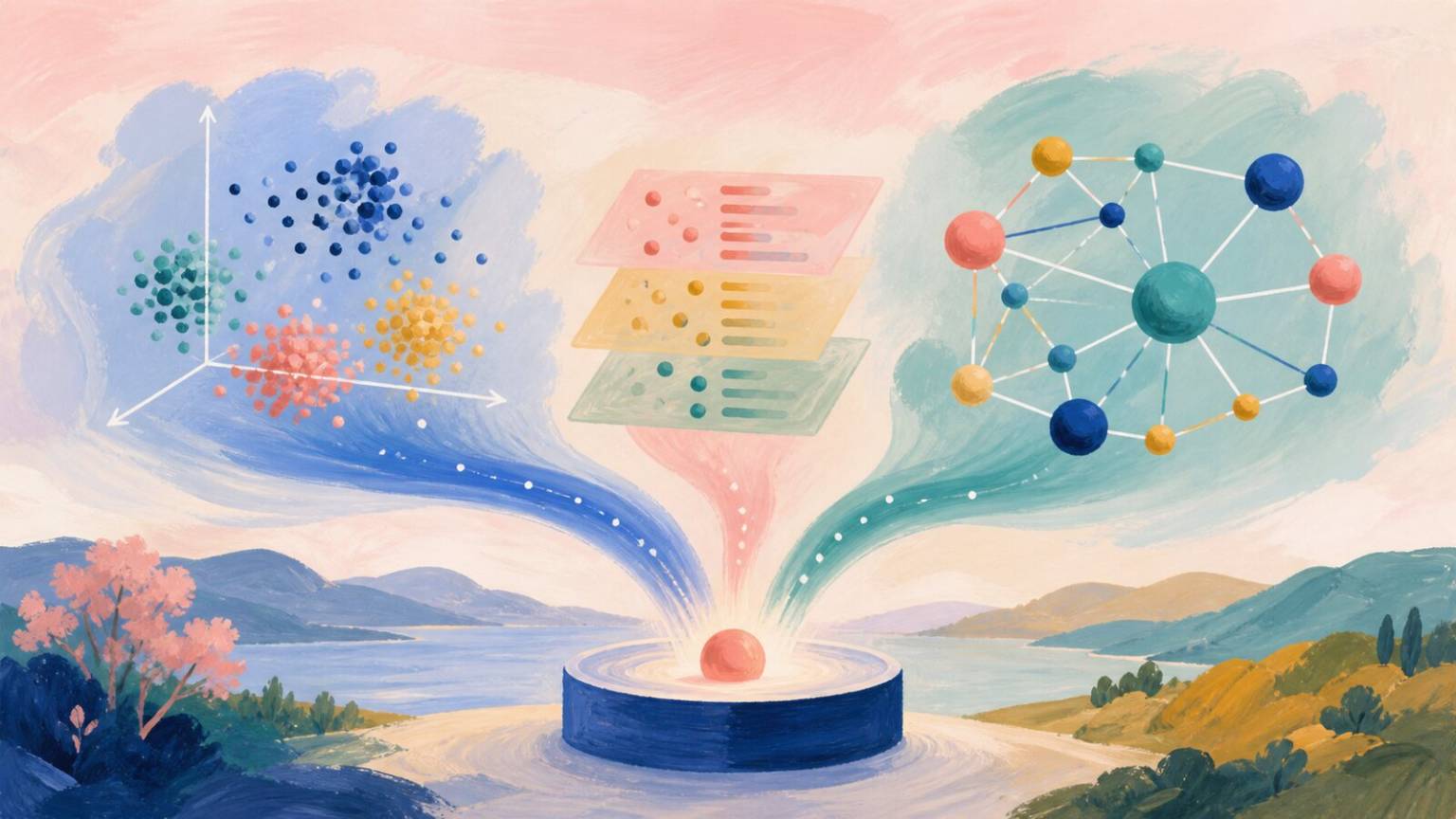
Vector search retrieves passages close to a question. It works well for local information contained in a document. It becomes less natural when it is necessary to link multiple entities, traverse dependencies, or produce an overview of a corpus. GraphRAG approaches propose extracting or using a knowledge graph to represent these relationships.
A graph is not automatically superior. Its construction, updating, and evaluation can cost more than the vector index. The decision must start from the questions and the structure of the data.
Three architectures to distinguish
Vector RAG
The documents are cut up, transformed into embeddings, and then searched by proximity. The approach is quick to prototype and suited to paraphrases.
Hybrid search
The system combines full text, vectors, filters, and reranking. It handles exact references, metadata, and varied vocabulary better.
GraphRAG
The pipeline identifies entities and relationships, builds communities or summaries, and uses the graph to retrieve local or global context. The term encompasses several techniques and should not be reduced to a single product.
Local issues and relational issues
A local question asks: "What is the notice period indicated in this contract?" A good excerpt is sufficient.
A relational question asks: 'Which subsidiaries depend on the suppliers affected by this incident and which contracts are coming due?'. It spans multiple entities and relationships.
A global question asks: 'Which themes and risks structure all the customer feedback of the year?' It requires a synthesis of the corpus, difficult to obtain from a few isolated passages.
The existing knowledge graph
When the company already has identifiers, relationships, and rules in a business database, it is often preferable to use this explicit graph rather than re-extracting it with an LLM.
The graph can represent:
- organizations;- people and roles;- products;- contracts;- documents;- events;- dependencies;- versions.
Document passages are linked to entities. The answer combines structured queries and text search.
The GraphRAG extracts
On an unstructured corpus, a pipeline can detect entities, relationships, statements, and communities. Hierarchical summaries make it possible to answer global questions.
This extraction is probabilistic. It can merge two entities, invent a relationship, or miss a nuance. Each node and edge must retain the provenance, confidence, and version.
The extracted graph is not automatically a source of business truth.
The criteria that make the graph useful
Essential relationships
The answer depends on the path between several objects, not just on a similar passage.
Stable identities
Entities can be resolved and distinguished despite name variations.
Multi-hop questions
Users regularly ask questions that require multiple steps.
Overall vision
The summaries of themes, communities, or dependencies have real value.
Explainability
Displaying the relationship path helps to validate the answer.
Acceptable cost
Indexing, updating, and governance are proportionate to value.

Map linking question types to vector-based, hybrid, and graph-based RAG architectures.
Hidden costs
Entity resolution
"Partitech", "partITech" and a business name can represent the same entity. Two people with the same name should not be merged. The resolution requires rules, models, and sometimes human validation.
Relationship extraction
A sentence can express a temporary, hypothetical, or negative relationship. The graph must retain the context, date, and source.
Community building
Algorithms produce groups according to parameters. Summaries must be updated when the corpus changes.
Storage and calculation
The pipeline can multiply calls to models, embeddings, and graph operations. The initial cost is higher than simple indexing.
Maintenance
Deleting or correcting a document must invalidate the derived entities, relationships, and summaries.
Hybrid graph + vector architecture
The graph does not exclude vectors. A chain can:
- identify the entities of the question;2. browse the authorized relationships;3. retrieve the associated documents;4. look for the relevant passages;5. reranker;6. generate with citations and path.
Conversely, a vector search can find a passage and then use its entities to broaden the context.
Model the provenance
Each statement must point to one or more passages. The extracted relationships retain:
- source ;- location;- version ;- date ;- extraction method;- trust;- validation status.
The answer distinguishes a confirmed business relationship from an inferred relationship.
Apply the rights
A graph can reveal sensitive relationships even without displaying the document. Permissions must apply to nodes, edges, properties, and paths.
Community summaries are particularly delicate: they aggregate sources that may have different rights. They must be generated by scope or filtered with a proven strategy.
Incremental update
A production pipeline must handle adding, modifying, deleting, and merging entities. A complete reconstruction can be costly. Dependencies between source, relation, community, and summary are tracked.
Freshness is measured. An old graph can produce a coherent but false answer.
Evaluate according to the types of questions
The assessment game separates:
- local questions;- exact references;- multi-hop ;- global;- temporal;- negative;- ambiguous.
Compare the architectures on quality, citations, cost, latency, and ease of updating. A GraphRAG can improve overall questions while being useless for simple searches.
Explain the way
For a relational query, the interface can display the entities and relationships used, with access to the sources. This explanation must remain readable and not expose prohibited data.
The path is not sufficient evidence if the relationships are inferred. The status and the provenance are visible.
Start with a strong baseline
Before building a graph, improve metadata, full text, vectors, and reranking. Measure the questions that still fail. If they share a relational or global need, a graph prototype becomes justified.
A reduced sub-corpus makes it possible to estimate the extraction cost, the quality of the entities, and the actual gain.
Choose the proportionate structure
An explicit business graph is powerful when the relationships are already known. An extracted GraphRAG is useful for exploring a complex corpus, provided the provenance is retained and its errors are measured. A hybrid search often remains the best foundation.
Partitech can build the baseline, integrate pgvector, model a graph, and compare the results on an evaluation set. The goal is to use the structure that answers the questions, not to add a graph for its novelty effect.
Let's talk about your project
Prototype and compare knowledge architectures with Partitech.Contact Partitech.