





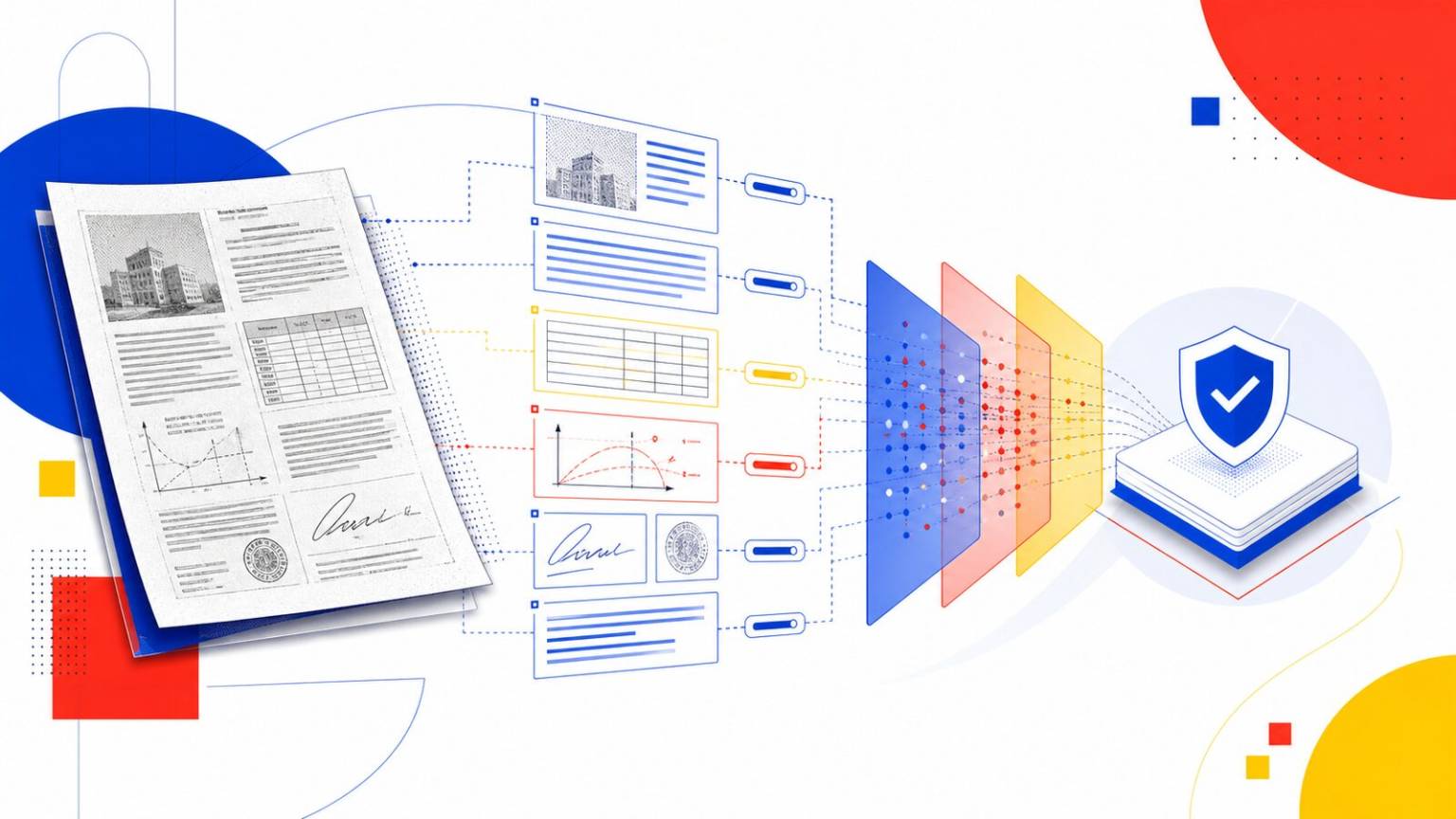
Traditional OCR transforms an image into characters. To automate a process or feed a RAG, more is needed: understanding the reading order, reconstructing tables, identifying blocks, locating a signature, retaining coordinates, and indicating uncertain areas.
In 2026, specialized models such as Mistral OCR 4 and the OCR 4.1 service announced in the official documentation illustrate this evolution towards multimodal Document Intelligence. Production still requires a security, evaluation, and validation pipeline specific to the corpus.
The features, languages, deployment modes, and rates must be rechecked in the supplier's documentation.
Why plain text fails
A PDF can contain two columns, a table, notes, an image, and a signature. A linear extraction can mix up the lines or associate an amount with the wrong header.
For a RAG, a passage without a title or page produces a weak citation. For an extraction, a value without coordinates is difficult to verify. For compliance, the version and integrity of the file are essential.
The output must therefore represent the document, not just its characters.
The layers of understanding
Image and preprocessing
Rotation, noise, contrast, resolution, and missing pages are detected. Preprocessing must not erase useful elements.
Segmentation
The engine locates paragraphs, headings, tables, figures, equations, headers, footers, signatures, and fields.
Recognition
The text and symbols are extracted with language and confidence.
Structure
Reading order, heading levels, cells, lists, and relationships are reconstructed.
Semantics
The system identifies the type of document, fields, and entities according to the use case.
Origin
Each result corresponds to a page and an area of the original document.
Output formats
An enriched Markdown can preserve headings, lists, and tables. JSON retains blocks, coordinates, types, confidence, and relations. Images or figures can be referenced separately.
The internal format must be versioned and independent of any vendor. The raw outputs of the engine are temporarily retained for diagnostics according to the policy.
The coordinates use a clear convention and allow highlighting in the viewer.
Build a block-based assessment game
Evaluating only the overall text masks important errors. The game must grade:
- text;
- order;
- titles;
- tables;
- fields;
- contact details;
- signatures;
- equations;
- language;
- complete document.
The documents are stratified by quality, language, format, and complexity. Difficult and rare cases are overrepresented if their impact is high.

Document pipeline from the secure repository to extraction, validation, structured storage, and RAG.
Adapted metrics
The character or word distance measures the transcription, but not the structure. For fields, use accuracy and business tolerances. For blocks, compare type and position. For a table, check cells, headers, and relationships.
The most useful result is often the rate of documents without critical errors, because a single wrong value can invalidate the process.
The supplier's scores are supplemented by internal tests.
Confidence and calibration
A confidence score is only useful if it corresponds to the actual risk on the dataset. It is necessary to measure, for each confidence range, the error rate. Two engines may use different scales.
The validation rules can be:
- confidence below threshold;
- critical field;
- calculation inconsistency;
- new format;
- incomplete document;
- values out of range;
- divergence between engines.
The threshold is adjusted to balance quality and human workload.
Human validation
The interface shows the document and the value side by side, with highlighting of the area. The validator corrects quickly, flags an unknown type, and sees the rules.
Corrections are traceable and can contribute to evaluation. They are not automatically used for training without oversight.
The review workload is sized for peaks. A queue prioritizes critical documents and those approaching a deadline.
Paintings
Tables require structure: merged cells, multiple headers, units, totals, and notes. An HTML or JSON representation must preserve the relationships.
The checks can recalculate sums, taxes, and consistency. A model must not invent a missing cell without indicating the uncertainty.
For RAG, the table can be indexed in block and accompanied by a description, while keeping the link to the source cells.
Handwritten documents and low quality
The manuscript, stamps, photocopies, and compression reduce quality. The system detects these categories and can choose another engine, request a new scan, or enforce a review.
Aggressive preprocessing can remove a feature or a signature. Transformations are versioned and the original is preserved according to the rules.
Multilingual
Language detection works by page or block. Proper names, codes, and units are not translated. Models must be tested on real languages and the alphabets concerned.
The pipeline retains the original language. Any translation is a separate artifact with provenance.
Warehouse security
Incoming files are unreliable. They go through maximum size, type verification, antimalware analysis, and isolated processing. Macros, scripts, and active content are not executed.
External links and images are not freely retrieved. Temporary files are deleted and accesses are logged.
Personal data and secrets
The pipeline applies classification, encryption, access, residence, and retention. Logs do not record the full text by default. Test sets are anonymized or authorized.
The editorial team can use the contact details, but they must be verified: visually hiding them without deleting the text layer is insufficient.
Integration into the RAG
Titles, pages, blocks, tables, and coordinates accompany each fragment. The response cites the passage and allows opening the corresponding area.
Replaced or deleted documents are removed from the index. Extraction errors are visible and can exclude a file rather than introduce noise.
Structured extraction
A next step maps the blocks to a business schema. The model receives only the necessary content and returns a validated format. The rules control dates, amounts, identifiers, and relationships.
The source, trust, and human correction are preserved for each field.
Choose API, managed service, or self-hosting
An API accelerates the driver and absorbs peaks. A private deployment can meet data and volume constraints. A Document AI service adds interface and workflow.
Compare quality, languages, structure, contact information, cost, throughput, residence, support, export, and reversibility on the same sample.
Observability
Follow:
- processed pages;
- errors;
- duration;
- cost;
- types of blocks;
- trust;
- review rate;
- corrections;
- unknown formats;
- delay;
- deletions.
A change in source or model triggers a regression campaign.
Deploy by document family
Start with a stable family with high value. Build the game, the rules, and the validation interface. Then add variants while measuring the coverage.
A universal engine does not eliminate business modeling. Each family has its fields, exceptions, and controls.
From the document to a verifiable piece of data
Document Intelligence becomes useful when it turns a file into a traceable structure, not when it simply produces a lot of text. The coordinates, confidence, and validation make the data usable.
Partitech can build the pipeline, compare the engines, integrate Mistral OCR or a private deployment, develop the viewer, and feed RAG and business applications. The goal is a measurable and verifiable extraction, adapted to real documents.
Let's talk about your project
Prototype a Document Intelligence chain on your documents with Partitech. Contact Partitech.