






Your store is testing a new advertising channel. The dashboard attributes purchases to it, while your usual tool attributes some to an already existing campaign. Have you sold more, or just changed the way of counting the same orders? This question must be asked before increasing the budget.
This fictional scenario illustrates the difference between attribution and incremental effect. The ChatGPT Ads announcements of October 5, 2026 provide an opportunity to prepare a measurement protocol. No media purchase or campaign test has been carried out for this item. Our goal is to define what a future result would actually allow us to decide.
Separate the announced measurement from the format still to be tested
On October 5, OpenAI announced new measurement integrations and attribution partners. The company also indicates that testing a visual format during image generation will begin later in October in the United States, with an initial group of advertisers. Therefore, it is not a format already available in France.
The additional presentation from OpenAI Ads describes several families of measurement: conversion signals, attribution, incrementality, and brand. It comes from the same provider; it provides detail without constituting an independent validation of commercial effectiveness.
| Item to qualify | Preliminary verification |
|---|---|
| Announced measurement integration | Effective access and compatibility with your tools |
| Conversion attribution | Definition and counting window |
| Incrementality experimentation | Access conditions and comparable population |
| Future visual format | Calendar, eligible countries and advertisers |
The main announcement refers to geographic experiments of incrementality still at an early stage, as well as pilots for evaluating the advertising environment. These projects do not prove a general gain, nor a guarantee of brand safety. The performance testimonials cited by partners are not included here: they do not replace a measurement adapted to your business.
Our article dedicated to the launch of ChatGPT Ads in France deals with the arrival of the channel and the acquisition prerequisites. The current topic is different: how to link the new measurement to a campaign decision without confusing attribution with causality.
Define the conversion before connecting the tools
A conversion is the business event that you want to count: confirmed purchase, qualified request for a quote, or accepted registration. Clicking on an ad and opening a form are not necessarily this final event. Choose a definition that matches your goal, then keep it in all the tools being compared.
In our fictional store, the source of truth would be the confirmed order in the sales system. The word 'confirmed' must be explicit: an attempted payment, a canceled order, and an actually accepted order do not represent the same result. Determine how refunds will be handled in the final reading.
The event ID is used to recognize the same conversion. If your browser and your server report the same order, you need a deduplication rule: count once what is sent through two paths. A pixel is a browser-side tracking mechanism; a conversion interface can transmit an event from your server. Their coexistence should not double the results.
Before any connection, have the transmitted fields, accesses, retention periods, and consent choices reviewed by the managers of your existing system. Do not send the content of a conversation to fill a conversion event. The relevance of the data for measurement must be established without implicitly expanding collection.
In a test environment, prepare a fictitious purchase, an event received twice, and a cancellation. Document the expected behavior and then observe what each tool counts. This proposed protocol still needs to be executed. It checks the quality of the counting before any conclusion on the quality of the channel.
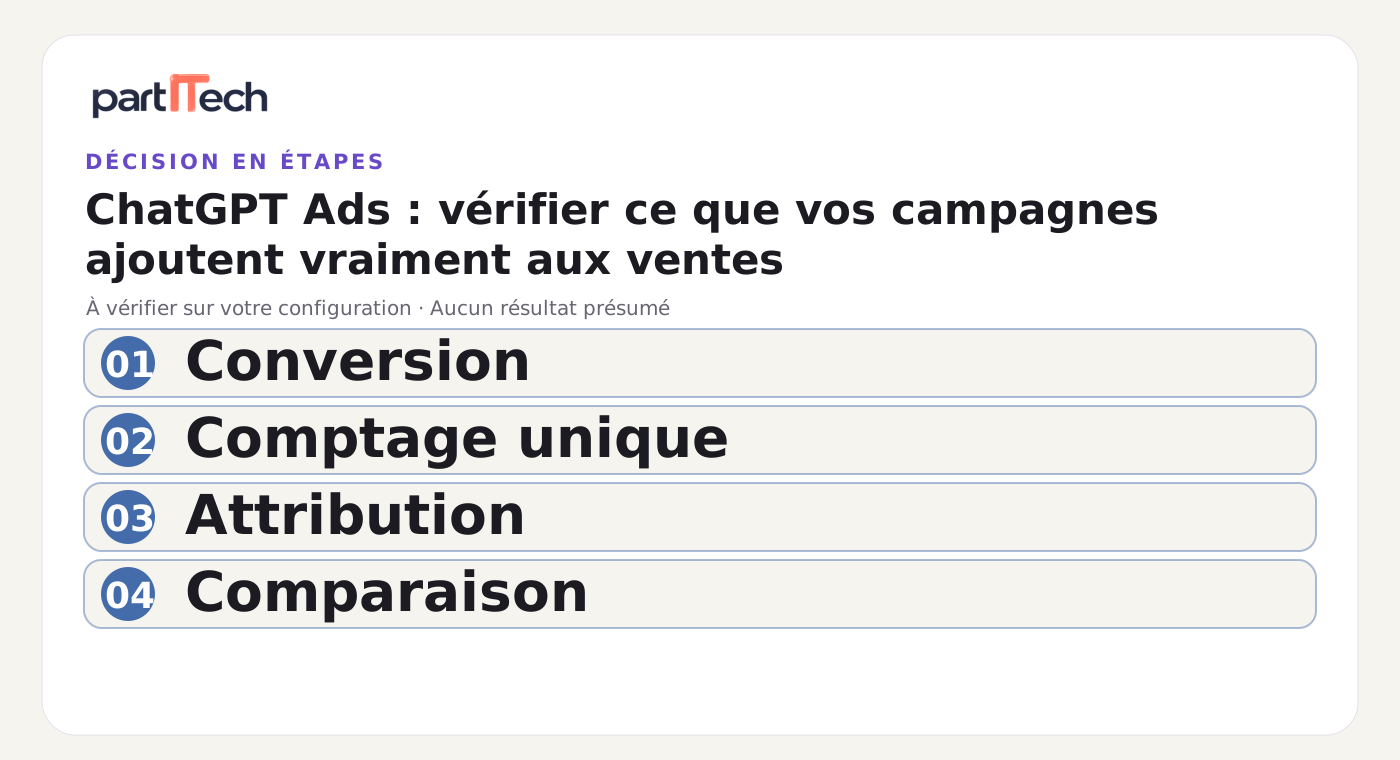
Assigning a sale does not demonstrate that it was created
Attribution links a conversion to an advertising contact according to a rule. This rule can give credit to a recent click or share the credit among several contacts. Two tools can produce different numbers while correctly applying their own conventions.
In our educational example, a person already knew the store and was considering their purchase. They see an ad, click, then order. Attribution can associate this order with the click. It is still possible that they would have bought without this ad. The attributed result describes a journey; it does not alone answer the question 'what would have happened without the campaign?'.
Incrementality refers to the additional effect of the campaign compared to this situation without exposure. Since it is not possible to observe both paths of the same person simultaneously, a credible comparison is sought. A control group, when possible and properly constituted, helps to estimate this effect.
A geographical comparison can also be considered if the territories and volumes allow it. It requires examining seasonality, promotions, product availability, and other campaigns. A territory out of stock does not constitute a good mirror of a normally supplied territory.
These methods are a Partitech analysis to design the test, not a procedure imposed by OpenAI. The mere presence of an attribution tool does not guarantee the possibility of a causal experiment. If your access or volume does not allow for building a credible comparison, present the result as an attributed observation and retain this limitation in the decision.
Prepare a protocol with a real exit decision
The protocol must be written before the results. This prevents selecting the most favorable metric afterward. Start with a useful hypothesis: for example, checking if the channel can provide additional orders at a cost compatible with your activity. This hypothesis is not a promise.
| Field of the proposed protocol | Question to resolve before launch |
|---|---|
| Business goal | Which decision should the measure inform? |
| Eligible population | Who can actually see the campaign? |
| Main event | Which conversion counts and where is it confirmed? |
| Observation | What period does the customer decision cycle cover? |
| Deduplication | How to recognize an event sent multiple times? |
| Comparison | Which group or territory provides a credible contrast? |
| Costs | What media, measurement, and preparation expenses are included? |
| Exit decision | What will justify continuing, adjusting, or stopping? |
Do not set a duration or budget based on a generic example. They depend on the buying cycle, the number of expected events, and access to measurement. Ask the person in charge of analysis to explain the necessary volumes and the uncertainty that the test can reasonably reduce.
The cost per attributed conversion is the expense divided by the attributed conversions. The cost per incremental conversion requires an estimate of the incremental effect. The denominator must be named: simply writing 'acquisition cost' often hides this difference.
Also include connection, creation, and tracking costs. Observe the other channels: a new attribution credit can shift that of an existing campaign. An increase in a chart does not demonstrate an increase in total activity. During the test, record promotions and website changes that could explain the result.
Present the result without exceeding the evidence
The future report should distinguish between observed data, counting rules, and estimation. For example, 'orders confirmed in our system' is a fact; 'orders credited to the channel' depends on a convention; 'additional estimated orders' depends on a comparison and its limitations.
Keep the protocol results empty until experimentation. Do not replace these boxes with a partner's gains. If the number of events is too low to conclude, state what is missing and what additional data collection could help. 'Inconclusive' constitutes a useful result when it prevents a decision based on insufficient evidence.
Three decisions are possible: continue the test because the measurement becomes usable, correct the counting before investing further, or not continue because the conditions do not allow for clarifying the decision. The announcement of the new format imposes none of these responses. The right next step is to check your business event and your source of truth, then your actual access to the announced tools.
Sources and verification date
Sources reopened on October 6, 2026: OpenAI announcement of October 5 and additional OpenAI Ads information. Scenario, protocol, and decision criteria are original Partitech proposals. No result from our own tests, guaranteed profit, or effective access to an advertiser account is claimed.