





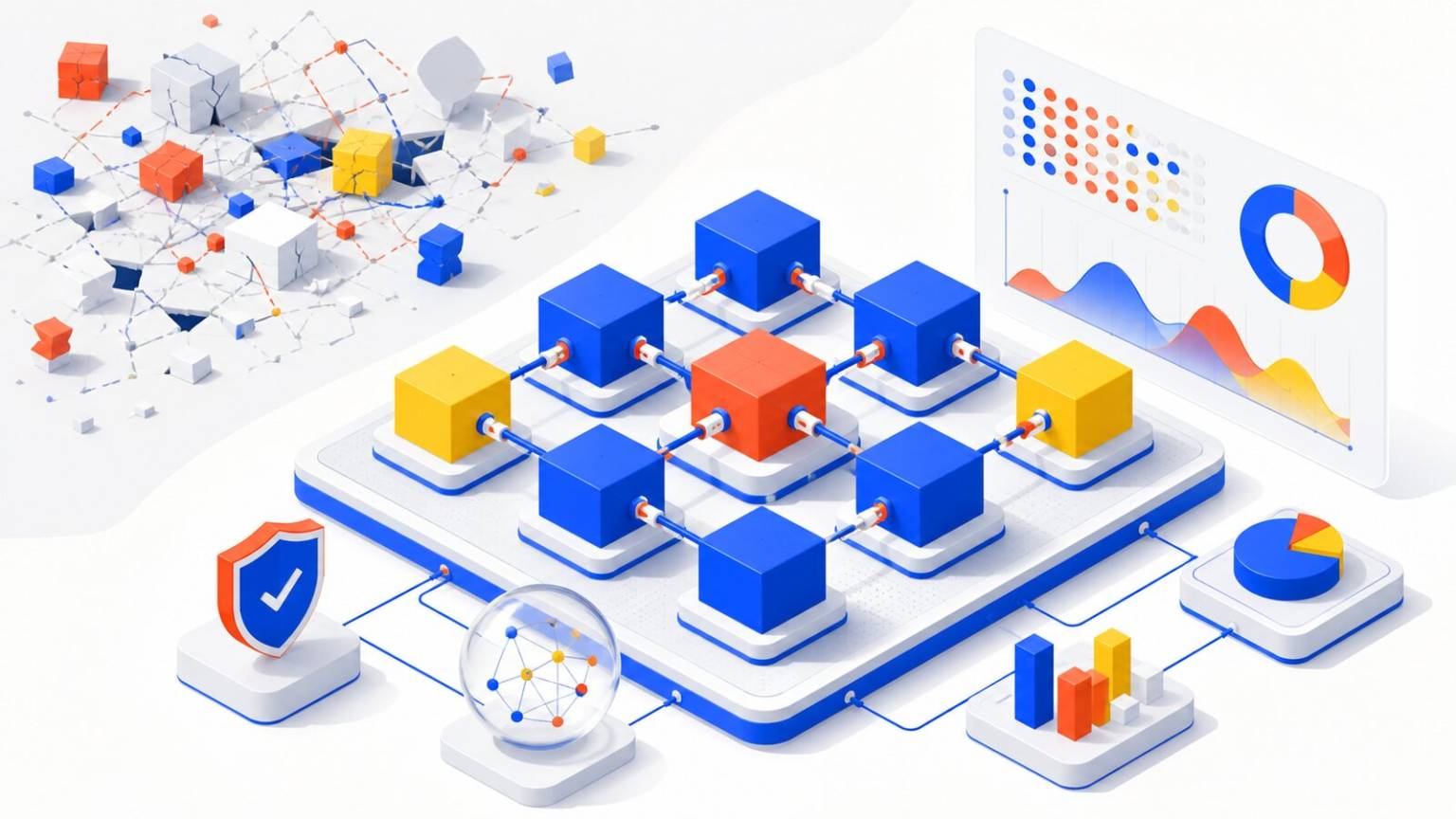
API-first and composable promise to replace a monolithic platform with a set of independent capabilities: content, commerce, search, identity, payment, or product data. Teams could evolve each building block and create new channels more quickly.
This promise is real in certain contexts. It can also turn an understandable application into a network of dependencies, contracts, and suppliers that are difficult to manage. Decoupling is not an end in itself. It must reduce the cost of change on stable boundaries.
What API-first really means
API-first is not about adding endpoints after building the interface. The contract is designed as a product used by multiple consumers. It describes the resources, operations, errors, permissions, limits, and evolution rules before implementations diverge.
A complete approach includes:
- consumer needs;- domain model and shared vocabulary;- versioned specification ;- examples and test environment;- authentication and authorization policy;- contract tests;- observability;- depreciation procedure.
The API is not just a technical interface. It becomes a commitment between teams.
What the composable covers
A composable architecture assembles replaceable capabilities behind contracts. It can include market products, internal services, and open-source components. The frontend sometimes orchestrates multiple sources through a dedicated layer, such as a backend-for-frontend.
Useful composability assumes that the building blocks can evolve without permanent coordination. If each change requires modifying six services and three teams, the platform is distributed but not truly composable.
Situations where the approach creates value
Several channels
A website, a mobile application, an extranet, and partners can use the same capabilities. A stable API avoids re-implementing the business logic for each channel.
Different rates of development
The catalog, the content, and the payment can change at different frequencies. Clear boundaries limit coupled deployments.
Truly autonomous teams
Each capability has an owner, a budget, a possible on-call duty, and goals. Organizational autonomy then gives meaning to technical autonomy.
Need for targeted replacement
A brick can be changed without global migration if the data, contracts, and dependencies are controlled.
The situations where she overestimates the project
A unique team, a single channel, and a still unstable domain often benefit more from a modular monolith. Early splitting freezes boundaries that will have to be renegotiated. Network, security, observability, and coordination costs appear immediately, while the benefits remain hypothetical.
A composable solution does not eliminate integration. It makes it a permanent responsibility.
The eight essential skills
1. Product strategy
Each API or component must have users, goals, a roadmap, and a service level. Without this, the API catalog becomes an abandoned inventory.
2. Business segmentation
Boundaries must follow responsibilities and data, not screens or the organizational chart. A domain must be able to explain what it owns and what it publishes.
3. Data contracts
Schemas, identifiers, units, temporality, and source of truth must be explicit. Examples and validation rules are part of the contract.
4. Safety
Authentication, resource-level authorization, rate limiting, secret protection, and logging must be consistent across all APIs.
5. Life cycle
A version cannot disappear without knowing its users. Compatibility, deprecation dates, and migrations are managed.
6. Tests
Unit, integration, contract, and end-to-end tests must complement each other. Test environments should not depend on unstable services without a simulation solution.
7. Observability
Each request receives a correlation ID. Logs, metrics, and traces allow tracking the journey and distinguishing a local error from a provider failure.
8. Organization and operation
A component has a reachable owner, documentation, a budget, and an incident procedure. The consuming team knows what level of service to expect.

Progressive trajectory of a structured monolith towards a composable architecture when needs justify it.
Design contracts before code
An OpenAPI specification can serve as a support for discussion, validation, client generation, and testing. It does not replace domain design. Names, statuses, errors, and asynchronous behaviors must be understood by the business teams.
Errors are a part of the product. An API must distinguish a validation, a conflict, a temporary absence, and a prohibition. Consumers should not parse free text to decide what to do.
Version with discipline
Create/v2Each change leads to maintaining multiple worlds. The priority is compatibility: adding an optional field, accepting new values without breaking the old ones, and announcing deprecations.
When a break is necessary, take stock of the consumers, provide a coexistence period, migration tools, and usage metrics. A version can be removed when its absence is verified, not just when a date has passed.
Avoid the default microservices trap
API-first does not mean microservices. A modular monolith can expose stable contracts and clearly separate domains without distributed cost. Services can be extracted when measurable reasons appear: different scaling needs, team autonomy, deployment cycle, or risk isolation.
This gradual trajectory retains the possibility of learning before multiplying the components.
Compose the frontend without weakening it
A frontend that directly calls ten services becomes responsible for security, latency, and consistency. An aggregation layer or a backend-for-frontend can adapt the responses, enforce permissions, and limit the number of round trips.
Server-side rendering, preview, cache invalidation, and partial errors must be designed. A page should not become unusable because a secondary component is unavailable.
Governing the suppliers
The composable facilitates the use of specialized products, but creates commercial and technical dependencies. For each component, document:
- data held and possibility of export;- contracts and limits;- availability and support;- rate evolution;- residence and subcontractors;- replacement strategy;- degraded behavior in case of failure.
An internal adapter can reduce coupling, but it must remain simple and tested.
End-to-end observability
Monitoring each service is not enough. A complete path must be tracked: user request, aggregation, business API, asynchronous message, and third-party system. Service level objectives can be defined for paths, not just for components.
Error budgets help balance speed and reliability. If a service regularly consumes the journey's budget, its priority becomes visible.
Total cost and operating capacity
The purchase price of a brick represents only part of the cost. Integration, security, environments, testing, monitoring, support, upgrades, and skills must be added. The composable platform often requires a platform team or automated standards.
An economically sound architecture limits the number of technologies, shares transversal mechanisms, and measures the value of each separation.
A cautious trajectory
The approach can begin with:
- map domains and sources of truth;2. stabilize some internal contracts;3. extract a high-value capability;4. set up tests, security, and observability;5. measure the benefits;6. expand only if the model works.
This sequence builds maturity before complexity.
Compose to change better
A successful composable platform is not distinguished by the number of services. It is distinguished by how easily a capability can scale, be observed, and be replaced without disrupting the rest.
Partitech can audit an existing architecture, define an API-first strategy, design the contracts, and industrialize security, testing, and operations. The goal is to gain autonomy without losing an overall understanding of the system.
Let's talk about your project
Have an API-first or composable trajectory evaluated with Partitech.Contact Partitech.