





On August 24, 2026, GitHub detailed a new module designed to check the quality of alternative text in its accessibility scanner. The announcement highlights an essential limitation: checking that an
altattribute exists is relatively simple, but determining whether it accurately describes an image in context remains an editorial exercise. AI can help focus human review; it does not turn an automated audit into proof of compliance.
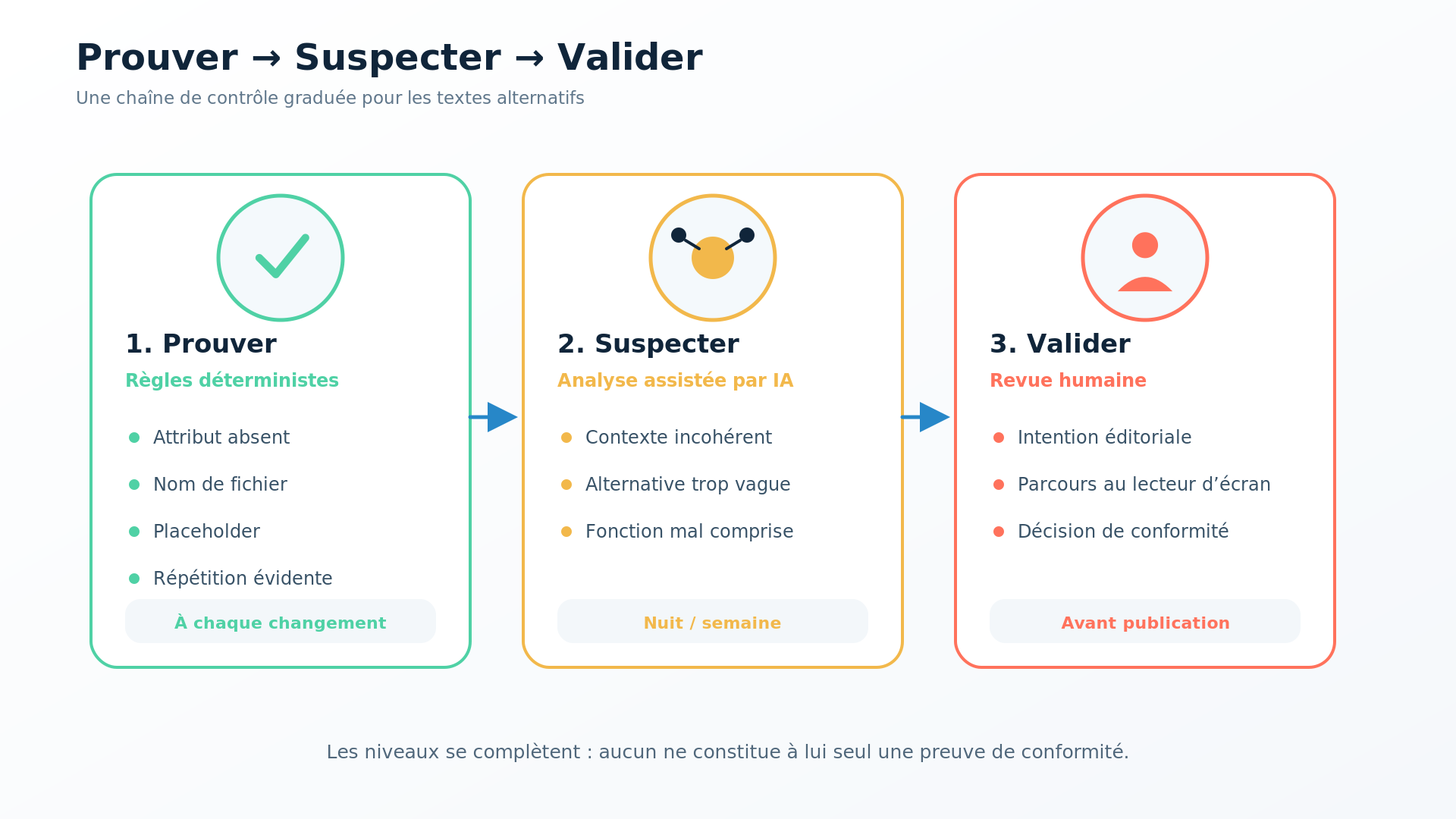
Key takeaway: a robust system separates three levels. Deterministic rules detect certain errors, AI flags doubtful cases, and a person validates intent, context, and real-world experience. Blending these levels produces either too many false positives or excessive confidence in an incomplete result.
1. Why the topic is becoming a priority again
The WebAIM Million 2026 report analysed one million home pages and more than 66.6 million images. It states that 16.2% of images had no alternative text, not counting intentionally decorative images with alt="". Among those that did have one, 10.8% presented text considered doubtful or repetitive: a file name, a generic word, a copied description, or content identical to that of a nearby image.
These figures illustrate two different problems. The first is technical: the information is missing. The second is semantic: a value exists, but it does not help the user. A conventional scanner handles the first case well and the second much less well.
For an organisation subject to an accessibility policy, the risk is turning a coverage indicator into a compliance conclusion. A campaign can show 100% of alt attributes filled in while leaving unnamed links, incomprehensible charts, and redundant descriptions. Automation must therefore improve the selection of items for review, not remove the review.
2. Presence, quality and function: three different checks
Alternative text does not always describe what an image represents. It depends on the element's function on the page.
An informative image conveys content that is absent from the surrounding text. Its alternative should convey that useful information without narrating every visual detail. A functional image, placed alone in a link or button, should generally name the action or destination. A decorative image should not be announced and normally uses an empty attribute. Finally, a complex chart may require a short summary in the alternative and a structured explanation elsewhere on the page.
This distinction explains why an apparently precise description can still be incorrect. “A blue arrow pointing right” describes the appearance of an icon, but “Next step” may be the right alternative when that icon is the entire content of a button. Conversely, automatically generating a sentence for every decorative illustration degrades the experience by adding noise.
The first design rule is therefore to determine the function before writing the text. That is also the first point an audit should check.
3. What deterministic rules can really prove
GitHub selected five checks that can run without an external model: a missing attribute or one made up only of spaces, a file name used as an alternative, a provisional marker such as “TODO”, a generic word such as “image” or “chart”, and the same alternative repeated on nearby images.
The value of these rules is their predictability. They produce findings that the team can explain, reproduce, and fix. They can be enabled on every pull request, with no inference cost and no transfer of a screenshot to an AI provider.
The repetition check nevertheless shows that the DOM alone is not always enough. Two identical logos may appear in the header and footer without bothering the user, whereas five neighbouring icons repeating “three out of five stars” create a painful result. GitHub explains that it used the visual position of elements to distinguish groups that are genuinely adjacent.
For an internal audit, the best practice is to keep a small number of strict, documented rules tested on real pages. A very ambitious but noisy heuristic will usually end up disabled. A modest and reliable rule stays in use.
4. Where AI adds value
AI-assisted analysis becomes useful when the image needs to be matched with its context. The page title, the nearest heading, the caption, the surrounding text, and the presence of a link make it possible to assess whether an alternative is sufficient, redundant, or aimed at the wrong function.
The model should not receive the vague instruction “improve this alternative text”. That wording encourages it to systematically propose another sentence, even when the existing one is correct. It is better to make it follow a decision procedure: is the image decorative? Is the information already provided by a caption? Is the element functional? If none of these cases applies, what information is missing for a person who cannot see the image?
The result should remain an opinion with a confidence level and a short rationale. It can be used to prioritise review, prepare a proposal, or group recurring defects. It should not automatically rewrite hundreds of alternatives in production.
An internal evaluation set should also be built from correct, incorrect, and ambiguous examples. A model that succeeds on a few visual demonstrations is not yet a reliable checker for your business content, languages, and editorial style.
5. Data, cost and prompt injection risks
As soon as a page, an image, and its context are sent to a vision service, the accessibility check becomes a data flow that must be documented. URLs may contain temporary tokens, session identifiers, or business parameters. Screenshots may reveal customer information, internal screens, or personal data.
The module described by GitHub removes parameters and fragments from URLs before sending them to the model and omits attributes that could expose signed links. This approach is useful, but it does not remove the need for a complete inventory: image origins, logging, retention period, processing location, possible secondary OCR, and access rights to the results.
Page content must also be treated as untrusted. A hidden sentence in a document may try to steer the model, including during an audit. A structured output format limits the shape of the response, but not necessarily the reasoning that produced it. Analysis must be isolated, all actions forbidden, transmitted data limited, and the output treated as a suggestion.
Finally, one call per image and per scan quickly becomes expensive. On a media-rich site, the AI check should be sampled, scheduled, or triggered for changed content, while deterministic rules continue to run continuously.
6. How to integrate the check into CI/CD
An effective pipeline can operate at three speeds.
For every change, fast tests check for missing attributes, unintended empty values, file names, placeholders, and obvious repetitions. They block only certain defects. Once a night or week, a more complete scan renders pages, observes the accessibility tree, and analyses a sample of images with a model. The results are opened as tasks to confirm, without automatically breaking delivery.
Before a major production release, a human review checks templates, critical journeys, charts, illustrated buttons, and high-traffic editorial pages. It uses a screen reader and also checks reading order, link labels, heading structure, and interactive states.
The indicators must remain interpretable: number of certain errors, number of suspicions, proportion confirmed after review, correction time, and recurrence by component. A single global “AI score” hides causes and encourages misleading comparisons.
This approach complements the principles presented in our guide to RGAA 4.1.2 and preparing for RGAA 5: industrialise checks while retaining the verifications that only a usage situation can validate.
7. The essential role of editorial validation
The content author knows the intent; the developer knows the structure; the auditor knows the criteria; the user knows the experience. None of these perspectives is sufficient on its own.
For each recurring image type, create a short editorial rule with an example: a portrait of a named person, a feature screenshot, an architecture diagram, an atmospheric illustration, a navigation icon, or a data chart. Add a required field to declare that an image is decorative instead of forcing text generation.
On a multilingual site, the alternative must be translated as content in its own right. Copying the French version into an English page may satisfy a technical check, but it does not make the information accessible. Validations must therefore cover every published language.
Human review does not mean systematically embellishing wording. It must answer a simple question: can a person who cannot access the image understand the necessary information or action without hearing unnecessary repetition?
8. A thirty-day implementation plan
In the first week, inventory the components containing images and measure certain errors in a staging environment. Identify pages behind authentication and data that must never leave your infrastructure.
In the second week, add deterministic rules to the pipeline and fix shared components before isolated content. A correction in a template can resolve hundreds of occurrences.
In the third week, test an opt-in AI analysis on a representative sample. Measure false positives, unanalysed cases, and the actual value of suggestions above all. Document the data flow and cap the number of calls.
In the fourth week, organise a validation session with editorial, technical, and accessibility profiles. Decide which checks block a release, which generate an alert, and which require periodic review. Keep confirmed examples to improve the evaluation set.
Conclusion
AI can make an alternative-text audit more relevant, particularly by connecting an image with its editorial context. It does not, however, resolve the definition of the image's function, validation of real-world experience, or a page's overall compliance.
The most reliable strategy remains progressive: automate what can be proven, use AI to surface doubtful cases, and leave the decision to the people responsible for content and accessibility. Partitech supports the implementation of these control chains, from component auditing to integration into staging and deployment pipelines.