



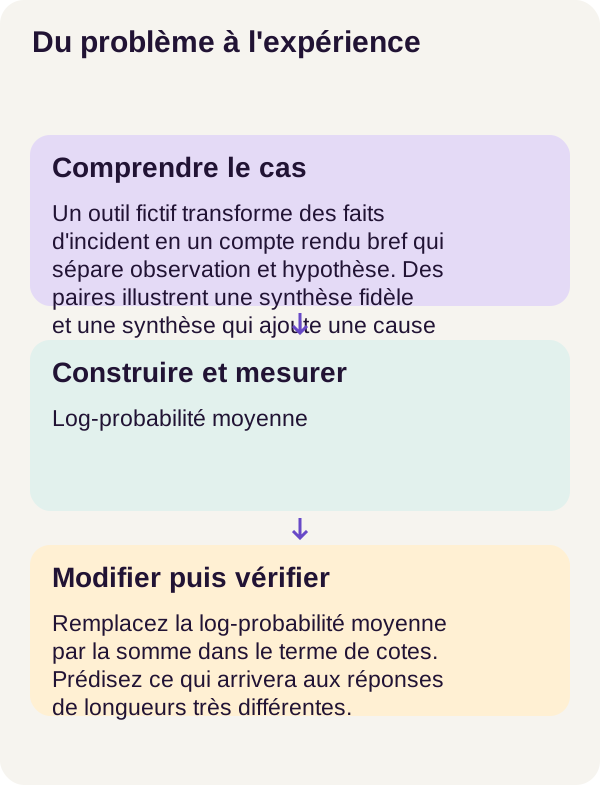
Một công cụ hư cấu biến sự kiện incident thành báo cáo ngắn, tách quan sát khỏi giả thuyết. Các cặp minh họa tổng hợp trung thực và tổng hợp thêm nguyên nhân chưa xác lập. Tác vụ không phải y tế hay điều khiển thiết bị.
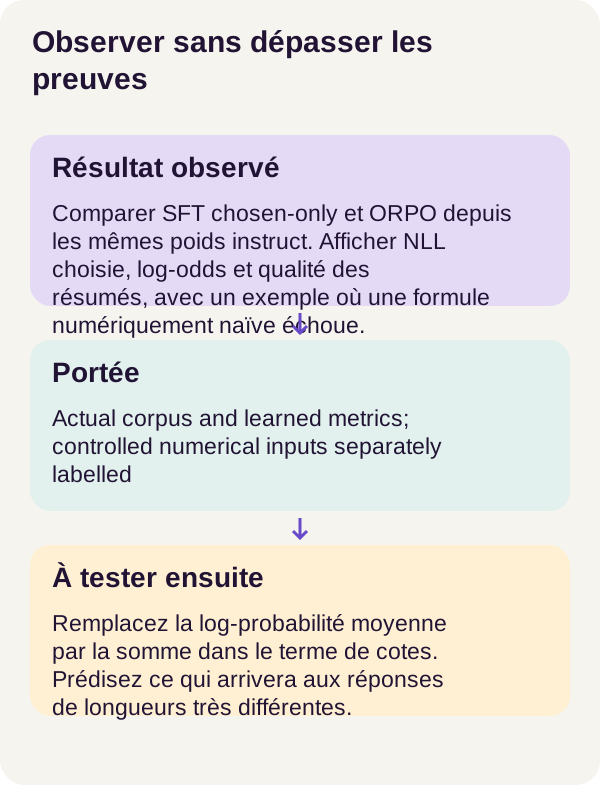
So sánh SFT chosen-only và ORPO từ cùng trọng số instruct. Hiển thị NLL chosen, log-odds và chất lượng tóm tắt, cùng ví dụ công thức ngây thơ về số học thất bại.
Tải dự án hoàn chỉnh, bản sửa đổi r003
Trước sự kiện, sau báo cáo
IncidentNotesPrefs-v1 có 300 family gồm bốn cặp, tức 1200 ví dụ. Family 0–209 cho 840 train; 210–254 cho 180 validation; 255–299 cho 180 test. Mỗi hồ sơ nêu đơn vị hư cấu, trạng thái stopped/running, áp suất đo hoặc không và nguyên nhân xác nhận hoặc chưa biết. Ghi chú cũ có trạng thái mâu thuẫn và nguyên nhân gợi ý; ghi hiện tại thay nó rõ ràng. Không hành động nào trên thiết bị thật được đề xuất.
Phản hồi chosen nêu sự kiện hiện tại. Rejected đảo một thông tin: nguyên nhân ở hai cách diễn đạt, áp suất một, trạng thái một. Một số nguyên nhân được xác nhận nên luôn viết « chưa biết » là sai. Phản hồi lịch sự vẫn có thể bịa nguyên nhân. Cách lịch sự luân phiên chosen ngắn hơn, cùng số từ hoặc dài hơn. Từ và chế độ này được audit; strata cuối dùng token thật.
Mọi biến thể family ở cùng partition. Định danh khác, nhưng sự kiện cơ bản và hình thức ngôn ngữ chung: tách này không chứng minh khái quát hóa sang incident hoặc miền thật. Annotation mô phỏng, không tuyên bố phản hồi con người. Audit từ không chứng minh không có mọi shortcut ngữ nghĩa.
Một phân phối trên token
Base Qwen2.5-0.5B-Instruct ở revision 7ae557604adf67be50417f59c2c2f167def9a775. Tất cả 494 032 768 tham số duy nhất đều train FP32. Kiến trúc kiểm tra: 24 block, rộng 896, 14 head Q, hai K/V, MLP 4864, vocabulary 151936, embedding/đầu ra liên kết. Attention eager, TF32 tắt, một GPU chọn rõ; không LoRA, lượng tử hay reference copy.
Template tokenizer ghép system, incident và ranh giới assistant. Phản hồi mã riêng với một EOS=151645 cuối. Hợp đồng không tuyên bố tương đương retokenize chuỗi hoàn chỉnh. Giới hạn prompt 256 token, phản hồi 128 gồm EOS, tổng tối đa 512. Vượt giới hạn gây lỗi có định danh, không cắt dữ liệu học.
Logit t−1 dự đoán token t. Sau dịch, chỉ label phản hồi hoạt động; prompt và padding là −100. PAD=151643 khác EOS, mask theo vị trí thật. Prompt không giám sát trực tiếp nhưng điều kiện hóa mọi điểm phản hồi.
Với phản hồi n token hoạt động, tính tổng s log-probability rồi ell=s/n. q=exp(ell) là trung bình hình học xác suất token, không là xác suất joint của phản hồi. EOS vào n. Phản hồi rỗng bị từ chối. Khác DPO, ORPO dùng ell, không s.
Từ xác suất tới odds
Odds q là q/(1−q). Log của nó là ell−log(1−exp(ell)). Với chosen và rejected, trừ hai log-odds; chênh lệch dương ưu chosen. Penalty cặp là −logsigmoid(chênh lệch). Loss tổng thêm supervision: NLL chosen + lambda × trung bình penalty cặp.
Hai reduction khác nhau quan trọng. NLL là tổng CE chosen chia mọi token hoạt động. Preference là trung bình theo cặp. Khi tích lũy tám cặp dài khác, mỗi CE chosen chung mẫu số token của tám cặp, còn penalty chia tám. Trung bình các CE trung bình sẽ đổi mục tiêu.
Lambda=0 phải tái tạo loss và gradient SFT với cùng mask/reduction. Nhánh SFT thật không tính rejected; test lambda=0 có thể tính để kiểm gradient bằng không. Phản hồi giống cho penalty log(2), không tín hiệu tương đối hữu ích; NLL chosen vẫn có. Cặp giống bị từ chối trong corpus.
Tránh phép trừ không chính xác
Tính trực tiếp log(1−exp(ell)) có thể log(0) gần không vì exp(ell) làm tròn 1. Dùng log1p(−exp(ell)) nếu ell < −log(2), và log(−expm1(ell)) nhánh khác. Chỉ nhánh cần dùng được đánh giá; đánh giá cả hai rồi chọn torch.where có thể để gradient NaN từ nhánh không hoạt động.
Hai phía được xếp trước thao tác chung. Tính đối xứng cho phép gradient đối nghịch của một đầu vào triệt tiêu chính xác tại chỗ gặp, không đổi công thức hay nới test.
Miền rõ: FP32 hoặc FP64, ell hữu hạn âm nghiêm ngặt, độ lớn ít nhất finfo.tiny. Zero và độ lớn subnormal bị từ chối vì log-odds hay đạo hàm không biểu diễn được. Không clamp ngầm tạo plateau. Test gồm −1000, biên −log(2), −1e−300 FP64 và −1e−30 FP32. Lỗi công thức ngây thơ giữ trạng thái và null cho số không hữu hạn, không JSON số giả.
Giá trị và gradient preference so với odds_ratio_loss TRL v0.23.1 commit 4529a1c8b1813480a85b02c9c8e7f75a29085d65 ở miền thường: dung sai 1e−12 FP64 và 2e−6 FP32. Trích Apache-2.0 có provenance và license; trainer không import. NLL mask so riêng với CrossEntropyLoss PyTorch.
So sánh không tái tạo toàn trainer TRL: version kiểm tra dựng lại label chosen từ ID và attention, gồm prompt. Bài dùng rõ label phản hồi đơn. Kho tác giả cũng kiểm tra; mask và chuyển BF16 cuối không dùng. So công thức preference và reduction công bố, không tuyên bố đồng nhất toàn hạ tầng.
Ba lần học và một base chung
So sánh tối thiểu là base, SFT chosen-only và ORPO lambda=0,1. Hai policy train khởi động độc lập từ cùng instruct, không SFT import hay khởi động tutorial khác. Mỗi policy thấy cùng 840 prompt trong hai epoch, cùng thứ tự: 1680 presentation và 210 update, microbatch một cặp, tích lũy tám.
AdamW lr=0,000002, weight_decay=0,01, clipping 1, warm-up 21 update rồi giảm tuyến tính đến 10 %. Seed 47. Tham số và gradient FP32 kiểm tra. Validation sau epoch không chọn checkpoint hay lambda theo test. ORPO còn xử lý rejected; cùng exposure prompt không là cùng token, forward hay thời gian.
Mỗi pha gián đoạn sau epoch đầu, chạy liên tục hai epoch và tiếp tục epoch hai. Trạng thái cuối model, AdamW, sampler, scheduler, RNG Python/NumPy/PyTorch CPU/CUDA và lịch sử phải giống chính xác. Checkpoint đầy đủ nén gzip mức 1 cục bộ, kích thước ghi, rồi rename nguyên tử. Nén không giảm VRAM hay hứa tỷ lệ. Chỉ tin vì tạo cục bộ; không tải object Torch thay thế. Model cuối lưu Safetensors và tải lại nghiêm ngặt.
Bài tập thêm policy train thứ ba sum-ablation, cùng trọng số đầu, thứ tự prompt, optimizer và update. Hạng odds nhận TỔNG thay trung bình: ablation có tên, không ORPO reference. Chín trạng thái đủ ba pha ở cục bộ. Thời gian tối ưu, validation, command hoàn chỉnh và peak đo tách riêng.
Đánh giá candidate và văn bản tự do
Mỗi state base/SFT/ORPO/sum-ablation score cùng 180 cặp test. Báo cáo NLL chosen/token, margin log-odds, penalty và accuracy nửa điểm hòa. Kết quả tách chosen ngắn hơn, bằng hay dài hơn theo token. Đánh giá policy luôn dùng odds trung bình, kể cả trọng số sum-ablation; tên model không đổi metric ngầm.
Mỗi state sinh 180 báo cáo tự do chỉ incident trong prompt: greedy, một beam, tối đa 128 token, EOS=151645. ID, văn bản thô, lý do dừng, độ dài, thời lượng giữ. Chạm trần là lỗi dù đầu có vẻ đủ. Không đầu ra gửi hay áp dụng hệ thống thật.
Rubric là grammar độc lập generation, nhận clause đơn vị/trạng thái, áp suất và nguyên nhân. Câu không nhận, trường lặp, tag hay chạm trần làm note không hoàn chỉnh. Paraphrase tự nhiên đúng ngoài grammar có thể lỗi. Điểm không là judge chung fidelity hay satisfaction.
Độ đúng đòi bốn trường đúng trên TẤT CẢ 180 ca. Nguyên nhân biết/chưa biết có mẫu số riêng. Nguyên nhân nhận khác ghi là không được chứng minh. Abstention nhận trên nguyên nhân biết báo riêng; trường thiếu trong prose không hiểu không tự gọi abstention. Áp suất nhận khi không đo được báo. Câu không nhận vẫn không chứng nhận, dù bộ đếm phần bằng không. Thất bại không bỏ khỏi mẫu số.
Bài tập về độ dài
Dòng đầu bài tập phân tích: log-probability hằng −1 token chosen và −1,2 rejected, độ dài 4, 16, 64. Trung bình, tổng, odds và gradient so cho chín cặp độ dài. Với trung bình, chất lượng trung bình hằng không phụ thuộc độ dài; với tổng, chosen dài có thể thua rejected ngắn. Đây không là đo trên văn bản nghiệp vụ.
Sau đó điểm thật 180 cặp policy ORPO chính được đưa qua hai công thức không đổi trọng số. Cuối cùng sum-ablation được train thật rồi đánh giá generation. Kết quả tách khỏi phân tích và tính lại công thức. SHA-256 model, kết quả chính và cấu hình tối thiểu được bảo vệ; bản chính giữ trung bình.
Loss ổn định số vẫn có thể học preference xấu. Margin dương hai candidate không bảo đảm văn bản mới tốt. Một seed và mẫu tổng hợp giới hạn mạnh kết luận; không yêu cầu ORPO cải thiện SFT.
Xác định preference không từ tiết lộ
Quan sát và nhân quả
Lỗi thường gặp: Mọi chosen nói 'unconfirmed': thêm nguyên nhân xác nhận và paraphrase mà không đổi test sau chạy.
Bất biến: 840/180/180 cặp, không rò rỉ incident, đa dạng mẫu.
Tệp src/orpo_sans_reference/data.py
import hashlib, re
from pathlib import Path
from .config import save_json, sha

CAUSES = ["filter blockage", "power loss", "sensor fault"]
COURTESY = [
    "This is the recorded incident note.",
    "Further details may be documented separately.",
]


def split_incident_families(family):
    return "train" if family < 210 else "validation" if family < 255 else "test"


def facts_for(family):
    return {
        "unit": f"P{family+1000}",
        "state": "stopped" if family % 3 else "running",
        "pressure": None if family % 4 < 2 else 10 + (family // 4) % 7,
        "cause": None if family % 2 == 0 else CAUSES[(family // 2) % 3],
    }


def incident_text(family, j, facts):
    previous = "running" if facts["state"] == "stopped" else "stopped"
    old_cause = CAUSES[(family // 2 + 1) % 3]
    pressure = (
        "not measured" if facts["pressure"] is None else str(facts["pressure"]) + " kPa"
    )
    cause = "not confirmed" if facts["cause"] is None else "confirmed " + facts["cause"]
    return f"Incident N{family:03d}-{j}. Superseded note: state {previous}; suggested cause {old_cause}. Current verified record: unit {facts['unit']}; state {facts['state']}; pressure {pressure}; cause {cause}. Use only the current record."


def reply(facts, j, courtesy=False):
    first = [
        f"{facts['unit']} is {facts['state']}.",
        f"Unit {facts['unit']} is {facts['state']}.",
        f"The state of {facts['unit']} is {facts['state']}.",
        f"The current state of {facts['unit']} is {facts['state']}.",
    ][j]
    pressure = (
        f"The pressure is {facts['pressure']} kPa."
        if facts["pressure"] is not None
        else ("Pressure was not measured." if j % 2 else "The pressure is unknown.")
    )
    cause = (
        f"The confirmed cause is {facts['cause']}."
        if facts["cause"] is not None
        else (
            "The cause remains unconfirmed."
            if j % 2
            else "The confirmed cause is not known."
        )
    )
    clauses = [first, pressure, cause]
    if courtesy:
        clauses = COURTESY[:1] + clauses + COURTESY[1:]
    return " ".join(clauses)


def audit_causal_labels(labels):
    n = len(labels)
    lengths = {"chosen_shorter": 0, "same_words": 0, "chosen_longer": 0}
    known = sum(r["expected"]["cause"] is not None for r in labels)
    features = []
    words = sorted(
        {
            w
            for r in labels
            for side in ["chosen", "rejected"]
            for w in re.findall("[a-z]+", r[side].lower())
        }
    )
    for row in labels:
        a, b = len(row["chosen"].split()), len(row["rejected"].split())
        lengths[
            "chosen_shorter" if a < b else "chosen_longer" if a > b else "same_words"
        ] += 1
    for word in words:
        a, b = [
            sum(word in set(re.findall("[a-z]+", r[side].lower())) for r in labels)
            for side in ["chosen", "rejected"]
        ]
        accuracy = (a + n - b) / (2 * n)
        features.append(
            {
                "word": word,
                "chosen_presence": a,
                "rejected_presence": b,
                "best_binary_label_accuracy": max(accuracy, 1 - accuracy),
            }
        )
    return {
        "pairs": n,
        "known_cause": known,
        "unknown_cause": n - known,
        "unknown_pressure": sum(r["expected"]["pressure"] is None for r in labels),
        "word_length_regimes": lengths,
        "best_length_preference_accuracy_half_ties": max(
            (lengths["chosen_longer"] + 0.5 * lengths["same_words"]) / n,
            (lengths["chosen_shorter"] + 0.5 * lengths["same_words"]) / n,
        ),
        "word_features": features,
        "maximum_word_accuracy": max(r["best_binary_label_accuracy"] for r in features),
        "scope": "Original words, not every possible semantic/BPE shortcut",
    }


def generate_incident_pairs():
    pages = []
    labels = []
    for family in range(300):
        facts = facts_for(family)
        for j in range(4):
            identifier = f"N{family:03d}-{j}"
            text = incident_text(family, j, facts)
            wrong = dict(facts)
            reason = ["cause", "pressure", "state", "cause"][j]
            if reason == "cause":
                wrong["cause"] = (
                    CAUSES[(family // 2) % 3] if facts["cause"] is None else None
                )
            elif reason == "pressure":
                wrong["pressure"] = (
                    10 + (family // 4) % 7 if facts["pressure"] is None else None
                )
            else:
                wrong["state"] = "running" if facts["state"] == "stopped" else "stopped"
            chosen = reply(facts, j, courtesy=j == 1)
            rejected = reply(wrong, j, courtesy=j == 2)
            if chosen == rejected:
                raise ValueError("Preference pair is identical")
            pages.append(
                {
                    "document_id": identifier,
                    "family": family,
                    "formulation": j,
                    "split": split_incident_families(family),
                    "incident": text,
                    "record": facts,
                    "content_sha256": hashlib.sha256(text.encode()).hexdigest(),
                }
            )
            labels.append(
                {
                    "document_id": identifier,
                    "chosen": chosen,
                    "rejected": rejected,
                    "expected": facts,
                    "preference_reason": reason,
                    "simulated_preference": True,
                }
            )
    if len({p["incident"] for p in pages}) != 1200:
        raise ValueError("Duplicate incident")
    return pages, labels


def prepare(config):
    root = Path("data/generated")
    if (root / "manifest.json").exists():
        raise ValueError("Preserve existing corpus; use a new extraction")
    pages, labels = generate_incident_pairs()
    gold = {r["document_id"]: r for r in labels}
    save_json(root / "input/pages.json", pages)
    save_json(root / "labels/gold.json", labels)
    counts = {}
    audits = {}
    for split in ["train", "validation", "test"]:
        selected = [p for p in pages if p["split"] == split]
        chosen = [gold[p["document_id"]] for p in selected]
        counts[split] = {
            "pairs": len(selected),
            "families": len({p["family"] for p in selected}),
        }
        audits[split] = audit_causal_labels(chosen)
        if split != "test":
            save_json(root / f"{split}/pages.json", selected)
            save_json(root / f"labels/{split}.json", chosen)
    save_json(
        "outputs/data-audit.json",
        {
            "dataset": "IncidentNotesPrefs-v1",
            "rights": "CC0-1.0",
            "counts": counts,
            "shortcuts": audits,
            "human_preferences": False,
            "shared_semantic_and_language_primitives": True,
            "current_record_supersedes_previous_note": True,
            "reference_model_or_cache": False,
        },
    )
    save_json(
        root / "manifest.json",
        {
            "dataset": "IncidentNotesPrefs-v1",
            "seed": config["seed"],
            "counts": counts,
            "files": {
                str(f.relative_to(root)): sha(f) for f in root.rglob("*") if f.is_file()
            },
        },
    )
    return counts
Tính trung bình token
Mask, độ dài và điểm q
Lỗi thường gặp: Một batch trung bình sai khi gán trọng số từng câu: đặt tên riêng trung bình token và trung bình cặp.
Bất biến: PAD bất biến, phản hồi không rỗng, reduction được kiểm soát.
Tệp src/orpo_sans_reference/scores.py
import torch
from .config import save_json

SYSTEM = "Write an incident note using only the current verified record. State the unit and its current state, the pressure if measured, and the confirmed cause if known. Distinguish observations from causal conclusions. A superseded suggestion is not a current fact. Do not add facts, actions or explanations."


def format_prompt(tokenizer, incident, version):
    if version != "incident-v1":
        raise ValueError("Unknown incident template")
    messages = [
        {"role": "system", "content": SYSTEM},
        {"role": "user", "content": incident},
    ]
    return messages, tokenizer.apply_chat_template(
        messages, tokenize=True, add_generation_prompt=True
    )


def completion_row(tokenizer, incident, response, config, identifier, version=None):
    version = version or config["template_version"]
    messages, prompt = format_prompt(tokenizer, incident, version)
    target = tokenizer.encode(response, add_special_tokens=False) + [151645]
    if (
        not prompt
        or len(prompt) > config["max_prompt_tokens"]
        or not 1 < len(target) <= config["max_response_tokens_including_eos"]
        or len(prompt) + len(target) > config["context"]
    ):
        raise ValueError(
            identifier + ": declared token budget exceeded; do not truncate"
        )
    return {
        "document_id": identifier,
        "messages": messages,
        "input_ids": prompt + target,
        "labels": [-100] * len(prompt) + target,
        "prompt_tokens": len(prompt),
        "response_tokens": len(target),
        "template_version": version,
    }


def paired_completion_batch(tokenizer, page, label, config, version=None):
    chosen = completion_row(
        tokenizer,
        page["incident"],
        label["chosen"],
        config,
        page["document_id"],
        version,
    )
    rejected = completion_row(
        tokenizer,
        page["incident"],
        label["rejected"],
        config,
        page["document_id"],
        version,
    )
    if (
        chosen["input_ids"] == rejected["input_ids"]
        and chosen["labels"] == rejected["labels"]
    ):
        raise ValueError("Identical completions are not an informative preference")
    return {
        "document_id": page["document_id"],
        "chosen": chosen,
        "rejected": rejected,
        "response_length_delta": chosen["response_tokens"]
        - rejected["response_tokens"],
    }


def collate(rows, device="cuda", pad_to=None):
    if not rows:
        raise ValueError("Empty completion batch")
    width = max(len(r["input_ids"]) for r in rows) if pad_to is None else pad_to
    ids = torch.full((len(rows), width), 151643, dtype=torch.long, device=device)
    mask = torch.zeros_like(ids, dtype=torch.bool)
    labels = torch.full_like(ids, -100)
    for i, row in enumerate(rows):
        n = len(row["input_ids"])
        if n > width:
            raise ValueError("Padding width would truncate a response")
        ids[i, :n] = torch.tensor(row["input_ids"], device=device)
        mask[i, :n] = True
        labels[i, :n] = torch.tensor(row["labels"], device=device)
    return ids, mask, labels


def sequence_logprob(logits, labels):
    if logits.shape[:2] != labels.shape:
        raise ValueError("Logits and labels shape mismatch")
    active = labels[:, 1:] != -100
    counts = active.sum(dim=1)
    if (counts == 0).any():
        raise ValueError("Every sequence needs an active response target")
    selected = logits[:, :-1][active]
    targets = labels[:, 1:][active]
    values = (
        torch.log_softmax(selected, dim=-1)
        .gather(-1, targets.unsqueeze(-1))
        .squeeze(-1)
    )
    sums = torch.stack([v.sum() for v in values.split(counts.tolist())])
    return sums, counts, values, selected, targets


def model_scores(model, rows):
    ids, mask, labels = collate(rows)
    logits = model(
        input_ids=ids, attention_mask=mask, use_cache=False, return_dict=True
    ).logits
    return sequence_logprob(logits.float(), labels)


def mean_completion_logprob(logits, labels):
    sums, counts, values, selected, targets = sequence_logprob(logits, labels)
    return sums / counts, counts, values, selected, targets


def chosen_token_nll(logits, labels):
    sums, counts, _, _, _ = sequence_logprob(logits, labels)
    return -sums.sum() / counts.sum()


def inspect_pair_lengths(config):
    from .model import load_tokenizer
    from .data import generate_incident_pairs

    tokenizer = load_tokenizer()
    pages, labels = generate_incident_pairs()
    pairs = [
        paired_completion_batch(tokenizer, pages[i], labels[i], config)
        for i in range(4)
    ]
    save_json(
        "outputs/tokenization-mechanism.json",
        {
            "pairs": pairs,
            "preference_reduction": "mean_response_logprob_including_EOS",
            "nll_reduction": "all_chosen_active_tokens",
            "prompt_and_padding_excluded": True,
        },
    )
Mã hóa odds ổn định
log1mexp và sigmoid
Lỗi thường gặp: Clamp im lặng tạo plateau gradient: làm rõ và kiểm tra vùng hoạt động.
Bất biến: Test FP64/FP32 và khớp reference theo dung sai đã định.
Tệp src/orpo_sans_reference/loss.py
import math
from types import SimpleNamespace
import torch
from .config import save_json


def log1mexp(a):
    if a.dtype not in [torch.float32, torch.float64] or not torch.isfinite(a).all():
        raise ValueError("Use finite FP32/FP64 log probabilities")
    if (a >= 0).any() or (a.abs() < torch.finfo(a.dtype).tiny).any():
        raise ValueError(
            "Log probability must be strictly negative with a representable finite derivative; no silent clamp"
        )
    # Compute only the selected branch: torch.where on two evaluated formulas
    # could propagate NaN gradients from its inactive near-zero branch.
    far = a < -math.log(2)
    result = torch.empty_like(a)
    result[far] = torch.log1p(-torch.exp(a[far]))
    result[~far] = torch.log(-torch.expm1(a[~far]))
    return result


def orpo_preference_loss(chosen_logps, rejected_logps):
    if chosen_logps.shape != rejected_logps.shape or not chosen_logps.numel():
        raise ValueError("Matching nonempty paired score vectors required")
    paired = torch.stack([chosen_logps, rejected_logps])
    odds = paired - log1mexp(paired)
    margin = odds[0] - odds[1]
    return -torch.nn.functional.logsigmoid(margin), margin


def orpo_total_loss(
    chosen_sums,
    rejected_sums,
    chosen_counts,
    rejected_counts,
    coefficient=0.1,
    normalization="mean",
):
    if (
        coefficient < 0
        or not math.isfinite(coefficient)
        or normalization not in ["mean", "sum"]
    ):
        raise ValueError("Explicit nonnegative lambda and named normalization required")
    if (chosen_counts <= 0).any() or (rejected_counts <= 0).any():
        raise ValueError("Responses must have active tokens")
    chosen = chosen_sums / chosen_counts if normalization == "mean" else chosen_sums
    rejected = (
        rejected_sums / rejected_counts if normalization == "mean" else rejected_sums
    )
    nll = -chosen_sums.sum() / chosen_counts.sum()
    preference, margins = orpo_preference_loss(chosen, rejected)
    return nll + coefficient * preference.mean(), nll, preference, margins


def numeric_mechanism(config):
    from .reference_loss import odds_ratio_loss

    reference_rows = []
    for dtype, tolerance in [(torch.float64, 1e-12), (torch.float32, 2e-6)]:
        chosen = torch.tensor([-1.0, -3.0, -0.1], dtype=dtype, requires_grad=True)
        rejected = torch.tensor([-2.0, -1.0, -0.5], dtype=dtype, requires_grad=True)
        loss, margin = orpo_preference_loss(chosen, rejected)
        control = SimpleNamespace(
            beta=config["lambda_orpo"], accelerator=SimpleNamespace(device="cpu")
        )
        reference = -odds_ratio_loss(control, chosen, rejected)[0]
        a = torch.autograd.grad(
            config["lambda_orpo"] * loss.mean(), (chosen, rejected), retain_graph=True
        )
        b = torch.autograd.grad(reference.mean(), (chosen, rejected))
        checks = [
            torch.allclose(
                config["lambda_orpo"] * loss, reference, atol=tolerance, rtol=0
            ),
            *(torch.allclose(x, y, atol=tolerance, rtol=0) for x, y in zip(a, b)),
        ]
        if not all(checks):
            raise ValueError("Pinned ORPO reference value/gradient comparison failed")
        reference_rows.append(
            {
                "dtype": str(dtype),
                "chosen_mean_logps": chosen.tolist(),
                "rejected_mean_logps": rejected.tolist(),
                "preference_losses": loss.tolist(),
                "log_odds_margins": margin.tolist(),
                "weighted_reference_losses": reference.tolist(),
                "chosen_gradient": a[0].tolist(),
                "rejected_gradient": a[1].tolist(),
                "reference_chosen_gradient": b[0].tolist(),
                "reference_rejected_gradient": b[1].tolist(),
                "lambda": config["lambda_orpo"],
                "atol": tolerance,
            }
        )
    stability = []
    for dtype, values in [
        (
            torch.float64,
            [-1000.0, -100.0, -1.0, -math.log(2), -0.1, -1e-10, -1e-100, -1e-300],
        ),
        (
            torch.float32,
            [-1000.0, -100.0, -1.0, -math.log(2), -0.1, -1e-5, -1e-10, -1e-30],
        ),
    ]:
        x = torch.tensor(values, dtype=dtype, requires_grad=True)
        stable = log1mexp(x)
        gradient = torch.autograd.grad(stable.sum(), x)[0]
        naive = torch.log(1 - torch.exp(x))
        naive_grad = torch.autograd.grad(naive.sum(), x)[0]
        if not torch.isfinite(stable).all() or not torch.isfinite(gradient).all():
            raise ValueError("Stable numerical branch is not finite")
        for a, s, g, n, ng in zip(
            x.tolist(),
            stable.tolist(),
            gradient.tolist(),
            naive.tolist(),
            naive_grad.tolist(),
        ):
            expected = (
                math.log1p(-math.exp(a))
                if a < -math.log(2)
                else math.log(-math.expm1(a))
            )
            stability.append(
                {
                    "dtype": str(dtype),
                    "log_probability": a,
                    "stable": s,
                    "stable_gradient": g,
                    "analytic_float64_value": expected,
                    "absolute_error": abs(s - expected),
                    "naive": n if math.isfinite(n) else None,
                    "naive_gradient": ng if math.isfinite(ng) else None,
                    "naive_finite": math.isfinite(n) and math.isfinite(ng),
                }
            )
    save_json(
        "outputs/numeric-mechanism.json",
        {
            "reference": reference_rows,
            "stability": stability,
            "data_source": "Controlled analytical log probabilities, not incident quality measurements",
            "zero_or_subnormal_magnitude_policy": "Explicit rejection, no clamp",
            "reference_model_loaded": False,
        },
    )
Huấn luyện SFT và ORPO từ cùng base
Hai mục tiêu có thể so sánh
Lỗi thường gặp: Sao config DPO nhập reference không dùng: audit object và allocation.
Bất biến: Update thật, checkpoint và tiếp tục được kiểm tra; không model ref nào tạo.
Tệp src/orpo_sans_reference/train.py
import math, time
from pathlib import Path
import torch
from .config import read_json, save_json, sha, seed_all, rng_state, restore_rng
from .model import (
    load_base,
    load_tokenizer,
    parameter_manifest,
    manifest_digest,
    save_learned,
)
from .scores import paired_completion_batch, model_scores
from .loss import orpo_preference_loss
from .state import save_resume_state, load_resume_state, equal

BRANCHES = ["sft", "orpo", "sum-ablation"]


def learning_rate(config, step, total=210):
    peak = config["learning_rate"]
    warmup = max(1, int(total * config["warmup_ratio"]))
    if step < warmup:
        return peak * (step + 1) / warmup
    return peak * (
        1
        - min(1.0, (step - warmup) / max(1, total - warmup - 1))
        * (1 - config["minimum_lr_ratio"])
    )


def encoded_split(config, tokenizer, split):
    pages = read_json(f"data/generated/{split}/pages.json")
    gold = {
        r["document_id"]: r for r in read_json(f"data/generated/labels/{split}.json")
    }
    if any(p["split"] != split for p in pages):
        raise ValueError("Family partition differs")
    return [
        paired_completion_batch(tokenizer, p, gold[p["document_id"]], config)
        for p in pages
    ]


@torch.no_grad()
def validate_policy(model, pairs):
    model.eval()
    rows = []
    total_nll = 0.0
    total_tokens = 0
    wins = 0.0
    for pair in pairs:
        chosen, nc, *_ = model_scores(model, [pair["chosen"]])
        rejected, nr, *_ = model_scores(model, [pair["rejected"]])
        a = chosen / nc
        b = rejected / nr
        preference, margin = orpo_preference_loss(a, b)
        total_nll -= float(chosen[0])
        total_tokens += int(nc[0])
        wins += 1 if float(margin[0]) > 0 else 0.5 if float(margin[0]) == 0 else 0
        rows.append(
            {
                "document_id": pair["document_id"],
                "chosen_sum": float(chosen[0]),
                "rejected_sum": float(rejected[0]),
                "chosen_tokens": int(nc[0]),
                "rejected_tokens": int(nr[0]),
                "chosen_mean": float(a[0]),
                "rejected_mean": float(b[0]),
                "mean_log_odds_margin": float(margin[0]),
                "mean_odds_preference_loss": float(preference[0]),
            }
        )
    model.train()
    return {
        "pairs": len(pairs),
        "chosen_tokens": total_tokens,
        "chosen_nll_nats_per_token": total_nll / total_tokens,
        "mean_odds_accuracy_half_ties": wins / len(pairs),
        "rows": rows,
        "used_for_checkpoint_selection": False,
        "evaluation_normalization": "mean_even_for_sum_ablation",
    }


def train_policy(config, branch="orpo", mode="continuous"):
    if branch not in BRANCHES or mode not in ["interrupt", "continuous", "resume"]:
        raise ValueError("Unknown training branch/mode")
    normalization = "sum" if branch == "sum-ablation" else "mean"
    if config.get("normalization", "mean") != normalization:
        raise ValueError("Sum ablation requires its explicit exercise config")
    if (
        Path("data/generated/input").exists()
        or Path("data/generated/labels/gold.json").exists()
        or Path("assets/reference").exists()
        or Path("outputs/reference-cache").exists()
        or Path("outputs/inference").exists()
    ):
        raise ValueError(
            "Learning must not mount heldout outputs, labels or any reference model/cache"
        )
    seed_all(config["seed"])
    tokenizer = load_tokenizer()
    rows = encoded_split(config, tokenizer, "train")
    validation = encoded_split(config, tokenizer, "validation")
    if len(rows) != 840 or len(validation) != 180:
        raise ValueError("Frozen population differs")
    model = load_base().cuda()
    parameters = list(model.parameters())
    initial = parameter_manifest(model)
    initial_digest = manifest_digest(initial)
    if (
        sum(p.numel() for p in parameters) != 494032768
        or any(not p.requires_grad or p.dtype != torch.float32 for p in parameters)
        or len({id(p) for p in parameters}) != len(parameters)
    ):
        raise ValueError("All unique FP32 policy parameters must be optimized")
    identity = {
        "branch": branch,
        "normalization": normalization,
        "lambda": 0.0 if branch == "sft" else config["lambda_orpo"],
        "config": config,
        "initial_model_digest": initial_digest,
        "model_sha256": sha("assets/model/model.safetensors"),
        "tokenizer_sha256": sha("assets/model/tokenizer.json"),
        "implementation_sha256": {
            name: sha("src/orpo_sans_reference/" + name)
            for name in ["model.py", "scores.py", "loss.py", "train.py", "state.py"]
        },
        "data_sha256": {
            name: sha("data/generated/" + name)
            for name in [
                "train/pages.json",
                "labels/train.json",
                "validation/pages.json",
                "labels/validation.json",
            ]
        },
        "reference_models": 0,
        "reference_caches": 0,
    }
    optimizer = torch.optim.AdamW(
        parameters, lr=config["learning_rate"], weight_decay=config["weight_decay"]
    )
    sampler = torch.Generator().manual_seed(config["seed"] + 100)
    per_epoch = math.ceil(len(rows) / config["accumulation_pairs"])
    total = per_epoch * config["epochs"]
    root = Path("assets/checkpoints")
    destination = root / f"{branch}-{mode}.pt.gz"
    updates = start = 0
    history = []
    validation_history = []
    if destination.exists():
        raise ValueError("Preserve existing local checkpoint")
    if mode == "resume":
        state = load_resume_state(root / f"{branch}-interrupt.pt.gz")
        if state["identity"] != identity:
            raise ValueError("Resume identity changed, including lambda/normalization")
        model.load_state_dict(state["model"], strict=True)
        optimizer.load_state_dict(state["optimizer"])
        sampler.set_state(state["sampler"])
        restore_rng(state["rng"])
        updates = state["updates"]
        start = state["epoch"]
        history = state["history"]
        validation_history = state["validation_history"]
        if state["scheduler"] != {
            "next_update": updates,
            "next_lr": learning_rate(config, updates, total),
        }:
            raise ValueError("Scheduler identity changed")
        del state
    stop = config["interrupt_epoch"] if mode == "interrupt" else config["epochs"]
    model.train()
    torch.cuda.reset_peak_memory_stats()
    torch.cuda.synchronize()
    begun = time.perf_counter()
    optimization_seconds = 0.0
    for epoch in range(start, stop):
        order = torch.randperm(len(rows), generator=sampler).tolist()
        torch.cuda.synchronize()
        epoch_begun = time.perf_counter()
        for offset in range(0, len(rows), config["accumulation_pairs"]):
            selected = order[offset : offset + config["accumulation_pairs"]]
            chosen_denominator = sum(
                rows[i]["chosen"]["response_tokens"] for i in selected
            )
            lr = learning_rate(config, updates, total)
            for group in optimizer.param_groups:
                group["lr"] = lr
            optimizer.zero_grad(set_to_none=True)
            details = []
            nll_numerator = preference_numerator = 0.0
            policy_tokens = 0
            for index in selected:
                pair = rows[index]
                chosen, nc, *_ = model_scores(model, [pair["chosen"]])
                nll = -chosen.sum()
                contribution = nll / chosen_denominator
                policy_tokens += int(nc[0])
                detail = {
                    "document_id": pair["document_id"],
                    "chosen_sum": float(chosen.detach()[0]),
                    "chosen_tokens": int(nc[0]),
                    "rejected_sum": None,
                    "rejected_tokens": 0,
                    "preference_loss": None,
                    "log_odds_margin": None,
                    "preference_chosen_logp": None,
                    "preference_rejected_logp": None,
                }
                if branch != "sft":
                    rejected, nr, *_ = model_scores(model, [pair["rejected"]])
                    a = chosen / nc if normalization == "mean" else chosen
                    b = rejected / nr if normalization == "mean" else rejected
                    preference, margin = orpo_preference_loss(a, b)
                    contribution = contribution + config[
                        "lambda_orpo"
                    ] * preference.sum() / len(selected)
                    preference_numerator += float(preference.detach()[0])
                    policy_tokens += int(nr[0])
                    detail.update(
                        rejected_sum=float(rejected.detach()[0]),
                        rejected_tokens=int(nr[0]),
                        preference_loss=float(preference.detach()[0]),
                        log_odds_margin=float(margin.detach()[0]),
                        preference_chosen_logp=float(a.detach()[0]),
                        preference_rejected_logp=float(b.detach()[0]),
                    )
                if not torch.isfinite(contribution):
                    raise ValueError("Nonfinite objective")
                contribution.backward()
                nll_numerator += float(nll.detach())
                details.append(detail)
            norm = torch.nn.utils.clip_grad_norm_(
                parameters, config["gradient_clip"], error_if_nonfinite=True
            )
            if any(p.grad is None or p.grad.dtype != torch.float32 for p in parameters):
                raise ValueError("All policy gradients must exist in FP32")
            optimizer.step()
            updates += 1
            nll = nll_numerator / chosen_denominator
            preference = (
                preference_numerator / len(selected) if branch != "sft" else 0.0
            )
            history.append(
                {
                    "update": updates,
                    "epoch": epoch + 1,
                    "document_ids": [rows[i]["document_id"] for i in selected],
                    "chosen_token_denominator": chosen_denominator,
                    "preference_pair_denominator": (
                        len(selected) if branch != "sft" else 0
                    ),
                    "policy_response_tokens": policy_tokens,
                    "chosen_nll": nll,
                    "preference_loss": preference,
                    "total_loss": nll + identity["lambda"] * preference,
                    "learning_rate": lr,
                    "gradient_norm_before_clip": float(norm),
                    "pairs": details,
                }
            )
            if updates % 21 == 0:
                print(
                    {k: v for k, v in history[-1].items() if k != "pairs"}, flush=True
                )
        torch.cuda.synchronize()
        optimization_seconds += time.perf_counter() - epoch_begun
        observed = validate_policy(model, validation)
        validation_history.append({"epoch": epoch + 1, **observed})
        print(
            {
                "branch": branch,
                "epoch": epoch + 1,
                **{k: v for k, v in observed.items() if k != "rows"},
            },
            flush=True,
        )
    torch.cuda.synchronize()
    elapsed = time.perf_counter() - begun
    peak = torch.cuda.max_memory_allocated()
    final = parameter_manifest(model)
    final_digest = manifest_digest(final)
    if final_digest == initial_digest:
        raise ValueError("No real learned parameter change")
    state = {
        "identity": identity,
        "epoch": stop,
        "updates": updates,
        "model": model.state_dict(),
        "optimizer": optimizer.state_dict(),
        "sampler": sampler.get_state(),
        "scheduler": {
            "next_update": updates,
            "next_lr": learning_rate(config, updates, total),
        },
        "rng": rng_state(),
        "history": history,
        "validation_history": validation_history,
    }
    compression = save_resume_state(destination, state)
    if mode == "resume":
        save_learned(model, root / f"{branch}-resume.safetensors", identity)
    save_json(
        f"outputs/learning/train-{branch}-{mode}.json",
        {
            "branch": branch,
            "mode": mode,
            "identity": identity,
            "epochs": stop,
            "updates": updates,
            "history": history,
            "validation_history": validation_history,
            "tokenization": rows,
            "initial_parameters": initial,
            "final_parameters": final,
            "initial_model_digest": initial_digest,
            "final_model_digest": final_digest,
            "trainable_parameters": 494032768,
            "checkpoint_sha256": sha(destination),
            "checkpoint_bytes": destination.stat().st_size,
            "checkpoint_compression": compression,
            "optimization_seconds_this_process": optimization_seconds,
            "training_and_validation_seconds_this_process": elapsed,
            "max_torch_allocated_bytes": peak,
            "test_visible": False,
            "reference_models_loaded": 0,
            "policy_models_loaded": 1,
        },
    )


def verify_resume(branch):
    root = Path("assets/checkpoints")
    a = load_resume_state(root / f"{branch}-continuous.pt.gz")
    b = load_resume_state(root / f"{branch}-resume.pt.gz")
    checks = {k: equal(a[k], b[k]) for k in a}
    if a.keys() != b.keys() or not all(checks.values()):
        raise ValueError("Continuous/resumed full states differ: " + str(checks))
    save_json(
        f"outputs/learning/resume-{branch}.json",
        {
            "status": "PASS",
            "all_state_exact": True,
            "checks": checks,
            "boundary": "Full epoch; model/AdamW/scheduler/sampler/RNG/history compared exactly after lossless decompression",
        },
    )
Quan sát nguyên nhân bịa và abstention
Chất lượng generation tự do
Lỗi thường gặp: Chỉ đánh giá nguyên nhân chưa biết thưởng abstention hệ thống: giữ hai strata.
Bất biến: 180 đầu ra mỗi nhánh, nguyên nhân biết/chưa biết trình bày riêng.
Tệp src/orpo_sans_reference/evaluate.py
import math, re, time
from pathlib import Path
import torch
from transformers import GenerationConfig
from .config import read_json, save_json, sha, seed_all
from .model import (
    load_base,
    load_tokenizer,
    reload_learned,
    parameter_manifest,
    manifest_digest,
)
from .scores import format_prompt, paired_completion_batch, model_scores
from .loss import orpo_preference_loss
from .data import COURTESY


def parse_note(text, finish):
    sentences = [
        s.strip() for s in re.split(r"(?<=[.!?])\s+", text.strip()) if s.strip()
    ]
    fields = {}
    unknown = []
    duplicates = []
    for sentence in sentences:
        if sentence in COURTESY:
            continue
        value = sentence.rstrip(".!?").strip()
        items = None
        match = re.fullmatch(r"(?:Unit )?(P\d{4}) is (stopped|running)", value, re.I)
        if match:
            items = {"unit": match[1].upper(), "state": match[2].lower()}
        else:
            match = re.fullmatch(
                r"The (?:current )?state of (P\d{4}) is (stopped|running)", value, re.I
            )
            if match:
                items = {"unit": match[1].upper(), "state": match[2].lower()}
            else:
                match = re.fullmatch(r"The pressure is (\d{1,4}) kPa", value, re.I)
                if match:
                    items = {"pressure": int(match[1])}
                elif value.lower() in [
                    "pressure was not measured",
                    "the pressure is unknown",
                ]:
                    items = {"pressure": None}
                elif value.lower() in [
                    "the cause remains unconfirmed",
                    "no cause has been confirmed",
                    "the confirmed cause is not known",
                ]:
                    items = {"cause": None}
                else:
                    match = re.fullmatch(
                        r"The confirmed cause is (filter blockage|power loss|sensor fault)",
                        value,
                        re.I,
                    )
                    if match:
                        items = {"cause": match[1].lower()}
        if items is None:
            unknown.append(sentence)
        else:
            for key, item in items.items():
                if key in fields:
                    duplicates.append(key)
                else:
                    fields[key] = item
    covered = bool(sentences) and not unknown and not duplicates
    return {
        "recognized": fields,
        "unrecognized_sentences": unknown,
        "duplicate_fields": duplicates,
        "all_text_covered": covered,
        "complete": finish == "eos"
        and covered
        and set(fields) == {"unit", "state", "pressure", "cause"},
        "truncated": finish != "eos",
    }


def score_causal_claims(rows, gold):
    metrics = {
        "documents": len(rows),
        "complete_controlled_notes": 0,
        "exact_facts": 0,
        "truncated": 0,
        "unrecognized_prose": 0,
        "known_cause_cases": 0,
        "unknown_cause_cases": 0,
        "known_cause_correct": 0,
        "unknown_cause_correct": 0,
        "recognized_unsupported_cause": 0,
        "recognized_known_cause_abstention": 0,
        "unknown_pressure_cases": 0,
        "recognized_invented_pressure": 0,
    }
    fields = dict.fromkeys(["unit", "state", "pressure", "cause"], 0)
    details = []
    for row in rows:
        expected = gold[row["document_id"]]["expected"]
        parsed = parse_note(row["text"], row["finish_reason"])
        if row["parsed"] != parsed:
            raise ValueError("Stored parser result differs")
        actual = parsed["recognized"]
        valid = parsed["complete"]
        correct = {k: valid and actual.get(k) == v for k, v in expected.items()}
        exact = all(correct.values())
        metrics["complete_controlled_notes"] += valid
        metrics["exact_facts"] += exact
        metrics["truncated"] += parsed["truncated"]
        metrics["unrecognized_prose"] += bool(parsed["unrecognized_sentences"])
        for key, value in correct.items():
            fields[key] += value
        known = expected["cause"] is not None
        metrics["known_cause_cases" if known else "unknown_cause_cases"] += 1
        metrics["known_cause_correct" if known else "unknown_cause_correct"] += correct[
            "cause"
        ]
        metrics["recognized_unsupported_cause"] += (
            actual.get("cause") is not None and actual["cause"] != expected["cause"]
        )
        metrics["recognized_known_cause_abstention"] += (
            known and "cause" in actual and actual["cause"] is None
        )
        if expected["pressure"] is None:
            metrics["unknown_pressure_cases"] += 1
            metrics["recognized_invented_pressure"] += (
                actual.get("pressure") is not None
            )
        details.append(
            {
                "document_id": row["document_id"],
                "expected": expected,
                "recognized": actual,
                "complete": valid,
                "fields_correct": correct,
                "exact": exact,
                "unrecognized_sentences": parsed["unrecognized_sentences"],
            }
        )
    n = len(rows)
    metrics.update(
        exact_accuracy_over_all_cases=metrics["exact_facts"] / n,
        field_correct_over_all_cases=fields,
        field_accuracy_over_all_cases={k: v / n for k, v in fields.items()},
        known_cause_accuracy=metrics["known_cause_correct"]
        / metrics["known_cause_cases"],
        unknown_cause_accuracy=metrics["unknown_cause_correct"]
        / metrics["unknown_cause_cases"],
        recognized_known_cause_abstention_rate=metrics[
            "recognized_known_cause_abstention"
        ]
        / metrics["known_cause_cases"],
        mean_generated_tokens=math.fsum(r["output_tokens"] for r in rows) / n,
    )
    return {
        "metrics": metrics,
        "rows": details,
        "unrecognized_prose_is_not_certified_faithful": True,
    }


def pair_metrics(rows):
    result = {}
    for group in ["all", "chosen_shorter", "same_tokens", "chosen_longer"]:
        selected = (
            rows
            if group == "all"
            else [
                r
                for r in rows
                if (
                    "chosen_shorter"
                    if r["response_length_delta"] < 0
                    else (
                        "chosen_longer"
                        if r["response_length_delta"] > 0
                        else "same_tokens"
                    )
                )
                == group
            ]
        )
        n = len(selected)
        count = sum(r["scores"]["chosen"]["response_tokens"] for r in selected)
        result[group] = {
            "pairs": n,
            "chosen_response_tokens": count,
            "chosen_nll_nats_per_token": (
                -math.fsum(r["scores"]["chosen"]["sum_logprob"] for r in selected)
                / count
                if count
                else None
            ),
            "mean_log_odds_margin": (
                math.fsum(r["mean_log_odds_margin"] for r in selected) / n
                if n
                else None
            ),
            "mean_odds_preference_accuracy_half_ties": (
                sum(
                    (
                        1
                        if r["mean_log_odds_margin"] > 0
                        else 0.5 if r["mean_log_odds_margin"] == 0 else 0
                    )
                    for r in selected
                )
                / n
                if n
                else None
            ),
            "mean_odds_preference_loss": (
                math.fsum(r["mean_odds_preference_loss"] for r in selected) / n
                if n
                else None
            ),
        }
    return result


def load_policy(branch):
    if branch not in ["base", "sft", "orpo", "sum-ablation"]:
        raise ValueError("Unknown evaluation branch")
    path = Path(
        "assets/model/model.safetensors"
        if branch == "base"
        else f"assets/checkpoints/{branch}-resume.safetensors"
    )
    model = load_base() if branch == "base" else reload_learned(path)[0]
    digest = manifest_digest(parameter_manifest(model))
    for parameter in model.parameters():
        parameter.requires_grad_(False)
    return model.cuda().eval(), {
        "branch": branch,
        "file_sha256": sha(path),
        "model_digest": digest,
        "tokenizer_sha256": sha("assets/model/tokenizer.json"),
        "reference_models_loaded": 0,
    }


@torch.no_grad()
def score_pairs(config, branch):
    seed_all(config["seed"])
    model, identity = load_policy(branch)
    tokenizer = load_tokenizer()
    pages = [
        p for p in read_json("data/generated/input/pages.json") if p["split"] == "test"
    ]
    gold = {g["document_id"]: g for g in read_json("data/generated/labels/gold.json")}
    rows = []
    probes = []
    torch.cuda.reset_peak_memory_stats()
    torch.cuda.synchronize()
    begun = time.perf_counter()
    for index, page in enumerate(pages):
        pair = paired_completion_batch(
            tokenizer, page, gold[page["document_id"]], config
        )
        scores = {}
        mean_tensors = {}
        for side in ["chosen", "rejected"]:
            sums, counts, values, logits, targets = model_scores(model, [pair[side]])
            mean_tensors[side] = sums / counts
            scores[side] = {
                "sum_logprob": float(sums[0]),
                "mean_logprob": float(mean_tensors[side][0]),
                "response_tokens": int(counts[0]),
                "token_logprobs": values.cpu().tolist(),
                "targets": targets.cpu().tolist(),
            }
            if index == 0:
                probes.append(
                    {
                        "document_id": page["document_id"],
                        "side": side,
                        "response_position": 0,
                        "target": int(targets[0]),
                        "logits": logits[0].cpu().tolist(),
                        "logprob": float(values[0]),
                    }
                )
        loss, margin = orpo_preference_loss(
            mean_tensors["chosen"], mean_tensors["rejected"]
        )
        rows.append(
            {
                "document_id": page["document_id"],
                "pair": pair,
                "scores": scores,
                "response_length_delta": pair["response_length_delta"],
                "mean_log_odds_margin": float(margin[0]),
                "mean_odds_preference_loss": float(loss[0]),
            }
        )
    torch.cuda.synchronize()
    save_json(
        f"outputs/evaluation/pairs-{branch}.json",
        {
            "branch": branch,
            "identity": identity,
            "rows": rows,
            "probes": probes,
            "metrics": pair_metrics(rows),
            "seconds": time.perf_counter() - begun,
            "max_torch_allocated_bytes": torch.cuda.max_memory_allocated(),
            "evaluation_normalization": "mean_even_for_sum_ablation",
            "test_selection": False,
        },
    )


@torch.no_grad()
def generate_notes(config, branch):
    if (
        Path("data/generated/labels").exists()
        or Path("assets/reference").exists()
        or Path("outputs/reference-cache").exists()
    ):
        raise ValueError("Blind generation must not mount labels or a reference")
    seed_all(config["seed"])
    model, identity = load_policy(branch)
    tokenizer = load_tokenizer()
    pages = [
        p for p in read_json("data/generated/input/pages.json") if p["split"] == "test"
    ]
    generation = GenerationConfig(
        do_sample=False,
        num_beams=1,
        max_new_tokens=config["max_new_tokens"],
        use_cache=True,
        eos_token_id=151645,
        pad_token_id=151643,
        bos_token_id=151643,
    )
    rows = []
    torch.cuda.reset_peak_memory_stats()
    torch.cuda.synchronize()
    begun = time.perf_counter()
    for index, page in enumerate(pages):
        messages, ids = format_prompt(
            tokenizer, page["incident"], config["template_version"]
        )
        if not 0 < len(ids) <= config["max_prompt_tokens"]:
            raise ValueError("No silent prompt truncation")
        tensor = torch.tensor([ids], device="cuda")
        torch.cuda.synchronize()
        started = time.perf_counter()
        output = (
            model.generate(
                input_ids=tensor,
                attention_mask=torch.ones_like(tensor),
                generation_config=generation,
            )[0, len(ids) :]
            .cpu()
            .tolist()
        )
        torch.cuda.synchronize()
        finish = "eos" if output and output[-1] == 151645 else "length"
        text = tokenizer.decode(
            output[:-1] if finish == "eos" else output,
            skip_special_tokens=False,
            clean_up_tokenization_spaces=False,
        )
        rows.append(
            {
                "document_id": page["document_id"],
                "messages": messages,
                "input_ids": ids,
                "output_ids": output,
                "text": text,
                "finish_reason": finish,
                "parsed": parse_note(text, finish),
                "input_tokens": len(ids),
                "output_tokens": len(output),
                "seconds": time.perf_counter() - started,
            }
        )
        if (index + 1) % 30 == 0:
            print({"branch": branch, "generated_notes": index + 1}, flush=True)
    torch.cuda.synchronize()
    save_json(
        f"outputs/inference/predictions-{branch}.json",
        {
            "branch": branch,
            "identity": identity,
            "generation": generation.to_dict(),
            "input_sha256": sha("data/generated/input/pages.json"),
            "rows": rows,
            "seconds": time.perf_counter() - begun,
            "max_torch_allocated_bytes": torch.cuda.max_memory_allocated(),
            "gold_visible": False,
            "reference_models_loaded": 0,
            "training": False,
        },
    )


def evaluate_notes(config, exercise=False):
    gold = {g["document_id"]: g for g in read_json("data/generated/labels/gold.json")}
    test_ids = [
        p["document_id"]
        for p in read_json("data/generated/input/pages.json")
        if p["split"] == "test"
    ]
    results = {}
    for branch in ["sum-ablation"] if exercise else ["base", "sft", "orpo"]:
        predictions = read_json(f"outputs/inference/predictions-{branch}.json")
        pairs = read_json(f"outputs/evaluation/pairs-{branch}.json")
        if (
            [r["document_id"] for r in predictions["rows"]] != test_ids
            or [r["document_id"] for r in pairs["rows"]] != test_ids
            or len(test_ids) != 180
            or predictions["identity"] != pairs["identity"]
        ):
            raise ValueError("Same180testcases and model weights required")
        results[branch] = {
            "free_notes": score_causal_claims(predictions["rows"], gold),
            "pairs": pair_metrics(pairs["rows"]),
        }
        print(
            {
                "branch": branch,
                "free_notes": results[branch]["free_notes"]["metrics"],
                "pairs": results[branch]["pairs"],
            },
            flush=True,
        )
    save_json(
        (
            "outputs/evaluation/exercise-comparison.json"
            if exercise
            else "outputs/evaluation/comparison.json"
        ),
        {
            "results": results,
            "lambda_selected_before_training": config["lambda_orpo"],
            "human_preferences": False,
            "quality_gain_required": False,
            "checkpoint_selection": False,
            "reference_models_loaded": 0,
            "same_prompt_presentations_not_same_compute": True,
            "exercise_sum_is_not_reference_ORPO": exercise,
            "no_real_incident_action": True,
        },
    )
Cô lập hiệu ứng độ dài
Ablation chuẩn hóa
Lỗi thường gặp: Trộn dữ liệu phân tích và kết quả đã train trong cùng biểu đồ không chú giải: tách nguồn.
Bất biến: Hai biến thể được đặt tên và ORPO cuối giữ trung bình.
Tệp src/orpo_sans_reference/exercise.py
from pathlib import Path
import torch
from .config import read_json, save_json, sha
from .loss import orpo_preference_loss


def main_artifacts():
    names = [
        "configs/minimum.yaml",
        "outputs/evaluation/comparison.json",
        "outputs/numeric-mechanism.json",
    ]
    for branch in ["base", "sft", "orpo"]:
        names += [
            f"outputs/evaluation/pairs-{branch}.json",
            f"outputs/inference/predictions-{branch}.json",
        ]
        if branch != "base":
            names += [
                f"assets/checkpoints/{branch}-resume.safetensors",
                f"outputs/learning/resume-{branch}.json",
            ]
    return names


def preserve_main():
    path = Path("outputs/exercise/protected.json")
    if path.exists():
        raise ValueError("Preserve existing exercise snapshot")
    save_json(path, {name: sha(name) for name in main_artifacts()})


def compare_sum_mean_odds():
    rows = []
    for chosen_length in [4, 16, 64]:
        for rejected_length in [4, 16, 64]:
            for normalization in ["mean", "sum"]:
                a = torch.full(
                    (chosen_length,), -1.0, dtype=torch.float64, requires_grad=True
                )
                b = torch.full(
                    (rejected_length,), -1.2, dtype=torch.float64, requires_grad=True
                )
                pa = a.mean() if normalization == "mean" else a.sum()
                pb = b.mean() if normalization == "mean" else b.sum()
                loss, margin = orpo_preference_loss(pa.reshape(1), pb.reshape(1))
                ga, gb = torch.autograd.grad(loss.sum(), (a, b))
                rows.append(
                    {
                        "normalization": normalization,
                        "chosen_length": chosen_length,
                        "rejected_length": rejected_length,
                        "chosen_token_logprob": -1.0,
                        "rejected_token_logprob": -1.2,
                        "chosen_score": float(pa.detach()),
                        "rejected_score": float(pb.detach()),
                        "log_odds_margin": float(margin.detach()[0]),
                        "preference_loss": float(loss.detach()[0]),
                        "chosen_token_gradients": ga.tolist(),
                        "rejected_token_gradients": gb.tolist(),
                    }
                )
    return rows


def run_length_ablation(config):
    if config.get("normalization") != "sum":
        raise ValueError("Exercise must identify the sum ablation")
    protected = read_json("outputs/exercise/protected.json")
    if protected != {name: sha(name) for name in main_artifacts()}:
        raise ValueError("Exercise changed main weights/results/config")
    actual = read_json("outputs/evaluation/pairs-orpo.json")
    rescored = []
    for row in actual["rows"]:
        a = torch.tensor(
            [row["scores"]["chosen"]["sum_logprob"]], dtype=torch.float32, device="cuda"
        )
        b = torch.tensor(
            [row["scores"]["rejected"]["sum_logprob"]],
            dtype=torch.float32,
            device="cuda",
        )
        na = row["scores"]["chosen"]["response_tokens"]
        nb = row["scores"]["rejected"]["response_tokens"]
        mean, mean_margin = orpo_preference_loss(a / na, b / nb)
        summed, sum_margin = orpo_preference_loss(a, b)
        if (
            float(mean[0]) != row["mean_odds_preference_loss"]
            or float(mean_margin[0]) != row["mean_log_odds_margin"]
        ):
            raise ValueError("Mean scoring changed in the exercise")
        rescored.append(
            {
                "document_id": row["document_id"],
                "chosen_tokens": na,
                "rejected_tokens": nb,
                "mean_log_odds_margin": float(mean_margin[0]),
                "sum_log_odds_margin": float(sum_margin[0]),
                "mean_preference_loss": float(mean[0]),
                "sum_preference_loss": float(summed[0]),
                "scope": "Same already scored main ORPO policy, formula ablation only",
            }
        )
    branches = {
        b: read_json(f"outputs/learning/train-{b}-continuous.json")
        for b in ["sft", "orpo", "sum-ablation"]
    }
    initial = {r["initial_model_digest"] for r in branches.values()}
    schedules = [
        [
            (r["document_ids"], r["chosen_token_denominator"], r["learning_rate"])
            for r in run["history"]
        ]
        for run in branches.values()
    ]
    if (
        len(initial) != 1
        or not all(schedule == schedules[0] for schedule in schedules)
        or any(run["updates"] != 210 for run in branches.values())
    ):
        raise ValueError("Ablation initial model/example budgets differ")
    result = read_json("outputs/evaluation/exercise-comparison.json")
    if not result["exercise_sum_is_not_reference_ORPO"]:
        raise ValueError("Sum variant must not be labelled reference ORPO")
    save_json(
        "outputs/exercise/odds-length.json",
        {
            "analytic_rows": compare_sum_mean_odds(),
            "analytic_source": "Constructed constant token log probabilities, not generated incident notes",
            "actual_main_policy_rescoring": rescored,
            "actual_fresh_sum_training": True,
            "same_base_and_prompt_order": True,
            "updates_per_branch": 210,
            "main_normalization_restored": "mean",
            "main_artifacts_unchanged": protected
            == {name: sha(name) for name in main_artifacts()},
            "protected_sha256": protected,
            "sum_variant_is_not_reference_ORPO": True,
            "quality_gain_required": False,
        },
    )
Nguồn
ORPO, bài báo gốc, kho tác giả cố định, hàm kiểm soát TRL cố định, Qwen2.5-0.5B-Instruct. Dữ liệu, mask và ngân sách cục bộ không tái tạo kết quả công bố của các tác giả.
Tham chiếu được đo
Xem kết quả phát triển r2 (RESULTATS_DEVELOPPEMENT.md, trong ZIP) và provenance rõ của chúng (OBSERVATIONS.json, trong ZIP). Mã khoa học giống r3; chỉ chú giải được sửa.